


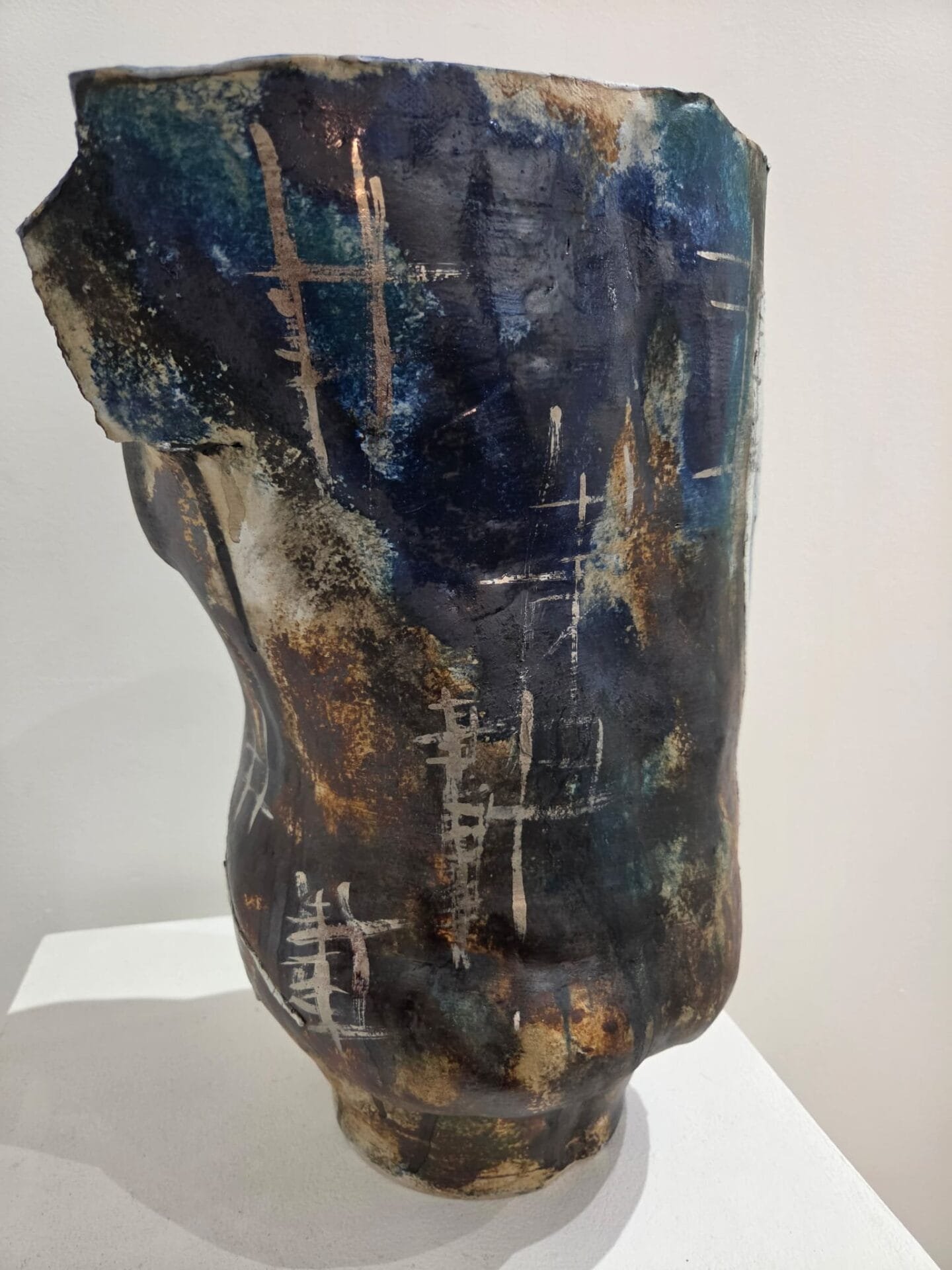
Muldannuzzi is the collaborative practice of Christine Muldoon Iannuzzi and Pete Iannuzzi, a husband-and-wife team whose work brings together two distinct material disciplines: ceramics and metalwork. Christine approaches clay through the language of natural forms, while Pete draws from a lifelong familiarity with industrial processes, transportation, aerospace, and hand-wrought metal fabrication. Their shared practice transforms these seemingly different perspectives into modern mixed-media vessels and sculptural forms that occupy a compelling space between the organic and the industrial.
Their work is defined by material contrast. Clay carries the evidence of touch, pressure, alteration, and firing, while copper, steel, aluminum, brass, and other metals introduce structural tension and engineered precision. Rather than treating these materials as separate visual elements, Muldannuzzi integrates them into unified objects in which ceramic and metal continually influence one another.
A Dialogue Between Nature and Industry
At the center of Muldannuzzi’s practice is a productive tension between natural forms and industrial aesthetics. Christine’s approach begins with clay and the physical possibilities of the ceramic process. Her larger vessels are paddled and dry thrown, techniques that encourage irregularity and emphasize the tactile character of the form. Instead of pursuing absolute geometric uniformity, she allows the vessel to retain an organic presence, giving each piece a sense of movement and individuality.
Pete’s artistic vocabulary comes from a very different source. His professional exposure to transportation and aerospace environments has given him a sustained connection to industrial processes, fabrication, and engineered structures. Yet his interest in industry is balanced by an appreciation for historical objects and artifacts encountered through museums and travel. These two influences, contemporary industrial knowledge and an awareness of historical craftsmanship, converge in his metalwork.
The result is not a straightforward contrast between old and new. Muldannuzzi instead creates a meeting point between them. Remnant and discarded pieces of copper, steel, and aluminum can become components of sculptural objects, their previous industrial lives transformed through artistic intervention. Materials associated with machinery, infrastructure, and fabrication acquire a new visual and conceptual identity.
Christine Muldoon Iannuzzi and the Language of Clay
Christine’s ceramic practice is grounded in an exploration of natural form. Her larger works are paddled and dry thrown, processes that contribute to their organic character while leaving visible traces of physical manipulation. The vessel becomes more than a container. Its surface and silhouette record the process through which it was formed.
Paddling is particularly significant because it introduces controlled irregularity into the clay. Rather than allowing the material to remain completely standardized, the technique creates subtle changes in contour and surface. The resulting forms can appear architectural and bodily at once, occupying a space between functional vessel and sculpture.
Christine’s approach also provides an important foundation for the collaborative works. The ceramic forms offer Pete a substantial three-dimensional structure around which he can develop his metalwork. As the scale of the pieces increases, so too does the opportunity for experimentation. Metal can become an external framework, a linear intervention, a binding element, or an independent visual counterpoint to the clay.
Pete Iannuzzi and Industrial Memory
Pete’s contribution introduces another kind of history into the work: the history of industrial material. His relationship with transportation and aerospace processes has exposed him to environments where precision, durability, engineering, and fabrication are fundamental. Those experiences inform his approach to sculpture without restricting it to industrial functionality.
His attraction to discarded and remnant materials is especially significant. Copper, steel, and aluminum are not treated simply as raw resources. Their previous uses and physical characteristics become part of the creative vocabulary. Scraps and remnants can carry associations with manufacturing, construction, machinery, or infrastructure, but through Pete’s intervention they are redirected into a new artistic context.
His sculptures often embrace a Brutalist sensibility, drawing upon the visual weight, structural directness, and material honesty associated with the movement. Yet the work is not merely an imitation of Brutalist architecture. By placing industrial metals around organic ceramic forms, Pete introduces a softer and more tactile dimension to the vocabulary of industrial sculpture.
“Lady Blues”: A Study in Material Tension
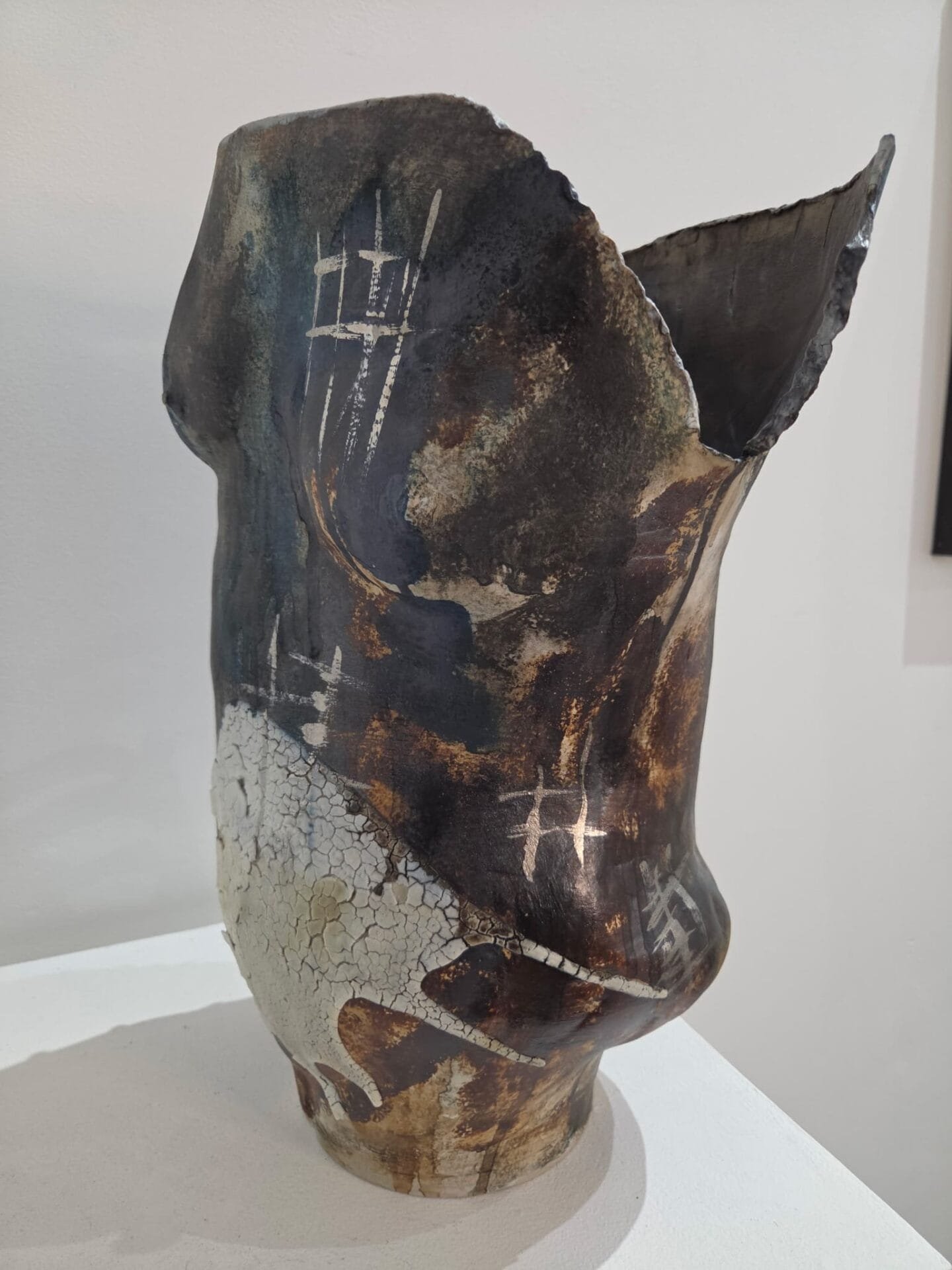
Lady Blues demonstrates the distinctive possibilities of the Muldannuzzi collaboration. Measuring 18 inches, the ceramic work combines Christine’s organic approach to clay with Pete’s carefully constructed metal intervention. The piece was glazed and fired three times, allowing its surface to develop through successive stages of ceramic treatment.
The vessel was built using Korean Onggi paddling techniques and altered throughout the forming process. Onggi traditions are particularly associated with the tactile shaping of large earthenware vessels, and the paddling process gives Lady Blues an unmistakably hand-formed character. Its surface is therefore not simply a passive foundation for decoration. The physical history of its construction remains embedded in the form.
The repeated firing process adds another layer of transformation. Rather than presenting the ceramic as a single-stage object, the work accumulates its visual identity through successive applications and firings. The final firing introduces platinum-gold luster markings, creating points of metallic brilliance across the ceramic surface.
These markings establish an important bridge between Christine’s ceramic language and Pete’s metalwork. The metallic accents visually anticipate the structural elements that surround the vessel, allowing surface decoration and physical construction to speak to one another.
Steel as Structure, Ornament, and Binding
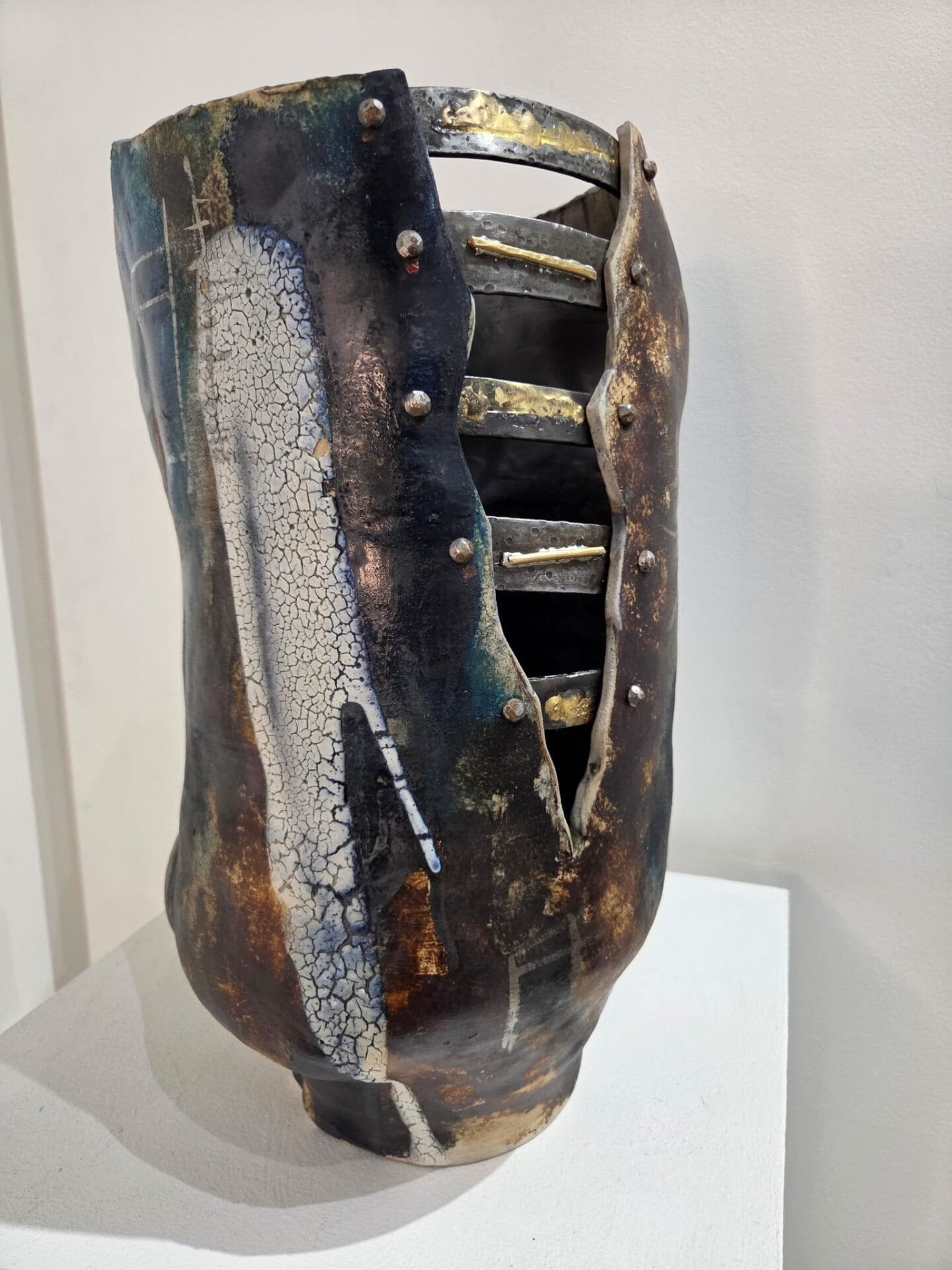
Pete’s intervention in Lady Blues is both structural and expressive. Textured steel strips wrap the ceramic form, introducing a strong linear rhythm against the softer contours of the vessel. Their presence changes how the object is perceived: the ceramic appears simultaneously contained, framed, reinforced, and transformed by the metal.
The steel strips are enriched with silver-soldered brass and brazed rod, bringing additional color and detail to the composition. These techniques emphasize the handcrafted nature of the metalwork while maintaining the industrial character of the materials.
The final attachment process is particularly revealing. The steel strips were secured through silver soldering to steel rivets, creating a visible connection between the components. Rather than concealing the methods of construction, Muldannuzzi allows these technical details to remain part of the aesthetic language.
This approach gives Lady Blues a sense of physical integrity. The metal does not function as an applied decoration placed onto an otherwise complete ceramic vessel. It becomes an essential part of the object’s identity. Ceramic and steel depend upon one another to establish the finished form.
Giving Industrial Materials a New Life
One of the most compelling aspects of Muldannuzzi’s practice is its ability to reconsider the value of materials. Pete’s use of discarded and remnant metals introduces a form of material renewal, allowing pieces associated with industrial production to enter a completely different context.
This transformation is particularly effective alongside Christine’s naturalistic ceramic forms. Clay carries associations with earth, geology, craft, and ancient vessel traditions, while steel and aluminum evoke modern industry and technological development. Their combination compresses seemingly distant histories into a single object.
The resulting sculptures suggest that organic and industrial aesthetics do not have to remain oppositional. They can coexist, reinforce one another, and produce new visual possibilities.
Craft, Process, and Collaboration
Muldannuzzi’s work ultimately reflects the possibilities of collaboration. Christine and Pete retain distinct material languages, but their practices converge through the construction of the final object. Her sensitivity to clay and natural form establishes the vessel; his experience with metal, fabrication, and industrial materials expands its physical and visual vocabulary.
Lady Blues makes this relationship particularly clear. Its paddled ceramic body, layered firings, platinum-gold luster, textured steel strips, brass details, brazed rod, and riveted connections are not isolated techniques. Together they create a sculptural language built from contrast and correspondence.
The work demonstrates how traditional craft processes can coexist with industrial methods without either losing their identity. Instead, each material reveals something about the other. Clay becomes more structurally assertive beside steel, while industrial metal acquires a more tactile and organic presence through its relationship with ceramic.
Muldannuzzi’s practice therefore occupies a distinctive territory between vessel and sculpture, nature and industry, historical craft and contemporary fabrication. Through Christine and Pete’s complementary approaches, materials with radically different origins are given a shared purpose. The result is a body of work in which process remains visible, discarded materials gain renewed significance, and the boundaries between ceramic art and metal sculpture become increasingly fluid.

