


In a time when screens often stand between us and the people next to us, Maria Riechert paints what is easy to lose sight of: the quiet, complicated ties that hold people together. Her expressionist figures, with their simplified and almost anonymous faces, ask viewers to pause and consider how they relate to the people around them. Behind that vision is a life that has crossed borders, careers and languages, and a conviction that painting is something she could never walk away from.
Early Years Among Artists
Maria Riechert was born in Poland in 1955 and grew up surrounded by artists and art teachers, some of them members of her own family. Those early encounters left a lasting mark on her worldview and her artistic sensibility. Creativity was never a distant ideal in her childhood. It was part of everyday life, and it shaped the way she learned to look at people and at the world.
From Glass Design to International Markets
After completing her education, Maria founded a small business in 1980 and ran it until 2003. During those years she built extensive experience as a decorative glass designer in Poland. Working from her own designs, she created, among other things, Christmas ornaments in both traditional and contemporary styles. Her products were sold internationally, reaching customers in Western Europe and the United States.
This chapter of her life was more than a day job. Designing objects that people would hang in their homes each year taught her about form, colour and the way a small piece of craft can carry emotion. It also gave her a first taste of life beyond her home country.
A New Home in Munich
Following the political changes in Poland, Maria began to feel that her world had become too small. During one of her business trips abroad she discovered Munich and decided to make it her new home. In 2003 she moved to Germany.
Starting over in a new country is rarely simple, and language was one of the obstacles. Maria had always been passionate about drawing and painting, and she found that art became an important means of communication. It helped her integrate into a new society and overcome language barriers, speaking where words sometimes could not.
Exhibiting and Joining the Local Art Scene
From 2010 onwards, Maria began exhibiting her paintings in Munich and the surrounding area. She also became increasingly involved in the local art scene, building connections with other artists and with audiences who responded to her work. Today she lives in eastern Germany. She believes that painting is her destiny, something she simply cannot escape.
Artist Focus: Connectedness (2011)
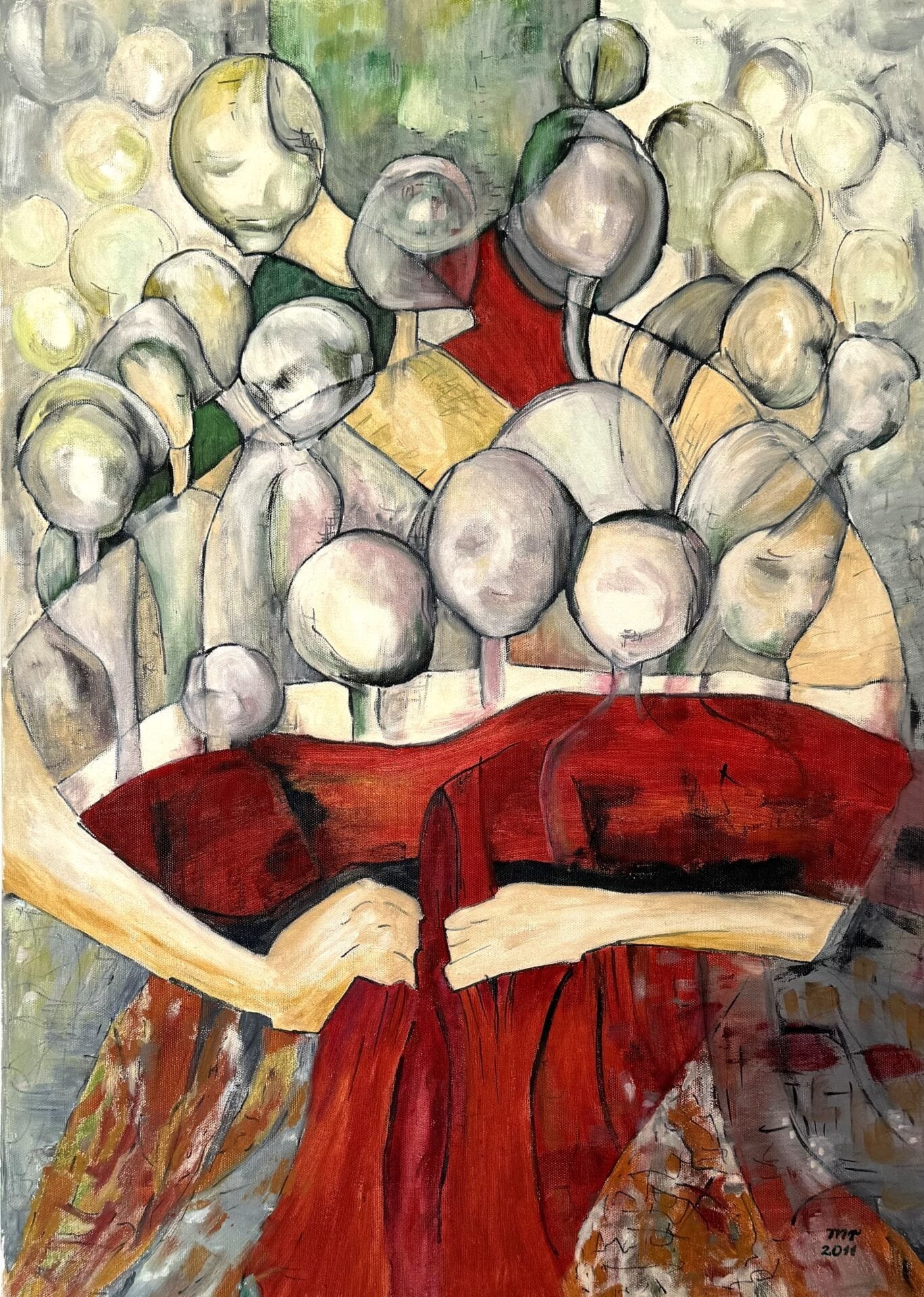
One painting captures the heart of her practice: Connectedness, an oil on canvas from 2011 measuring 50 x 70 cm.
In this expressionist work, the focus is on exploring social and interpersonal relationships. A crowd of pale, rounded faces fills the upper part of the canvas, rendered in soft greens, creams and greys. Many of them overlap and press close together, while others seem to float apart. Below them, a vivid red garment dominates the composition, with hands gathered at the waist. The contrast between the muted, crowded faces and the bold red creates a strong emotional centre, and it draws the eye to the human gestures within the crowd.
Maria explains that the painting aims to raise awareness of human behaviour in our digital and industrialised world. She draws particular attention to how people’s attitudes towards one another are changing. The work does not lecture. Instead, it invites quiet reflection on whether closeness in a crowded, connected world is the same as real connection.
Faces That Belong to Everyone
A defining feature of Maria’s work is the way she paints her figures. In her own words, the figures in her paintings are intended to touch the viewer emotionally and evoke empathy. Their simplified, almost anonymous faces convey a universal human presence. Because they are not portraits of specific individuals, viewers can identify with them more easily and reflect on their own relationships with others.
This approach gives her paintings a wide reach. A viewer in Munich, Warsaw or anywhere else can see something of themselves in these faces. The anonymity is not a lack of detail. It is an open door.
Why Her Work Matters Now
Social life has changed quickly. Messages travel instantly, yet many people report feeling more isolated than before. Maria’s paintings do not offer easy answers, but they hold up a mirror. They remind us that behind every notification, every crowd and every passing face is a person with the same need for belonging.
Her own path, from Poland to Germany, from glass design to painting, shows that connection is something we build through courage and creativity. Art helped her find her place in a new society, and now her paintings help viewers reflect on theirs.
Final Thoughts
Maria Riechert is an artist whose life and work point in the same direction: toward understanding, empathy and human closeness. Her expressionist paintings, including Connectedness, invite us to slow down and look at one another more carefully. For collectors, gallery visitors and anyone who has ever felt the strain of modern life, her work offers something quietly powerful: a reminder that we are not alone in the crowd.

