


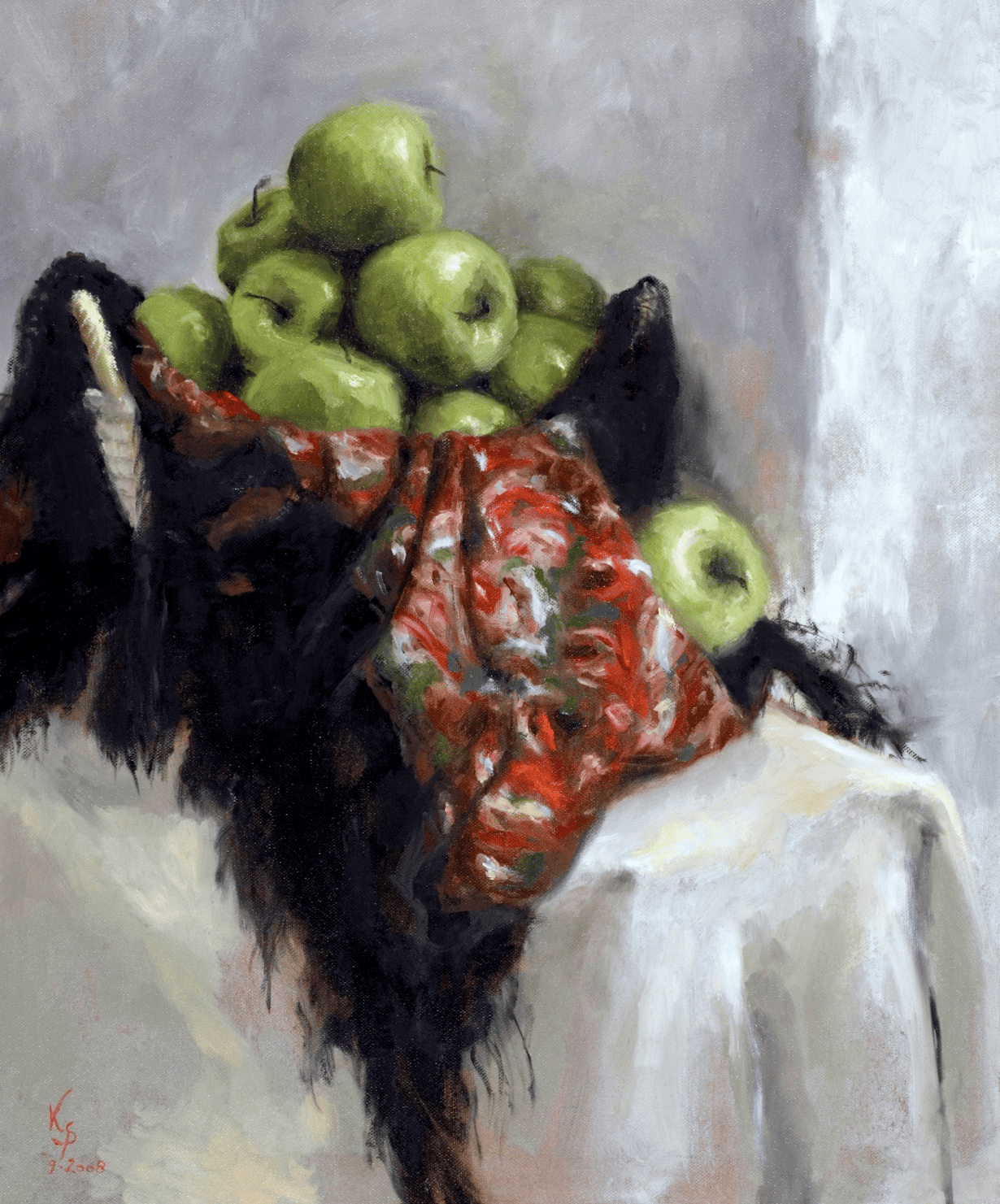
Some paintings simply show us what was in front of the artist. Others hold something quieter and harder to name: a mood, a memory, a feeling that lingers long after we have looked away. That is the poetry behind art. It is the deep, often unspoken emotional and intellectual essence that lifts a work beyond its material surface and speaks to the viewer on a more personal level. In Green Apples on a Polish Cloth, painter Karina Plachetka offers a lovely example of how a humble arrangement of fruit and fabric can carry that kind of quiet verse.
Where Poetry Lives in a Painting
Poetry in art rarely announces itself. It does not depend on grand subjects or dramatic scenes. Instead, it appears in the way a brushstroke softens an edge, the way colour settles into shadow, or the way an ordinary object seems to be holding a story.
Plachetka’s still life belongs to this tradition. A heap of green apples rests in a basket, a dark fringed shawl falls around it, and a richly patterned red cloth spills down toward a pale, softly draped surface. Nothing here is hurried or loud. Yet the longer we look, the more the scene seems to breathe, inviting us to slow down and notice what we usually overlook.
A Painter Shaped by Tradition
The sensitivity in this work grows from a long artistic journey. Karina Plachetka is a freelance painter based in Germany who has been creating art since 1997, working across landscapes, figurative painting, portraits, still lifes and abstraction. Her training began with graphic design and illustration at the Munich art school Freie Kunstwerkstatt under Professor Hans Seeger, where she earned her diploma in 2000.
She later deepened her classical skills through summer courses at the Florence Academy of Art in Italy, in 2005 and 2007, focusing on portraiture and traditional techniques. Painted in 2008, the year after her second course in Florence, Green Apples on a Polish Cloth reflects an artist who respects the discipline of the old masters while following her own expressive instincts.
Light, Colour and Texture as Language
In a still life, there is no narrative to lean on, so the painter’s language becomes light, colour and texture. Plachetka treats all three as equally important voices in the composition.
The apples glow with a luminous, fresh green, their rounded forms modelled with confident, visible strokes. Against them, the deep shadows of the dark shawl create a dramatic counterweight, its edges loose and feathery as if the paint itself were fraying. Below, the red cloth bursts with swirling pinks, whites and greens, while the pale drapery on the right rests like a calm pause between phrases. The grey, softly brushed background lets the entire arrangement emerge gently from the air around it.
This interplay of bright and dark, smooth and rough, cool and warm gives the painting its rhythm.
Nature Meeting Cultural Memory
What gives the painting its distinctive atmosphere is the traditional Polish cloth. Its patterns and colours bring a cultural dimension to the scene, suggesting craft, heritage and the quiet continuity of objects passed through households and generations. Textiles like this often carry personal associations: a grandmother’s table, a family celebration, a memory of home.
Set beside the apples, which represent nature at its simplest and most generous, the cloth creates a meeting of the natural and the cultural. The fruit is fleeting and the fabric is enduring, and together they form a gentle meditation on time, memory and belonging. Plachetka never spells this out, and that restraint is exactly where the poetry begins. The viewer is invited to bring their own memories to the table.
Transforming the Everyday Through Paint
Plachetka reinterprets the classical still life through her own expressive painting style. The focus is not merely on depicting everyday objects, but on their artistic transformation through paint. A basket of apples becomes a study in luminous contrast. A piece of cloth becomes a landscape of colour. A corner of a table becomes a small stage where light performs.
This transformation is what separates a skilful copy of reality from a work of art. The result is a still life with real presence, built from vibrant colours, a balanced composition and a meaningful cultural layer.
An Artist With a Wide Creative Range
Plachetka’s career extends well beyond this single canvas. She has exhibited both in Germany and internationally since 2003 and has taken part in art fairs in Zurich, Geneva, Osnabrück and Barcelona. Since 2021 she has been working on new projects from her studio in Forstinning, including her Abstract Art Project, which began in 2016, and the Garmisch Art Project, an exploration of Alpine landscape that has been underway since 2019.
The Quiet Verse of a Still Life
Green Apples on a Polish Cloth proves that poetry does not need grand themes. It can live in a bowl of fruit, a folded fabric and a soft pool of light. By combining luminous colour, expressive handling and cultural memory, Karina Plachetka turns a simple arrangement into a work that rewards patient looking.
To explore more of her paintings, collections and ongoing projects, visit www.karinaplachetka.de.

