


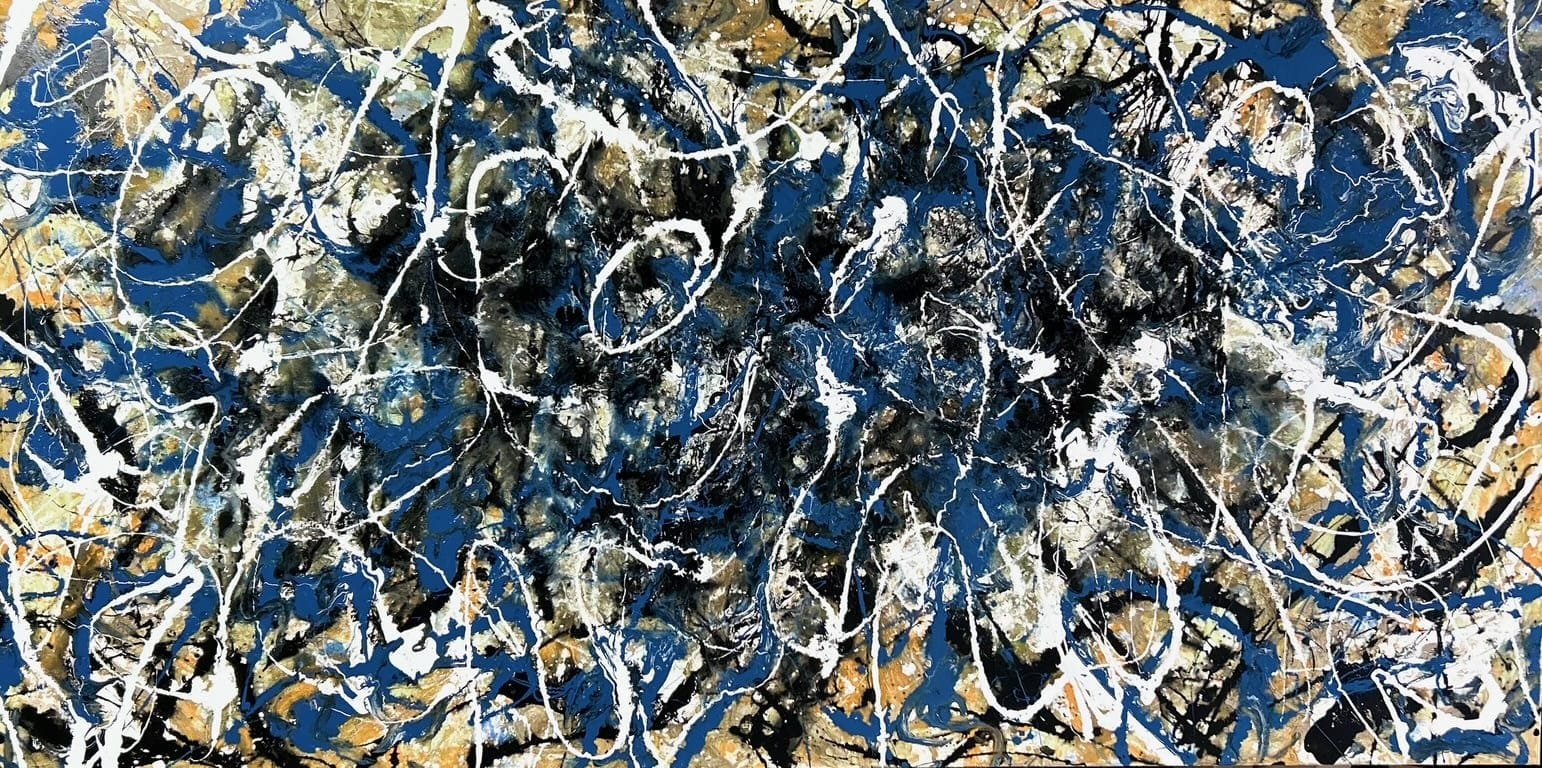
Marshall D. Williams has built an artistic practice around a compelling intersection: the structured world of aerospace and the deeply unpredictable territory of human emotion. Born in 1963 in Placerville, California, Williams spent more than three decades as an aerospace executive before turning his full attention toward painting. Today, based in Chesterfield, Missouri, he works as an abstract expressionist painter, creating energetic and emotionally resonant compositions that explore perception, experience, conflict, and the complexity of being human.
His transition from aerospace executive to full-time artist may appear unexpected, but the two worlds share an important foundation in his work: curiosity. Williams approaches both technology and art with a desire to understand what lies beneath the surface. His paintings are not simply arrangements of color and form. They are attempts to communicate moments of awareness, emotion, memory, and understanding.
From Aerospace to the Studio
Williams’s professional background has played an important role in shaping the way he sees the world. He earned a B.A. in Psychology and also pursued studies in Engineering at the University of Washington, bringing together an interest in human behavior with an appreciation for technical systems and structured thinking.
Over more than 30 years in the aerospace industry, Williams worked within an environment defined by precision, complexity, innovation, and technological advancement. Such an experience inevitably influences perception. The aerospace world requires an understanding of how individual components interact within larger systems, while psychology encourages deeper consideration of how people think, feel, and respond.
After retiring from his executive career, Williams redirected that intellectual energy toward painting. His studio became a creative sanctuary where technical knowledge and emotional exploration could meet. Rather than leaving his professional past behind, he transformed it into another layer of his artistic perspective.
An Abstract Expressionist Language
Williams works primarily within the tradition of abstract expressionism, using dynamic forms, vibrant colors, and expressive gestures to communicate experiences that may be difficult to describe through words.
For Williams, abstraction creates an opportunity to move beyond literal representation. Instead of showing viewers exactly what something looks like, he invites them to consider what something feels like. A particular arrangement of color may suggest tension, while a movement across the canvas might evoke uncertainty, conflict, release, or discovery.
This approach reflects his belief that art can communicate on an immediate, almost instinctive level. His paintings seek to create the kind of emotional response that can happen unexpectedly a feeling triggered by a sound, an image, or a memory before the conscious mind has fully identified why it is responding.
In this sense, Williams’s paintings are less about giving viewers a single interpretation and more about creating space for personal recognition.
The Human Condition as Inspiration
At the center of Williams’s artistic practice is a fascination with the human condition. He describes himself as intellectually curious, constantly searching for deeper meaning in the world around him. That curiosity extends beyond his own experiences. He is particularly interested in understanding people whose circumstances may be different from his own.
One of the recurring sources of inspiration in his work is the underdog in any conflict. Rather than approaching conflict only from an external perspective, Williams attempts to place himself in another person’s circumstances. He considers what that person might be seeing, feeling, fearing, or hoping for.
This empathetic approach gives his abstract work an emotional foundation. While the finished paintings may not depict recognizable figures or literal scenes, the human experience remains present beneath their surfaces.
His artistic process can therefore be understood as an attempt to translate empathy into visual form. The canvas becomes a place where moments of human awareness can be transformed into color, movement, texture, and composition.
“The Sound of Silence”
One of Williams’s notable works is The Sound of Silence, a 40-by-80-inch oil painting on canvas. The scale of the work gives the composition an expansive physical presence, while its title immediately introduces a conceptual tension: how can silence have a sound?
That contradiction offers a fitting entry point into Williams’s broader artistic philosophy. Silence can be peaceful, but it can also contain tension. It can represent absence, contemplation, grief, anticipation, isolation, or a moment before something changes. By giving silence a “sound,” Williams points toward the invisible emotional experiences that exist beneath observable reality.
The work reflects his interest in capturing an instant of awareness or understanding. Rather than telling viewers what to feel, the painting creates an opportunity for them to discover their own response.
Like a song that unexpectedly brings back a memory, The Sound of Silence seeks to trigger something internal. The painting’s meaning does not necessarily remain fixed. It can change depending on the person standing before it and the memories or emotions they bring into the encounter.
Painting the Moment of Recognition
Perhaps the most distinctive aspect of Williams’s practice is his interest in the instant when something suddenly becomes meaningful. He compares this experience to hearing a song and immediately being transported into a particular feeling or memory.
That emotional reaction can happen before rational analysis begins. A melody can evoke a childhood memory, a particular place, a relationship, or a moment that seemed forgotten. Williams attempts to create a similar experience through painting.
His objective is not simply to make an aesthetically compelling image. He wants the work to create a moment of connection between the painting and the viewer. The composition becomes a kind of emotional trigger, allowing each person to bring their own experiences into the work.
This makes perception an essential part of his artistic philosophy. Two viewers can stand before the same painting and experience entirely different emotional responses. Neither response has to be wrong. The painting becomes complete through the interaction between the artist’s intention and the viewer’s personal perception.
Between Technology and Emotion
Williams’s background in aerospace adds another dimension to his abstract practice. His career exposed him to technological systems and the complexity of the modern world, while his studies in psychology encouraged an interest in human behavior and perception.
His paintings exist between these two perspectives. They can suggest movement, systems, energy, disruption, and structure while simultaneously expressing emotion and human vulnerability.
This balance is particularly relevant to contemporary life, where technology increasingly shapes how people communicate, work, understand information, and experience the world. Williams does not simply reproduce technological imagery. Instead, his professional history becomes part of the lens through which he observes modern existence.
The result is an artistic language that feels both analytical and emotional structured enough to reflect his technical background, yet open enough to accommodate ambiguity and intuition.
A Studio Built Around Exploration
Based in Chesterfield, Missouri, Williams’s studio provides a space for continued experimentation and discovery. His practice is grounded in a willingness to question, observe, and search for meaning.
His evolution from aerospace executive to painter demonstrates that creative identity does not always follow a conventional path. The knowledge accumulated during one career can become the foundation for another form of expression. In Williams’s case, decades spent working within highly complex technological environments have become part of the intellectual framework behind his paintings.
His exhibitions and growing recognition reflect the originality and depth of this perspective. Yet the core of his practice remains personal: to understand experience and transform that understanding into something visual.
Inviting Viewers Into Their Own Experience
Marshall D. Williams’s paintings ultimately resist being reduced to a single message. They are invitations rather than explanations. Through abstraction, he creates room for viewers to pause, interpret, remember, and feel.
His work asks an important question: What happens when an image reaches us emotionally before we have found the words to explain it?
For Williams, that moment is where painting becomes most powerful. Whether exploring conflict, empathy, silence, memory, or the complexity of modern life, he seeks to capture the fleeting instant when perception turns into understanding.
His journey from aerospace executive to abstract expressionist painter is therefore more than a career change. It is a continuation of a lifelong curiosity about systems, people, perception, and meaning. On the canvas, technical experience meets emotional intuition, creating works that encourage viewers to look beyond what is immediately visible.
In Williams’s art, the visible becomes a doorway to the invisible the feelings, memories, questions, and moments of recognition that quietly shape human experience.

