


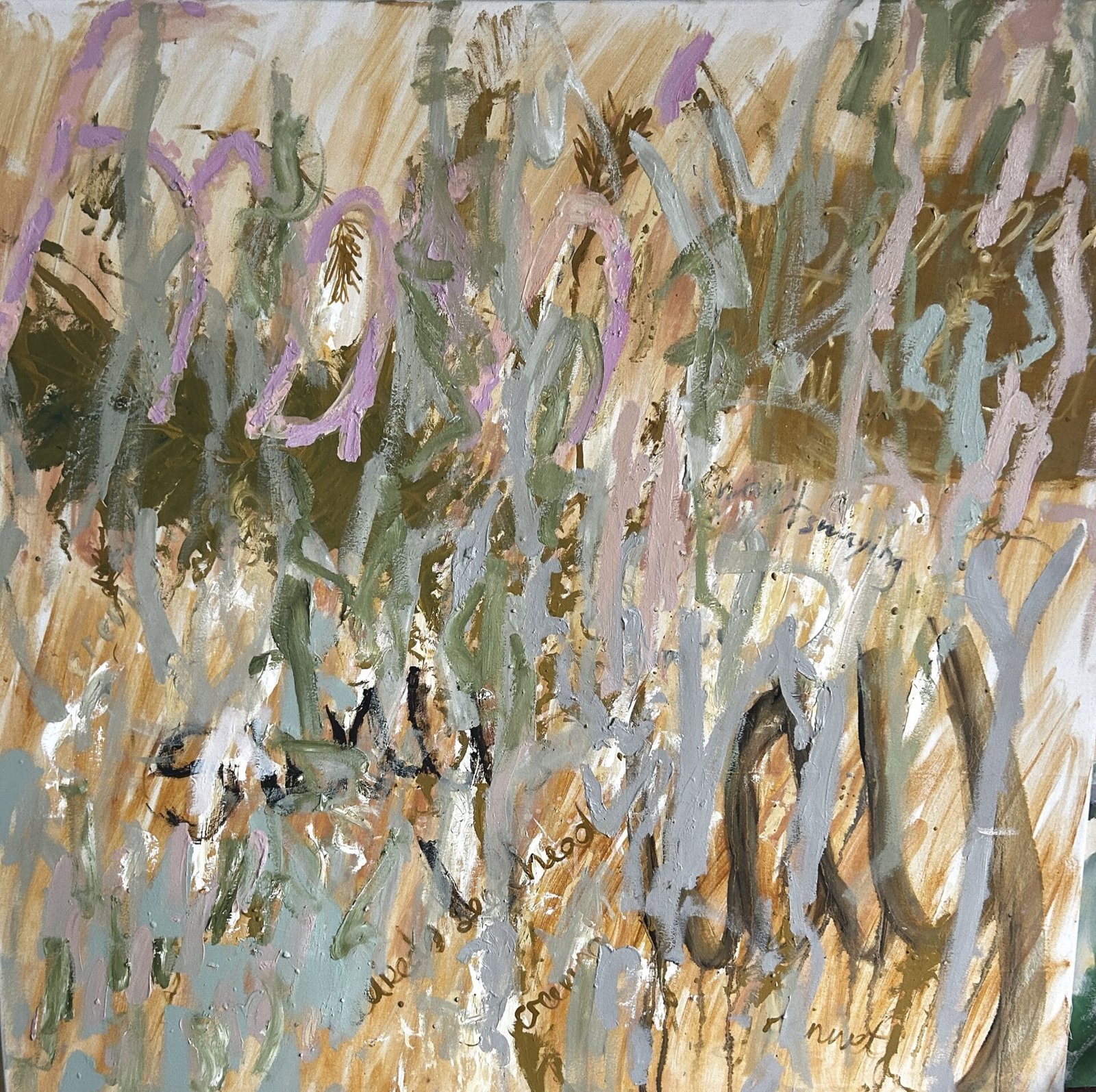
Scottish contemporary artist Irene Watson develops an abstract practice grounded in attentive listening, material exploration, and a sustained interest in vulnerability, care, control, and human experience. Based in Scotland, UK, Watson’s work emerges from long-term engagement with people navigating systems of protection and survival. These experiences have shaped the conceptual foundation of her practice, encouraging her to consider how lived experiences can be managed, controlled, represented, or made invisible.
Rather than translating these concerns into direct illustrations or conventional narratives, Watson allows them to exist within the physical and emotional atmosphere of her paintings. Her works hold pressure quietly. Layers, fragments, marks, textures, and partial words become a language through which complex experiences can be suggested without being completely resolved.
This approach gives her paintings an introspective quality. They invite viewers to look slowly and consider what may exist beneath the visible surface. The work does not necessarily offer a single interpretation; instead, it creates space for uncertainty, memory, presence, and reflection.
Landscape as a Psychological Space
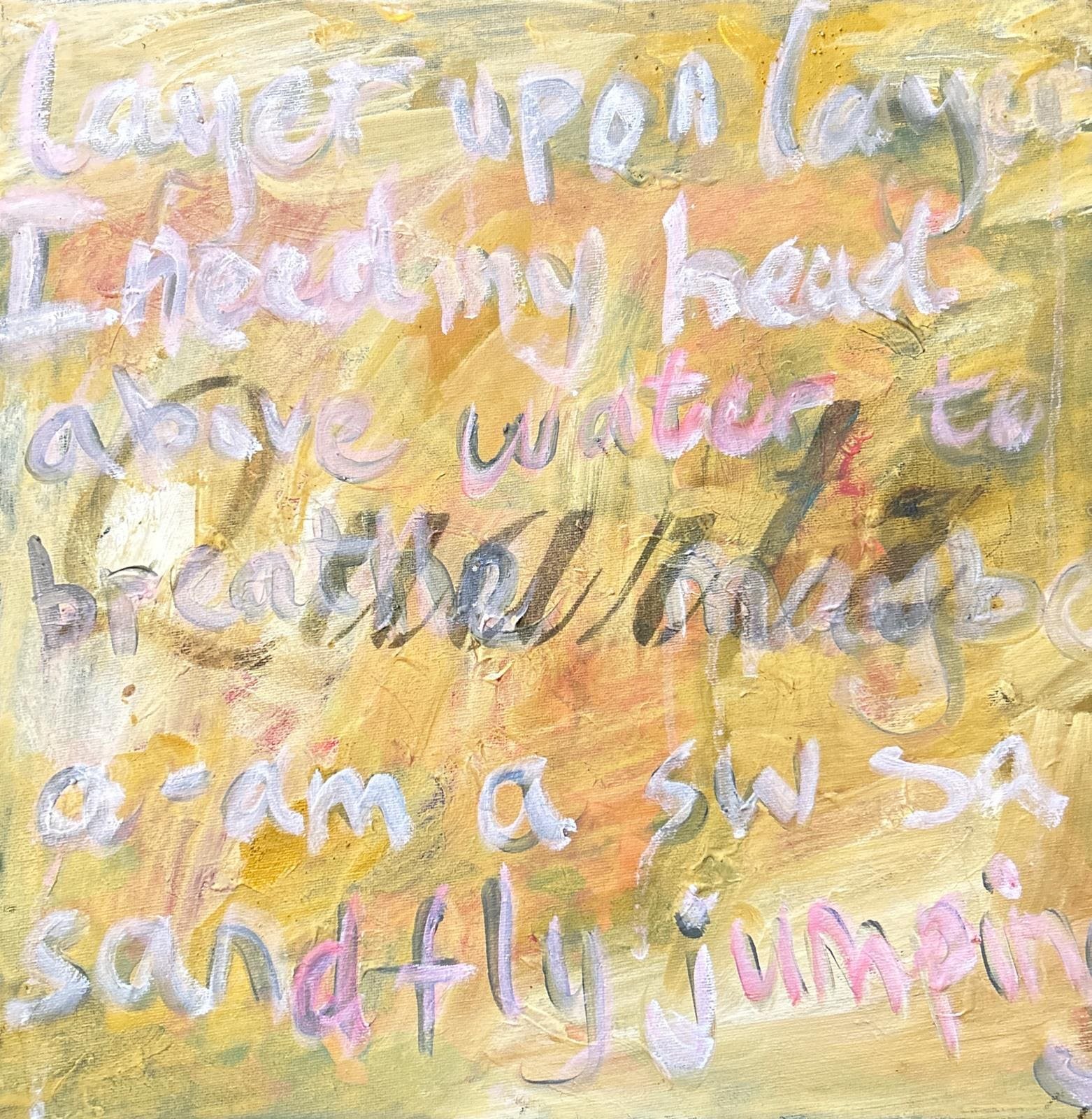
Landscape is an important element within Watson’s artistic thinking, although her landscapes are not primarily descriptive representations of particular places. Instead, landscape functions as a psychological space a means of considering the relationship between organic structures, human systems, and the forces that attempt to control them.
Watson is particularly interested in what can be lost when organic and random structures are ordered, contained, or subjected to systems of control. This tension extends beyond the natural environment and becomes a metaphor for human experience. People, like landscapes, can be shaped by structures around them, while their individual vulnerabilities and complexities may resist being neatly categorized.
This relationship between control and vulnerability contributes significantly to the emotional tone of her work. Her paintings can appear restrained while simultaneously suggesting instability beneath the surface. The viewer encounters spaces where order and disorder coexist, creating a visual tension that reflects the complexity of lived experience.
Material, Process, and the Layers of Memory
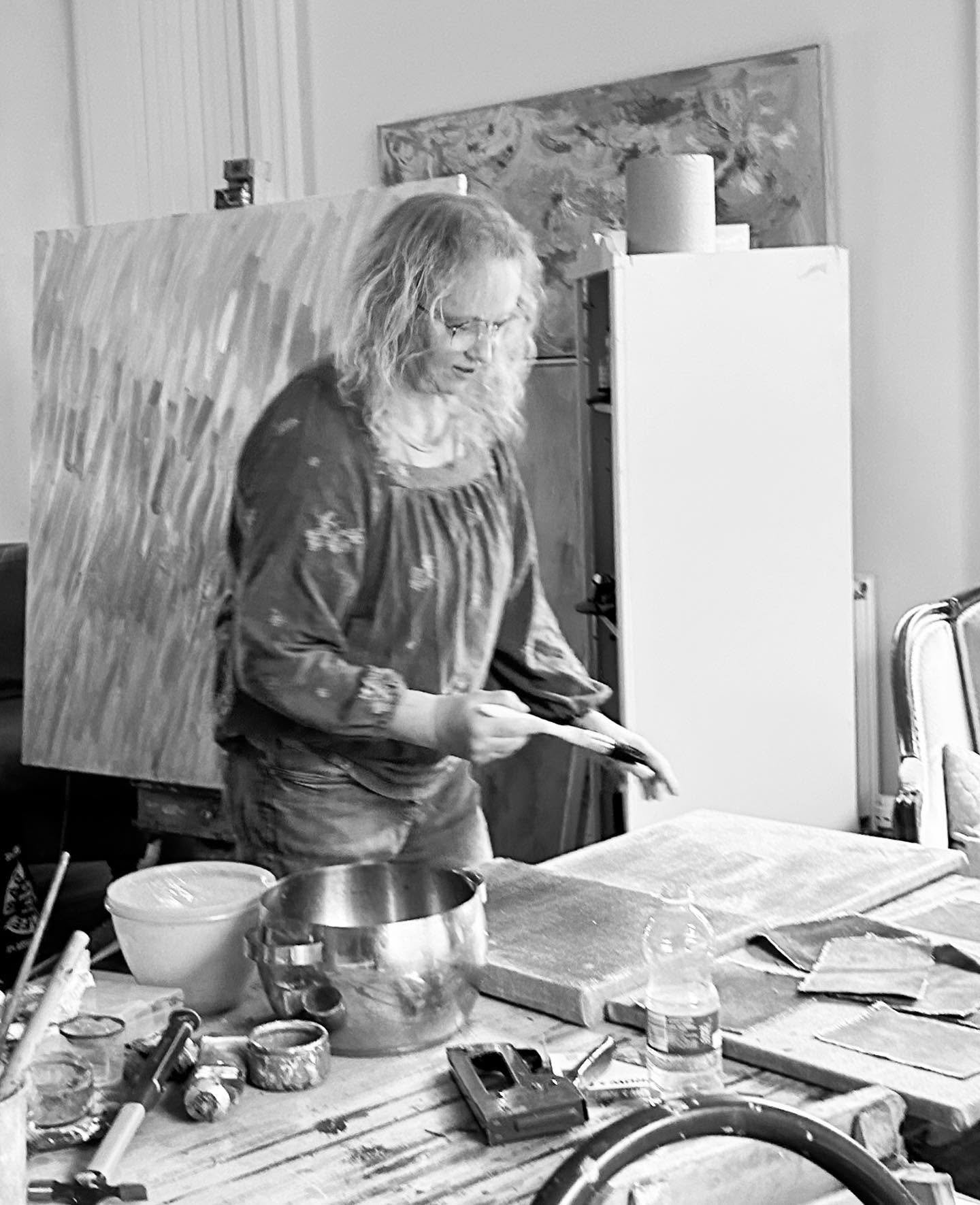
Watson’s practice is firmly rooted in abstraction and material process. She works with oil, pigment, wax, sand, and collage across canvas and linen, building surfaces through processes of accumulation and removal.
These materials allow her to create paintings that feel constructed over time. Marks are added, altered, obscured, exposed, and sometimes partially erased. Earlier layers remain visible beneath later interventions, creating surfaces that resemble records of their own making.
The process is important because the paintings do not present themselves as completely resolved or pristine objects. Instead, they retain traces of what has happened before. A previous mark may remain beneath a layer of pigment; a fragment of collage may interrupt an otherwise abstract surface; a section may appear removed while still leaving evidence of its existence.
This layered approach creates a powerful connection between material and memory. The surface becomes a place where presence and absence can coexist. What has been covered is not necessarily gone, and what has been removed can continue to influence what remains.
Text as Fragment and Voice
Text also plays a distinctive role within Watson’s visual language. Rather than using words to provide a straightforward explanation, she introduces text as fragments. These partial linguistic elements suggest presence, communication, and voice without delivering a complete statement.
The absence of resolution is central to this strategy. A fragment of text can feel like something overheard, remembered, interrupted, or deliberately withheld. It encourages the viewer to consider the relationship between language and silence.
In this way, Watson’s use of text connects closely with her broader interest in agency and representation. Who gets to speak? What happens when a voice is interrupted or controlled? How can an experience be represented without reducing it to a simple narrative?
Her paintings do not attempt to answer these questions literally. Instead, they create visual situations in which such questions can remain active.
Beyond Painting: Books, Writing, and Performance
Although painting is central to Watson’s practice, her artistic output extends across artist books, experimental writing, installation, and performance. These parallel forms allow her to explore similar concerns through different processes and modes of communication.
Artist publishing is particularly significant within her practice. Her publications include The Old Manse (2022), Warm Baskets (2024), and The Curlew, a limited-edition linocut zine. Her forthcoming projects include Ag Ann And, published by Sutteille and Swag, and an extract included in Dr Helen Gorrill’s Wife, Witch, Whore, published by Bloomsbury.
These projects demonstrate Watson’s interest in the book not simply as a container for images or words, but as an artistic space in its own right. Hand typesetting, writing, image-making, and physical publication can become extensions of the same concerns explored through her paintings.
Collaboration, Co-Authorship, and Agency
Collaboration and co-authoring are central to Watson’s broader practice. Her experience working with communities has influenced how she understands voice, agency, and representation. Rather than positioning the artist as the sole author, collaborative projects allow multiple experiences and perspectives to shape the outcome.
Her institutional and commissioned projects demonstrate the breadth of this approach. Selected projects include work for the National Trust for Scotland at Crathes Castle, Aberdeen Shell HQ, Dundee Rep Theatre, Ninewells Hospital’s Child Psychiatric Unit, and commissioned installations connected with Perth Prison and Saughton Prison through Duncan of Jordanstone College of Art.
Watson has also participated in socially engaged projects including Us and Them, a co-authored touring performance; digital happenings connected with St Magdalene’s Hill and funded by the Heritage Lottery; Furniture, a co-authored furniture-making project with homeless women; and Jewels, which involved workshops with female streetworkers.
Her long-running Let Me Speak workshops, developed over more than ten years with children identified by schools as experiencing behavioral difficulties, further demonstrate her commitment to creating spaces where voices can be acknowledged and explored.
Education and Artistic Development
Watson’s academic background reflects the interdisciplinary nature of her practice. She is currently undertaking a PhD in Fine Art and Practice-based Research at the University of Dundee. Her previous studies include an M.Litt in Letters with Distinction, an MPhil in Public Art & Design, a Diploma in Teaching Art from Christchurch, New Zealand, and a BA (Hons) in Painting & Printmaking from Duncan of Jordanstone College of Art in Dundee.
This combination of studio practice, research, public art, writing, and education has contributed to an artistic approach that crosses conventional boundaries. Her work operates simultaneously through image, material, language, publication, performance, and collaboration.
Exhibitions, Recognition, and International Reach
Watson’s work has been presented through solo and group exhibitions in the UK and internationally. Her solo exhibition highlights include artspace Scotland in Perth, LINLEY in Pimlico, London, The Meffan Institute in Forfar, the Crawford Centre in St Andrews, Gallery 48 in Dundee, Drawings Gallery in Auckland, New Zealand, and a touring exhibition with Angus Museums.
Her selected group exhibitions include the Royal Academy Summer Exhibition in London, the Royal Scottish Academy in Edinburgh, the Scottish Society of Arts, Glasgow Art Fair, Gallery Fresh in London, The Barbican in Plymouth, British Lime Gallery in Santa Ana, Los Angeles, and exhibitions in New Zealand and across the UK.
Her career has also been supported by several awards and scholarships, including the Design Star Award in 2015, Scotland Unlimited Awards Levels 1 and 2 in 2004–05, the Rotary Ambassadorial Scholarship for international study and travel in 1995, and the Shepley Shepley Trust Young Talent Scholarship in 1989–90.
Her work and practice have also received attention through publications including WALLPAPER Magazine, Artist Close Up, and New Art Project.
A Practice of Presence and Unresolved Possibility
At the heart of Irene Watson’s practice is an understanding that art does not always need to explain. Her paintings create environments in which experiences can remain partially visible, layered, interrupted, or unresolved. Through abstraction, material accumulation, fragmented text, and collaborative processes, she investigates the delicate relationship between vulnerability and control.
Her work asks viewers to pay attention to what might otherwise be overlooked: a trace beneath a surface, a fragment of language, an erased mark, or the emotional tension between organic freedom and imposed order.
By moving between painting, publishing, writing, performance, installation, and collaboration, Watson has developed a multidisciplinary practice concerned with voice, agency, memory, and representation. Her work ultimately demonstrates the expressive potential of uncertainty. Rather than closing down interpretation, she leaves space for viewers to listen to the material, to the fragments, and to the experiences that may remain just beneath the surface.
Discover more about Irene Watson and explore her artwork: www.irene-watson.com

