


Carolyn Oberst’s path to painting was not a straight line. Born in Philadelphia, she began her career as a photo stylist, a job that trained her eye to arrange color, texture, and form within a frame. She then lived in London, Southern Spain, and Morocco. In each place she drew constantly and took in the visual cultures around her.
Those years abroad gave her a wide visual vocabulary. Moorish patterns, Mediterranean light, and the street life of different cities all fed a sensibility that still shapes her work.
From Fashion to Fine Art
When Oberst settled in New York City, she turned to design. She created clothing and specialty fabrics, and eventually made one-of-a-kind, hand-painted garments. Working with pigment on cloth showed her where her real interest lay. She was more drawn to painting itself than to fashion, and she made the shift to fine art.
She did not start from scratch. Her years in photography and design had given her a strong sense of composition, and she brought it into her paintings.
Training at the Art Students League
To sharpen those instincts, Oberst studied life drawing with Marshall Glasier at the Art Students League of New York. She attended on a scholarship for two years. The discipline of drawing from the figure gave her a firm grounding in structure, gesture, and observation, and it still underlies her work today.
After leaving the League, she committed to drawing and painting full-time. She set up her own studio in a loft in what is now Tribeca, and in 1980 she began exhibiting her work.
The Language of Oil Paint
Oberst describes herself as enamored of the tactile richness of oil paint. Her canvases show it. The paint is vibrant and physical, and the surface holds on to the energy of its making.
Her current work sits between figuration and abstraction. Recognizable forms appear and then loosen into gesture and color, so viewers can find a narrative without being handed a literal one. She works by intuition, and those impulses give each piece a sense of life that planning alone rarely produces.
Responding to Contemporary Life
Oberst draws inspiration from the world around her. Her recent paintings take up the complexities of contemporary society. They do not preach or illustrate headlines. Instead, they let the pressures, contradictions, and moments of beauty in modern life come through in paint. Her intuitive approach lets feeling and observation guide the picture before analysis takes over.
Rethinking the Frame
One of the more interesting parts of Oberst’s current practice is her experiment with framing elements. For her, the frame is part of the painting, not a neutral border. She is exploring how it can extend the visual narrative, adding color, structure, and rhythm that interact with what happens on the canvas.
This idea is clearest in her work.
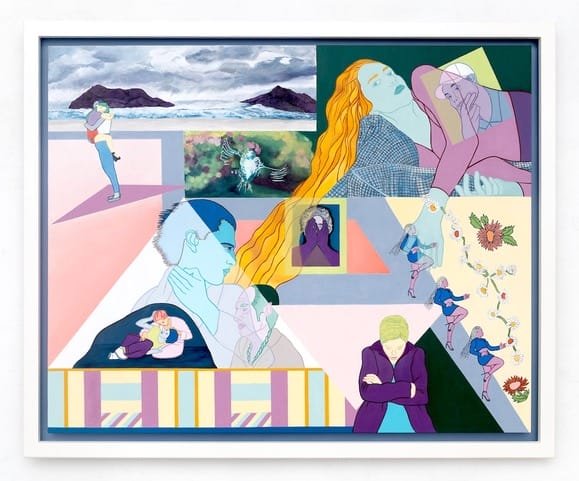
Featured Work: You Can Never Hold Back Spring (2025)
You Can Never Hold Back Spring is an oil on canvas measuring 54″ x 66″, set in a painted wood frame. At that size, the painting has a strong physical presence in a room.
The title suggests renewal and the way growth pushes forward whatever stands in its way. It also fits the way Oberst works: through intuitive, instinctive painting that lets energy build and move across the surface. The painted wood frame is part of the piece. In keeping with her recent experiments, it is designed to work with the image and to widen the story the painting tells.
A Career Built on Curiosity
Oberst has spent more than four decades exhibiting, and her work still shows the curiosity of someone who has lived and worked in many places. Her background in photography, fashion, and design continues to inform her compositions. Her training in life drawing keeps her connected to the human figure. Her ongoing experiments with oil paint and now with the frame show an artist who keeps pushing her work forward.
For collectors and viewers, her paintings offer rich color and a lively surface. They also invite people to look at the complicated world we live in and to find some vitality in it.

