


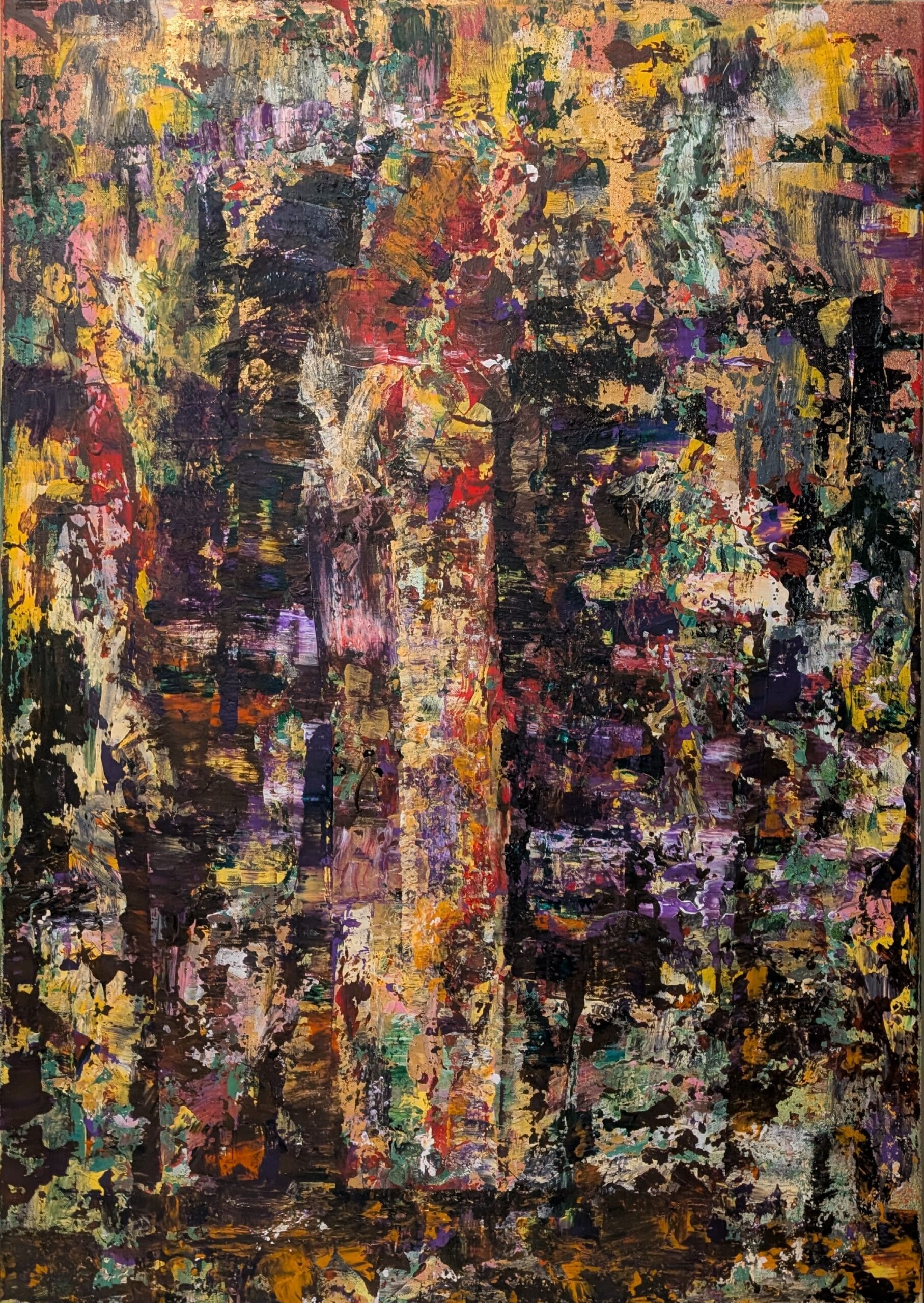
Daniel Gaciu is an eclectic contemporary artist whose practice moves between painting, philosophy, and sensory research. His work is driven by a deep curiosity about the structure of reality and how it can be translated into visual language. Rather than treating painting as a fixed tradition, Gaciu approaches it as an evolving system, one that can be tested, deconstructed, and rebuilt through continuous experimentation. His studio practice operates like a laboratory where ideas about color, light, sound, and perception are constantly explored and refined.
At the heart of his work lies a fundamental question: how does abstraction reveal truth? Through layered material exploration and conceptual depth, Gaciu seeks to bridge the gap between hands-on studio experimentation and the intellectual demands of museum-level contemporary art.
Early Foundations and Academic Background
Gaciu’s artistic journey began with formal training in design at the Design Academy Eindhoven (DAE), an institution known for encouraging critical thinking and conceptual rigor. This foundation introduced him to structured approaches in visual communication and problem-solving, shaping his sensitivity toward composition, form, and spatial awareness.
However, rather than remaining within the boundaries of design, Gaciu gradually shifted toward painting as a more direct and intuitive medium of inquiry. He transitioned into a self-directed practice, building his artistic identity outside traditional academic systems. This shift marked the beginning of a more personal and investigative phase in his career, one where artistic freedom became inseparable from intellectual exploration.
A Studio as a Research Laboratory
For Daniel Gaciu, the studio is not simply a place of production but a site of continuous research. He describes his process as being rooted in experimentation, where trial and error function as essential tools for discovery. Each canvas becomes an experiment in understanding how materials behave, how colors interact, and how perception can be manipulated or expanded.
This approach places equal importance on failure and success. Unexpected results are not discarded but analyzed and integrated into future work. Over time, this method has allowed Gaciu to develop a distinctive visual language grounded in process rather than repetition.
His practice reflects a belief that knowledge in art is not only theoretical but also embodied, something learned through physical engagement with paint, surface, and gesture.
Philosophy of Color, Light, and Perception
A central concern in Gaciu’s work is the relationship between color and light. He investigates how color can generate perceptual experiences that feel almost tangible, blurring the boundary between physical material and optical sensation.
Rather than treating color as a decorative element, he explores it as a structural force, one that constructs space, emotion, and meaning. This interest extends into broader philosophical questions about reality itself: what we see, how we see it, and how perception shapes understanding.
His work often draws from abstract thinking, but it is deeply grounded in material practice. Through layering, scraping, and textural manipulation, he builds surfaces that seem to oscillate between presence and disappearance, inviting viewers to reconsider the act of looking itself.
From Design Thinking to Artistic Independence
While Gaciu’s early academic training provided a strong foundation in structured thinking, his evolution as an artist has been defined by independence. Moving away from design constraints, he embraced painting as a space for intellectual and emotional freedom.
This transition also reflects a broader shift in his artistic philosophy. Instead of solving visual problems within predefined systems, he now constructs systems of his own ones that can evolve organically through practice. His studio becomes a place where ideas are tested against material reality, and where theory must constantly prove itself through execution.
Art history plays an important role in this process. Gaciu engages deeply with historical references, not as fixed influences but as starting points for reinterpretation. By questioning the “intrinsic value of visual representation,” he positions his work within a dialogue between past and present, tradition and experimentation.
“Gustavs Kiss”: Reinterpreting the Iconic Gesture
One of Gaciu’s key works, Gustavs Kiss, exemplifies his approach to abstraction, appropriation, and material transformation. The piece draws conceptual inspiration from Gustav Klimt’s iconic The Kiss, but rather than reproducing or referencing it in a traditional sense, Gaciu deconstructs and rebuilds its essence through abstract processes.
In his own words:
“Eliminating the brush allows me to engage directly with pure abstraction. At the core of this process lies a central motif inspired by Klimt’s The Kiss, not rendered traditionally, but extracted and rebuilt through the heavy texturing of Johns and the scraped, dragged paint layers characteristic of Richter.”
This statement reveals the layered complexity of his method. By removing the brush, Gaciu eliminates one of painting’s most direct traditional tools, allowing the material itself to dictate form. The influence of artists such as Jasper Johns and Gerhard Richter becomes evident not through imitation but through translation, textural density, scraping gestures, and physical manipulation of paint become carriers of meaning.
Gustavs Kiss therefore becomes less about depicting a subject and more about reconstructing visual memory through material tension. The original romantic symbolism of Klimt’s work is transformed into an abstract field where emotion is embedded in surface, movement, and texture rather than recognizable imagery.
Bridging Experimentation and Museum-Level Practice
A defining ambition in Gaciu’s practice is the desire to connect experimental studio work with the conceptual rigor required for institutional presentation. He is not interested in separating process from outcome; instead, he seeks to integrate them into a unified artistic language.
This approach positions his work within a contemporary discourse that values both research-based practice and aesthetic impact. His paintings are not merely finished objects but traces of ongoing investigation, records of thought made visible through material form.
By merging experimentation with conceptual depth, Gaciu aims to contribute to a broader understanding of what painting can be in a contemporary context: not a static medium, but an evolving system of inquiry.
Conclusion
Daniel Gaciu’s practice exists at the intersection of philosophy, experimentation, and material exploration. Through his investigation of color, abstraction, and perception, he challenges conventional definitions of painting and expands its possibilities as a research-driven discipline.
From his academic beginnings at Design Academy Eindhoven to his current self-directed studio practice, Gaciu has developed a deeply individual approach rooted in curiosity and experimentation. Works like Gustavs Kiss demonstrate his ability to transform historical references into new visual languages shaped by texture, process, and conceptual intensity.
Ultimately, his work invites viewers to reconsider how meaning is constructed in visual art not as something fixed or representational, but as something continuously formed through interaction, perception, and time.

