


Jonathan Keeton’s journey as an artist has been shaped by an unusually diverse range of experiences. His creative path has moved across painting, theatre, teaching, acting, picture framing, photography, and the rapidly evolving world of digital visual effects. Each chapter has contributed something distinctive to the way he sees and interprets the world today.
Keeton studied watercolor painting in London with Geoffrey Dupree, developing an early relationship with the expressive possibilities of paint and observation. His curiosity about visual storytelling also led him to Paris, where he studied theatre with Etienne Decroux. This experience introduced him to a different language of expression, one based on movement, presence, gesture, and the emotional power of carefully observed moments.
Over the years, Keeton worked as a schoolteacher, waiter, actor, and picture framer. These varied professions gave him the opportunity to encounter people and places from different perspectives, while also allowing him to remain connected to the creative world. Eventually, his career took him into the emerging field of digital visual effects, where he spent three decades as a pioneer working in visual effects for television and film.
This long career in visual effects added another dimension to his artistic vision. Working in an industry devoted to creating visual worlds, manipulating images, and transforming imagination into something tangible, Keeton gained an understanding of how technology and visual perception can work together. Yet, despite spending much of his professional life in the world of moving images and digital innovation, his personal artistic practice would ultimately return to something quieter: the direct experience of nature, architecture, light, and atmosphere.
The Decision to Become a Full-Time Artist
In 2011, Keeton moved to Santa Fe, a place known for its distinctive landscapes, dramatic light, and strong artistic traditions. The move marked an important turning point in his life, allowing him to pursue his creative practice as a full-time artist.
The landscapes surrounding Santa Fe offered a rich environment for an artist interested in the relationship between humanity and the natural world. The vastness of the wilderness, the changing quality of light, and the sense of stillness found in open spaces became important sources of inspiration.
For Keeton, however, the wilderness is not simply a subject to be reproduced on canvas. His paintings are an attempt to communicate something deeper about the experience of being alive. Rather than treating nature as a decorative backdrop, he approaches it as a presence with its own mystery and significance.
In 2022, another major chapter began when Keeton moved to Portugal with his wife, artist Melinda Tidwell, and their two dogs. This new environment brought with it another visual vocabulary. Portugal’s historic streets, architecture, changing light, and coastal and rural landscapes provided fresh opportunities for observation and artistic exploration.
Today, Keeton’s paintings and photographs are held in private collections across the United States and Europe, reflecting the international reach of a practice rooted in personal observation and a deep appreciation for the world around him.
Painting the Mystery of Being Alive
At the heart of Jonathan Keeton’s work is a simple but profound question: what does it mean to be alive on this planet?
His paintings of wilderness and cities before dawn emerge from a desire to explore this question through visual experience. He is interested in those moments when the ordinary can suddenly become mysterious, when familiar surroundings appear transformed by silence, darkness, or changing light.
Keeton describes his paintings as bringing to life “the mystery of being alive on this planet.” This idea provides a key to understanding his artistic philosophy. His work is not necessarily about providing answers. Instead, it invites viewers to pause and become more attentive to what is already present.
A landscape can become a meditation. A quiet street can become a moment of discovery. A building illuminated by the last traces of daylight can suggest an entire story without showing a single person.
This sensitivity to atmosphere allows Keeton to transform everyday scenes into something contemplative. His paintings encourage viewers to look beyond the surface and consider the presence, beauty, and mystery contained within seemingly ordinary places.
The Wilderness as a Place of Reflection
The natural world occupies a central position in Keeton’s artistic practice. His wilderness paintings are grounded in observation, but they also carry a strong sense of reflection.
For the artist, painting nature is connected to an impulse to honor the natural world and recognize the inherent completeness of things. His statement that “everything is just so” suggests an artistic philosophy based on acceptance and attentiveness. Rather than attempting to impose a predetermined meaning onto nature, Keeton looks closely and allows the subject to reveal its own character.
This approach creates a sense of reverence without becoming overly sentimental. His landscapes are not simply celebrations of scenic beauty. They are reminders of the extraordinary presence of the world itself.
The wilderness, in Keeton’s work, can therefore be understood as both a physical environment and an emotional space. It offers an opportunity to step away from the constant activity of modern life and reconnect with something larger, quieter, and less controlled.
The Poetry of Nocturnes and Cities Before Dawn
Keeton’s attraction to nocturnes, the artistic tradition of depicting scenes at night, adds another important dimension to his work.
Night changes the way we experience the world. Familiar streets become unfamiliar. Details disappear, while other elements emerge. Artificial light becomes more significant, and the boundaries between architecture, shadow, and atmosphere begin to shift.
For Keeton, this transformation is particularly meaningful because nighttime represents a period when human influence begins to diminish. As activity slows and people retreat indoors, the natural beauty and mystery of things can once again take center stage.
His interest in cities before dawn similarly focuses on a transitional moment. The city exists, but it has not yet fully awakened. Streets are quieter. Buildings stand in a different relationship to light and shadow. The absence of crowds creates space for contemplation.
These moments of stillness allow Keeton to discover poetry in places that might otherwise seem familiar or overlooked. A street becomes more than a street; it becomes an atmosphere, a memory, or an invitation to wonder.
“Afternoon, Rua das Flores, Lisbon”: A Moment in Portugal
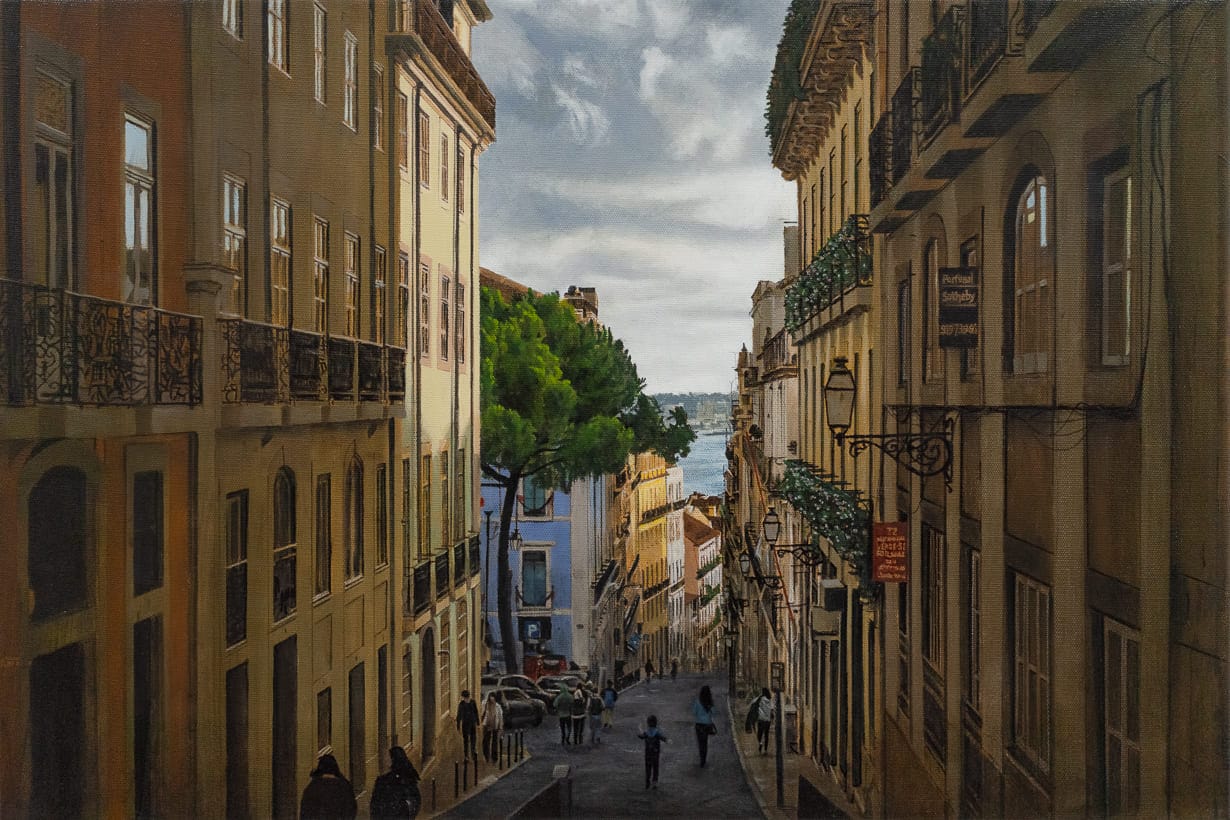
One example of Keeton’s engagement with the Portuguese environment is Afternoon, Rua das Flores, Lisbon, an oil painting on linen measuring 18 by 27 inches.
The title immediately places the viewer within a specific location: Rua das Flores in Lisbon. Yet the painting is not simply a geographical record. As with Keeton’s wider practice, the significance lies in the experience of looking.
The choice of an urban street connects the work to his broader interest in cities and the ways that light and time can transform familiar environments. Lisbon, with its historic architecture and distinctive atmosphere, offers an especially rich setting for an artist attentive to the relationship between place and perception.
The work’s afternoon setting also provides an interesting contrast to Keeton’s fascination with cities before dawn and nocturnal scenes. Here, the city is encountered during daylight, when human presence and architectural detail are more visible. Yet the same impulse toward contemplation remains.
Through oil on linen, Keeton captures an encounter with place that feels personal rather than purely documentary. The painting encourages viewers to consider not only what they are seeing, but also how a particular place makes them feel.
A Practice Rooted in Attention
Jonathan Keeton’s artistic journey demonstrates how a life spent moving between disciplines can ultimately deepen an artist’s way of seeing. His early studies in watercolor and theatre, his years working in diverse professions, and his pioneering career in digital visual effects have all contributed to a practice that is both visually informed and deeply reflective.
His paintings and photographs are grounded in a commitment to observation. Whether he is looking at a remote wilderness landscape or a quiet European street, Keeton searches for those moments when the world seems to reveal something beyond itself.
His work asks viewers to slow down and pay attention to notice the subtle beauty of a landscape, the silence of a city before dawn, or the changing atmosphere of a street in the afternoon.
Ultimately, Jonathan Keeton’s art is an invitation to reconnect with the mystery of existence. His wilderness scenes remind us of the power and presence of the natural world, while his urban paintings reveal the unexpected poetry contained within human environments. Across both subjects, his work is guided by the same impulse: to look carefully, to honor what is present, and to recognize that the world around us remains full of wonder when we take the time to truly see it.

