


Alejandro Caiazza is a contemporary international mixed-media visual artist whose work explores the complexities of human behavior through bold color, raw expression, tactile surfaces, and psychologically charged imagery. Rooted in Neo-Expressionism, Art Brut, and Outsider Art, his paintings often combine a seemingly naïve, childlike visual language with deeper and sometimes unsettling reflections on society, identity, politics, and the human condition.
Currently based in New York City, Caiazza has developed an artistic voice that is immediately recognizable for its vibrant colors, distorted figures, expressive lines, and richly layered surfaces. His characters can appear humorous, playful, or even absurd at first glance, yet beneath their whimsical appearance lies a more serious examination of the emotions, contradictions, and struggles that shape contemporary life.
From Argentina to Venezuela: The Foundations of an Artistic Voice
Born in December 1972 in Santa Fe, Argentina, Alejandro Caiazza has Italian ancestral roots and spent much of his formative years in Ciudad Guayana, Venezuela. Growing up in Venezuela played an important role in shaping his worldview and artistic perspective. The social and political experiences of the region, along with the cultural environments he encountered throughout his life, would later become important influences on the themes explored in his art.
Caiazza briefly studied Architecture and Fine Arts at Universidad José María Vargas in Caracas, Venezuela. However, rather than following a traditional academic path, he eventually chose to develop independently as a self-taught artist. This decision allowed him to explore his ideas freely and gradually establish a visual language that was driven by personal experience, experimentation, and instinct.
His independent approach is reflected in the raw quality of his work. Rather than pursuing perfection or conventional beauty, Caiazza embraces imperfection, distortion, and spontaneity. His paintings often appear deliberately rough and immediate, creating an intimate connection between the artist’s emotional response and the viewer’s experience.
The Monochromatic Years in Paris
A significant stage in Caiazza’s artistic evolution began after he relocated to Paris in 2000. During the 2000s, his paintings entered a monochromatic phase dominated by black, white, and gray. Although visually restrained compared with his later work, this period was conceptually important in the development of his artistic philosophy.
For Caiazza, the three colors carried symbolic meanings. Black represented raw human emotion, while white stood for reason, order, and structure. Gray existed between these two extremes, functioning as a balancing force. This exploration of opposites introduced a recurring idea that continues to appear throughout his work: the tension between contradictory aspects of human existence.
Emotion and reason, chaos and order, innocence and darkness, humor and seriousness are all forces that frequently collide within Caiazza’s imagery. His later transition toward vibrant colors did not abandon these ideas. Instead, it allowed him to express them through a more expansive and energetic visual vocabulary.
Finding a Universal Visual Language
From around 2010 onward, Caiazza’s artistic practice evolved into a highly tactile and expressive mixed-media language. He began incorporating thick lines, rich textures, collage elements, and found objects into his compositions. Primary colors became increasingly important, giving his works a strong visual energy while helping amplify the emotional intensity of his subjects.
His current practice draws upon a wide range of cultural references, including American pop culture and familiar archetypal figures such as tricksters and clowns. These characters often occupy an ambiguous space between comedy and tragedy. They can make viewers smile while simultaneously inviting them to question what lies beneath the surface.
This duality is central to Caiazza’s work. His figures may look naïve or childlike, but their expressions and gestures frequently suggest anxiety, alienation, conflict, or psychological tension. The apparent simplicity of his characters therefore becomes a vehicle for addressing complicated issues.
His influences include pioneering artists and movements associated with raw, expressive, and unconventional approaches to art. The work of Jean Dubuffet, the CoBrA movement, Jean-Michel Basquiat, and Willem de Kooning can be seen as important reference points in understanding Caiazza’s artistic vocabulary. Yet his work remains distinctly personal, combining these influences with his own experiences as an immigrant, an international artist, and an observer of modern society.
Art as a Reflection of Human Experience
At the heart of Caiazza’s practice is an interest in the universal experiences that connect people while also revealing the divisions between them. His work explores subjects including love, madness, migration, social isolation, politics, sex, and death.
These themes are not presented through conventional realism. Instead, Caiazza transforms them into expressive characters and symbolic compositions. His distorted faces and exaggerated figures become representations of broader human emotions rather than portraits of specific individuals.
The artist has described his naïve but sharply witty characters as reflections of society’s behavior. This idea is especially evident in his approach to painted faces. What might initially appear as an “ugly” face is often intended to represent ugly human behavior. By exaggerating facial features and presenting his characters in unconventional ways, Caiazza encourages viewers to look beyond physical appearance and consider the psychological qualities being represented.
Humor is therefore an important part of his visual language. His work can be playful and satirical, but the humor often conceals a darker message. This balance allows him to address difficult subjects without losing the sense of spontaneity and energy that defines his paintings.
Politics, Migration, and the Experience of Displacement
Caiazza’s personal history has also informed his interest in political and social issues. Having experienced major political and authoritarian shifts in Venezuela, he has developed an artistic practice that frequently alludes to modern political divisions and the discrimination experienced by immigrants.
Rather than offering straightforward political statements, his paintings often communicate through satire, symbolism, and exaggerated characters. His figures can become stand-ins for politicians, workers, outsiders, or ordinary people navigating an increasingly divided world.
Migration is particularly significant within this context. The experience of moving between countries and cultures can create a complex relationship with belonging and identity. Caiazza’s work reflects these tensions by exploring isolation, social expectations, and the ways individuals attempt to navigate unfamiliar environments.
“New York City Zen”: Finding Calm in the Chaos
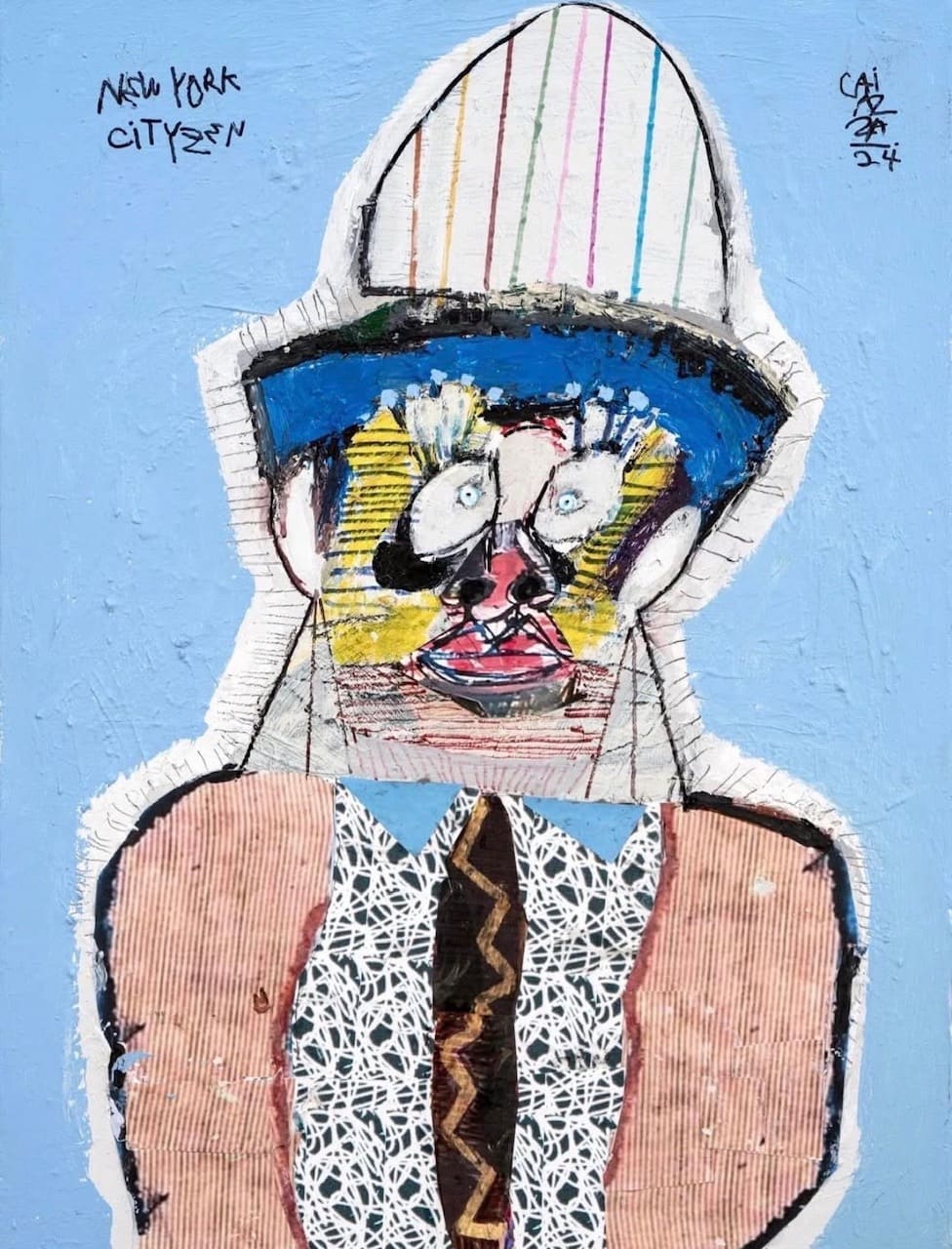
One of the works that brings many of these ideas together is New York City Zen. The painting presents a satirical commentary on human behavior, societal expectations, and the chaotic psychology of urban life.
At the center of the composition is a distorted, expressive face. Rather than depicting a specific person, the figure represents universal emotions associated with contemporary city living: anxiety, daily pressure, inner conflict, and psychological overload. The face appears exaggerated and chaotic, reflecting the intensity of emotions that can exist beneath the surface of everyday life.
The title itself introduces an intriguing contradiction. The word “Zen” suggests peace, mindfulness, balance, and tranquility. Yet the character presented in the painting appears anything but calm. This tension captures the experience of living in a major metropolis such as New York City, where millions of people move through crowded streets, demanding workplaces, social expectations, and an endless stream of sensory stimulation.
The character’s formal clothing adds another layer of meaning. The shirt, tie, and top hat suggest the rigid structures of professional and social life. These elements can be interpreted as symbols of conformity, responsibility, and the expectations placed upon individuals to perform certain roles. The clothing also suggests the masks people wear in society, presenting an acceptable exterior while concealing their private anxieties and struggles.
The thick textures and expressive lines further reinforce the painting’s urban atmosphere. Through mixed media and intense layering, Caiazza creates a surface that feels raw and visceral. The energetic marks evoke the gritty character of city streets and the visual intensity of urban environments.
In this way, New York City Zen becomes more than a portrait of an eccentric character. It is a reflection of the modern individual caught between the desire for inner peace and the relentless demands of contemporary life.
A Growing Presence in the Contemporary Art World
Today, Alejandro Caiazza maintains a studio in DUMBO, Brooklyn, placing him at the center of one of New York City’s most dynamic creative communities. His works have been displayed and sold through galleries including Van Der Plas Gallery in the Lower East Side, Winston Scott Gallery in Warwick, New York, Betsy Frank Gallery in Palm Beach, Florida, and CreativeBloch Art Gallery in Brooklyn.
His growing presence reflects the continuing interest in artists who challenge traditional definitions of beauty, technique, and artistic expression. Caiazza’s work occupies a compelling space between the playful and the profound, combining vibrant visual energy with observations about the darker realities of contemporary existence.
The Power of Raw Expression
Alejandro Caiazza’s art invites viewers to look beyond the surface. His bright colors and humorous characters may initially appear lighthearted, but they often conceal questions about human behavior, social pressure, migration, political division, and psychological struggle.
By bringing together the raw instincts of Art Brut, the emotional intensity of Neo-Expressionism, and the freedom of mixed-media experimentation, Caiazza has created a distinctive artistic language that speaks to the complexities of modern life. His characters are strange, funny, uncomfortable, and familiar all at once. They reflect the contradictions within society and, perhaps most importantly, within ourselves.
Through works such as New York City Zen, Caiazza demonstrates how a seemingly simple figure can become a powerful symbol of an entire urban experience. His art reminds us that beneath the polished surfaces of cities, institutions, and social identities lies a much more complicated human reality, one filled with anxiety, humor, conflict, absurdity, and the ongoing search for balance.
Recommended Reading: > 📖 Alejandro Caiazza: Exploring Identity, Memory, and Humanity Through Raw Expression

