


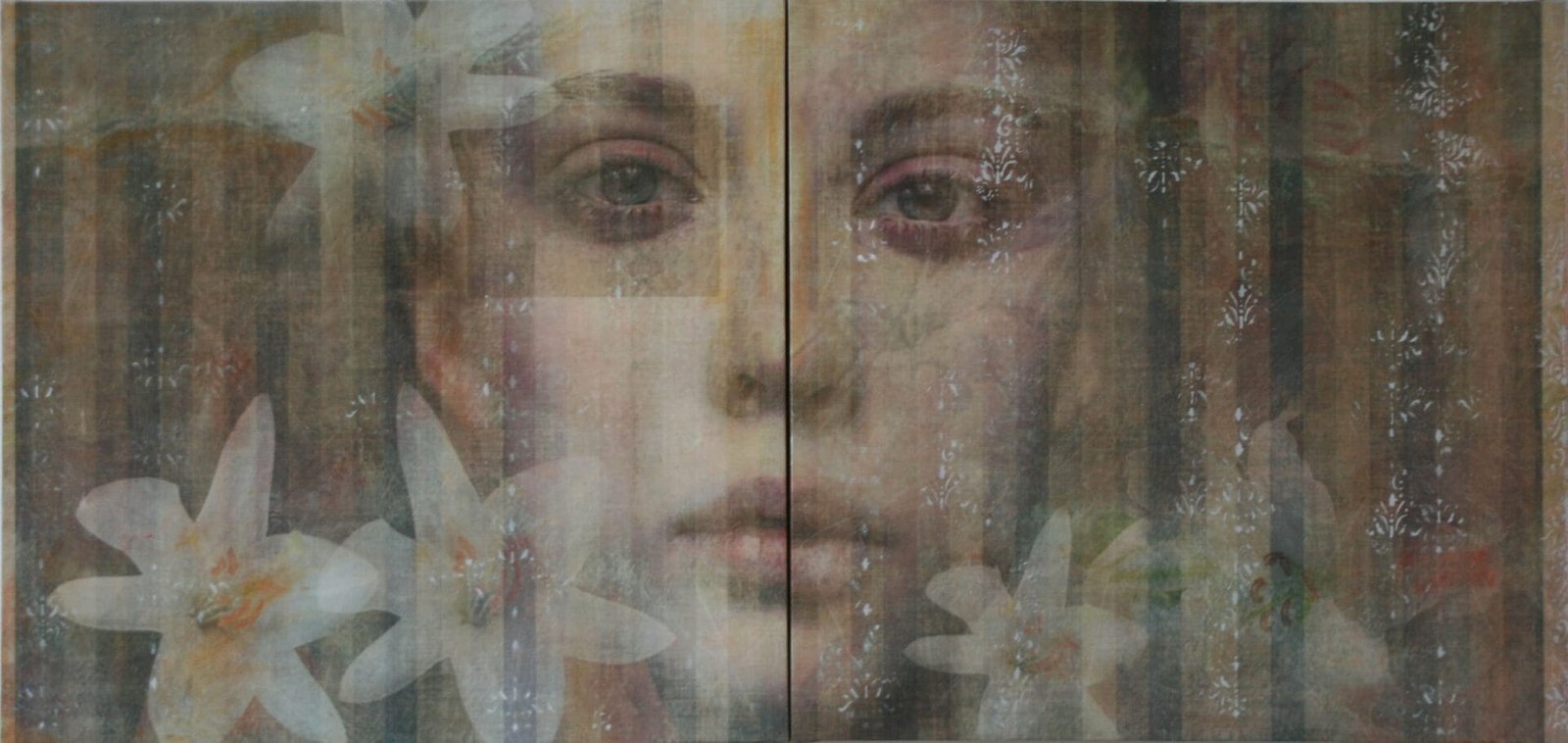
Anna Montanaro is an Italian contemporary artist whose multidisciplinary practice examines the unstable territory between memory and perception. Working across photography, painting, collage, and printmaking, Montanaro constructs images that appear to exist in a state of transition, where forms emerge, recede, overlap, and become partially obscured. Her work is concerned less with presenting an image as a fixed record than with questioning how images change through time and how memory alters what we believe we have seen.
Her artistic language is closely informed by her training in art restoration at the Brera Academy of Fine Arts in Milan. Restoration traditionally involves an encounter with the layers accumulated on an artwork over time, requiring attention to traces, alterations, fragments, and the relationship between what remains visible and what has disappeared. Montanaro translates this sensitivity into her own practice, treating the pictorial surface as something that can hold evidence of passing time.
Through this approach, photography does not function simply as documentation, while painting does not merely provide an additional visual layer. Instead, different media interact to create images in which recognition is constantly interrupted. Faces, bodies, and other forms can appear almost tangible before becoming partially erased or absorbed into the surrounding surface. The resulting tension between clarity and obscurity is fundamental to Montanaro’s exploration of identity and remembrance.
The Surface as a Record of Time
A recurring concern throughout Montanaro’s work is the relationship between presence and absence. Her surfaces suggest that an image can preserve something while simultaneously demonstrating its disappearance. Rather than treating memory as an accurate archive, she approaches it as a mutable process in which experiences are continually revised, fragmented, and reconstructed.
This becomes particularly significant in her use of layered imagery. Photographic elements may provide the initial trace of a person or moment, while painted and translucent interventions alter the stability of that record. Parts of an image remain recognizable, while others become interrupted by marks, veils, textures, or overlapping passages. The viewer is therefore encouraged to look through the image as much as at it.
Montanaro’s practice creates a productive uncertainty: what is being remembered, what is being concealed, and what has already been lost? The surface becomes an active participant in this process. It does not simply contain an image but records its transformation.
Ophelia: Between Appearance and Disappearance
Created in 2018, Ophelia is a mixed-media work on canvas measuring 80 × 160 cm. The work takes its point of departure from one of the most enduring figures in Western literary culture: Ophelia from William Shakespeare’s Hamlet. Montanaro also draws upon Arthur Rimbaud’s poetic reinterpretation of the character, creating a dialogue between literary history, poetry, and contemporary visual language.
Yet Ophelia does not attempt to illustrate Shakespeare’s tragedy or reproduce a recognizable literary scene. Instead, Montanaro uses the figure as a conceptual and emotional starting point. Ophelia becomes a vehicle through which the artist investigates memory, vulnerability, identity, and disappearance.
The face at the centre of the work does not remain completely fixed. Through the interaction of photography, painting, and translucent interventions, it seems to emerge from the surface before simultaneously withdrawing from it. Recognition is possible, but never entirely secure. The viewer encounters a figure that appears caught between visibility and erasure.
This instability is central to the work’s meaning. Ophelia is not presented as a historical or literary personality frozen within a familiar narrative. She becomes an image that has passed through different forms of cultural memory, carrying traces of Shakespeare, Rimbaud, and Montanaro’s own contemporary interpretation. The figure therefore exists across multiple temporalities.
Memory as Fragment
In Ophelia, memory is neither complete nor reliable. The image suggests that remembering is an act of reconstruction, one in which certain details remain while others fade or become distorted. Montanaro translates this psychological process into material terms.
The layered surface can be understood almost as a visual equivalent of recollection. A photographic fragment might suggest a precise moment, but subsequent interventions disturb that precision. Painted passages partially cover what came before, while translucent areas allow earlier imagery to remain perceptible beneath the surface. Nothing is entirely deleted, yet nothing remains untouched.
This creates a complex relationship between concealment and revelation. What is hidden has not necessarily disappeared; it may continue to exist beneath another layer. Likewise, what appears clearly in one moment can become uncertain when viewed from another position. The artwork consequently asks the viewer to consider how much of an identity can survive when the image through which we encounter it is continually changing.
The Body and the Question of Identity
Montanaro’s interest in the body extends beyond physical representation. In Ophelia, the face functions as both a recognizable human presence and a site of instability. It invites identification while resisting complete definition.
This tension reflects a broader question within Montanaro’s practice: how can an individual remain present within images that inevitably change over time? A face may serve as a marker of identity, but memory can fragment that marker. The more closely the viewer looks, the more apparent the distance between recognition and certainty becomes.
The body is therefore treated not as a static object but as something vulnerable to time, perception, and recollection. The fragmented image suggests that identity itself may be experienced through traces rather than through permanence.
Between Photography and Painting
Montanaro’s multidisciplinary background allows her to move freely between photographic representation and painterly intervention. In Ophelia, this interaction becomes particularly important because photography carries associations with evidence and preservation, while painting can introduce transformation, interpretation, and material disruption.
By bringing these approaches together, Montanaro undermines the expectation that a photograph should provide an authoritative record. The photographic image becomes only one layer of an evolving composition. Painting can interrupt its certainty, while translucent elements create intermediate spaces between what is visible and what remains concealed.
The result is neither purely photographic nor purely painterly. Instead, the work occupies an uncertain territory where different forms of representation overlap. This hybrid quality reflects the subject itself: memory is similarly composed of fragments drawn from experience, imagination, emotion, and reconstruction.
A Contemporary Reading of Ophelia
The enduring power of Ophelia as a cultural figure lies partly in her capacity to be repeatedly reinterpreted. Across literature, painting, photography, theatre, and popular culture, she has represented different ideas about vulnerability, femininity, madness, nature, death, and loss. Montanaro approaches the figure from another direction, focusing on the instability of the image itself.
Her Ophelia is consequently less concerned with retelling a familiar story than with asking what happens to an image after it has entered collective memory. How does a character change when generations repeatedly reinterpret her? What remains when the original context becomes distant? And how does the act of remembering transform the person or figure being remembered?
These questions give the work a contemporary resonance. Montanaro does not treat the past as something sealed away. Instead, she presents it as an active presence that continues to shift according to the perspective from which it is encountered.
Recognition and Disappearance
Throughout her practice, Anna Montanaro approaches the image as something simultaneously fragile and persistent. Her works do not simply preserve appearances; they expose the processes through which appearances deteriorate, change, and acquire new meanings.
Ophelia embodies this approach with particular force. The partially revealed face becomes a metaphor for the uncertain status of memory, while the layered surface suggests that the past is never entirely accessible in its original form. What survives is fragmentary: an outline, a gesture, a photographic trace, a partially concealed presence.
Montanaro’s artistic language ultimately transforms disappearance into a form of visual presence. What has been obscured remains active within the composition, just as forgotten experiences can continue to shape consciousness. In this sense, Ophelia is not an image of absence alone. It is an image of what persists within absence.
Recognition and International Practice
Montanaro’s sustained exploration of memory, identity, and the image has received recognition in Italy and internationally. Her exhibitions and presentations have included venues and events in New York, San Diego, and Skopje, alongside significant exhibitions in Italy.
Her distinctions include the 2016 Premio Arte Honour Diploma at Palazzo Reale in Milan, the 2018 First Absolute Prize in Digital Art at the Premio Città di Novara, the Ricoh First Prize in 2020, and the 2022 OSTEN Biennial First Prize for Graphic Arts. Her work has also appeared in international art catalogues and publications.
These recognitions reflect the breadth of a practice that refuses to remain confined to a single medium or visual category. Across photography, painting, collage, and printmaking, Montanaro continues to investigate how images carry traces of experience and how those traces are altered by time.
In Ophelia, this investigation becomes especially poignant. A literary figure associated with disappearance is transformed into a contemporary meditation on the instability of seeing and remembering. Through layered materials and an image that is never entirely revealed, Montanaro turns the canvas into a space of recollection, where presence and absence coexist. The work ultimately suggests that memory does not preserve the past intact. It continually remakes it.

