


Reinhardt Takeo Hollstein is a visionary artist and the founder of Art-Tronic Artwork Designs in Auburn, Washington, whose practice challenges the conventional boundaries of painting. Working from his garage studio, Hollstein has developed Art-Tronic, an experimental art medium that combines traditional painting with electronics, sound, light, motion, and interactive technology.
His signature TAP Touch Audible Paintings transform the canvas into a responsive experience. Using conductive paint connected to touch processor boards, Hollstein creates paintings that react when a viewer touches them. A fingertip can activate sound, allowing the artwork to answer through music and turning the act of viewing into a form of participation.
Across his practice, Hollstein has continued to expand the possibilities of the medium. Some works incorporate LEDs, ferrofluid, mini plasma disks, light, and motion, while others introduce functional elements capable of pouring real wine or beer or even brewing hot coffee. He is currently developing a waterfall piece designed to allow real water to flow through the artwork.
This unusual combination of visual art and engineered interaction reflects Hollstein’s belief that a painting can be more than a static image. It can become an object that responds, moves, sounds, and engages the viewer directly.
From Canvas to Interactive Experience
Hollstein’s Art-Tronic approach begins with the familiar language of painting but refuses to end there. His canvases become platforms for integrating electronic and physical elements, creating artworks that operate simultaneously as visual compositions and interactive systems.
Conductive paint is particularly important to his TAP Touch Audible Paintings. By incorporating electrically responsive surfaces into the composition, Hollstein allows viewers to interact with different areas of the artwork through touch. The painting therefore becomes an interface, with the viewer’s physical action forming part of the artistic experience.
This creates a fundamentally different relationship between audience and artwork. Instead of standing outside the work and simply observing it, the viewer participates in activating it. Touch can trigger sound, while other pieces introduce movement, illumination, magnetic effects, or functional mechanisms.
Hollstein’s experiments suggest that technology can become an artistic material in its own right. Electronics are not merely hidden behind the canvas to make an effect possible; they contribute to the identity and behavior of the artwork.
“Then There Was Venom!”

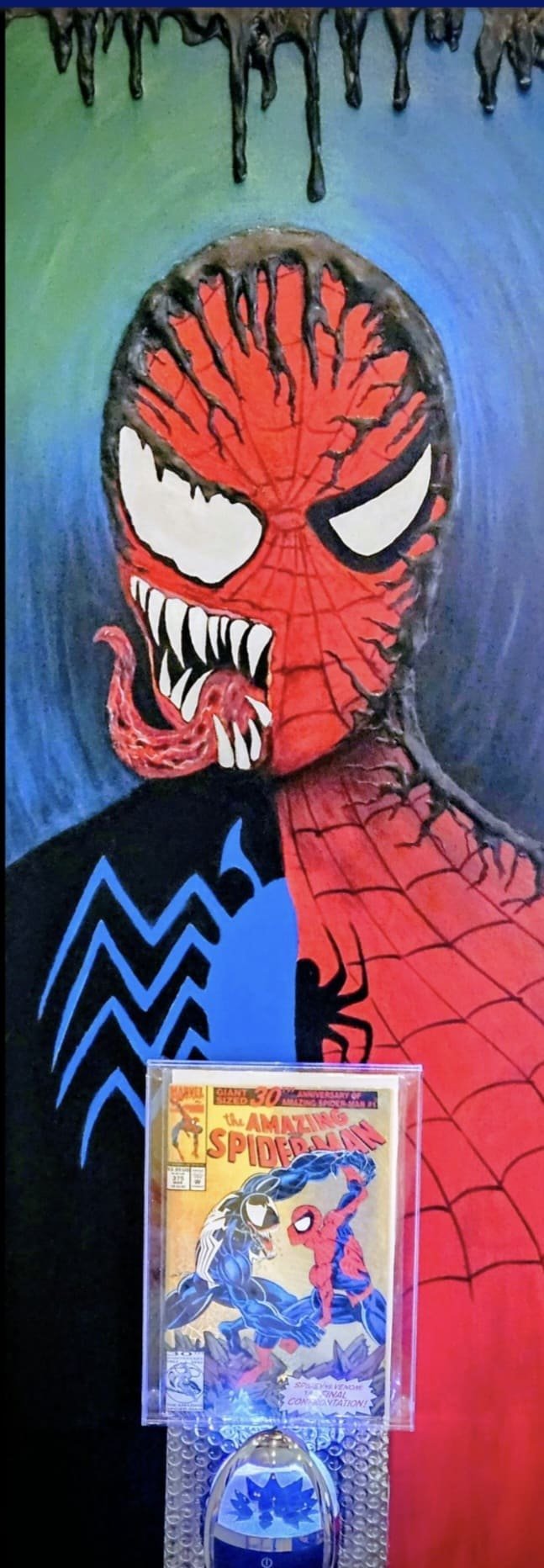
Among Hollstein’s distinctive Art-Tronic works is Then There Was Venom! (2025), an interactive painting inspired by the iconic relationship between Spider-Man and Venom.
The work incorporates a Bluetooth speaker that drives black ferrofluid contained within the artwork. Ferrofluid is a magnetic liquid originally developed through scientific research in the twentieth century, and Hollstein uses its unusual physical properties to create an animated interpretation of Venom’s shifting black symbiote.
When music begins, the magnetic field causes the ferrofluid to move, writhe, spike, and dance. The effect gives the dark liquid an almost living presence, visually echoing the fluid and constantly changing nature of Venom in popular culture.
Rather than simply depicting the symbiote, Hollstein has found a material capable of physically behaving like it.
A collector’s comic book is also incorporated into the piece inside a dedicated case. The comic can be removed and read, adding another physical and cultural layer to the artwork.
The result brings together painting, sound, magnetic movement, popular culture, and collectible material within a single interactive composition.
The Story Behind “Then There Was Venom!”
The inspiration for the work came from an unexpected source: a voice on the radio.
DJ Sarah of KZOK 102.5 FM Classic Rock Seattle is a devoted fan of the Venom films, and her enthusiasm for the character became familiar to her listeners. Her passionate discussions about the black symbiote, its personality, and its cinematic world eventually reached Hollstein, who was working in his garage studio in Auburn.
Rather than creating another conventional fan image, Hollstein decided that her enthusiasm deserved an artwork that could embody Venom itself.
He began constructing a painting that would not simply show the symbiote but behave like it.
The resulting work became Then There Was Venom!, combining Spider-Man and Venom imagery with an integrated Bluetooth speaker and ferrofluid system. Once music begins, the magnetic liquid responds, producing movement across the contained section of the artwork and giving the impression that the symbiote has come alive.
In July 2025, Hollstein carried the completed work into the KZOK studio and presented it to Sarah as a gift. The piece became an unusual exchange between fandom and artistic invention: a radio personality’s enthusiasm inspired an artist to build something that could physically respond to the music surrounding the character she loved.
Where Art and Engineering Meet
Hollstein’s practice requires an artistic mindset as well as an interest in engineering and technology. His works demand attention not only to composition and visual presentation but also to circuitry, processors, speakers, magnetic materials, lighting, and mechanical behavior.
That combination makes Art-Tronic difficult to place within a single traditional category. The works retain the identity of paintings, yet their physical behavior brings them closer to interactive sculpture, kinetic art, installation, and technological design.
For Hollstein, however, these distinctions appear less important than the possibilities created by combining them.
A painted surface can become a touch interface. A speaker can become part of a visual composition. Ferrofluid can become a moving character. LEDs can transform the atmosphere of a canvas. A functional mechanism can turn an artwork into something that performs an action.
The artwork is no longer defined solely by what it looks like. Its behavior becomes part of its meaning.
Experience the Work
Hollstein’s approach is best understood through direct interaction. He has created an interactive founder cover piece that allows viewers to touch different sections and hear them respond, providing an accessible introduction to the principles behind his Art-Tronic paintings.
Readers can experience the interactive piece themselves here:
Experience the Art-Tronic founder cover piece
The experience demonstrates how Hollstein moves beyond the traditional relationship between viewer and canvas. Instead of simply looking at the work, the audience becomes part of the mechanism through which the work is experienced.
Sharing a New Medium
Hollstein’s ambitions extend beyond creating unusual individual artworks. He believes Art-Tronic should not belong exclusively to him.
His goal is to teach other artists how to work with the methods and technologies he has developed, giving them the opportunity to explore interactive artwork through their own creative languages. By opening the medium to other practitioners, Hollstein hopes to create another path for artists to generate value and income from their work.
This philosophy positions Art-Tronic not simply as a personal signature but as a developing artistic medium.
Hollstein also recognizes that interactive artwork brings practical responsibilities that conventional paintings may not require. Because his works contain electronic systems, he provides a post-service plan for their electronics, supporting collectors beyond the initial acquisition.
Redefining What a Painting Can Be
Reinhardt Takeo Hollstein’s Art-Tronic works propose a different future for the painted image. His canvases can respond to touch, produce music, generate movement, emit light, manipulate magnetic materials, and incorporate functional physical processes.
Then There Was Venom! offers a particularly vivid example of this philosophy. Its ferrofluid does not merely depict Venom’s fluidity; it physically moves in response to sound. The integrated speaker does not simply accompany the painting; it helps activate its central visual phenomenon. The removable comic book further connects the artwork to the culture that inspired it.
From his garage studio in Auburn, Hollstein is developing a practice in which painting becomes an active encounter rather than a purely visual one.
His larger vision is equally ambitious: to demonstrate that artists can combine traditional creative expression with technology while opening the medium to others.
In Hollstein’s world, the canvas is no longer necessarily the final surface of an artwork. It can become an interface, an instrument, a machine, or an experience and perhaps, most importantly, something that responds when someone reaches out and touches it.

