


Sylvain Prévost is a Canadian multidisciplinary concept POP artist and creative producer whose artistic journey spans more than 30 years. Born in Montreal in 1967, Prévost has developed a distinctive creative practice shaped by his extensive experience in commercial arts, marketing, television and film production, and screenwriting.
Throughout his career, he has collaborated with numerous prestigious art galleries across Canada and the United States, while continuously developing an artistic language that brings together popular culture, nostalgia, storytelling, and contemporary commentary.
His diverse creative background has had a significant influence on the way he approaches visual art. Rather than viewing a painting simply as an image, Prévost approaches each work much like a movie script, moving through stages of drafting, rewriting, refining, and polishing. This structured process reflects his experience in film and production while allowing his creativity to remain unrestricted.
The combination of discipline and imagination has become an important characteristic of his work. His paintings are carefully developed compositions in which recognizable characters, cultural references, objects, and materials come together to create a larger visual narrative.
Redefining POP Art Through Popular Culture
Popular culture is at the heart of Prévost’s artistic practice, but his interpretation of POP art extends far beyond reproducing familiar images.
He incorporates research, original concepts, hand-sculpted 3D elements, real glass neon, and physical objects into his works. Some pieces can even incorporate objects such as full-size electric guitars, creating a physical dimension that expands the traditional boundaries of painting.
His use of iconic cartoon characters is particularly distinctive. Rather than simply reproducing existing characters, Prévost places them within new conceptual environments, allowing familiar imagery to take on different meanings.
These characters often carry decades of cultural history and personal memories for viewers. By bringing them into contemporary compositions, Prévost creates a bridge between generations and backgrounds. His work can feel nostalgic at first glance while revealing more complex ideas beneath the surface.
Storytelling Through Familiar Imagery
Prévost’s background in screenwriting and film production can be felt in the narrative quality of his paintings. Each composition is approached as an opportunity to tell a story.
Characters are not merely decorative elements. Their positioning, expressions, objects, and surrounding references contribute to the overall narrative of the work. This approach encourages viewers to look beyond the immediate familiarity of a cartoon character and consider why that character has been placed within a particular context.
His creative process reflects the same attention to development that can be found in filmmaking. Ideas are drafted, reconsidered, rewritten, and refined before reaching their final form.
The result is artwork that combines the immediate visual appeal of POP art with the layered structure of storytelling.
“Guns for Hire”: Cartoon Culture and Censorship
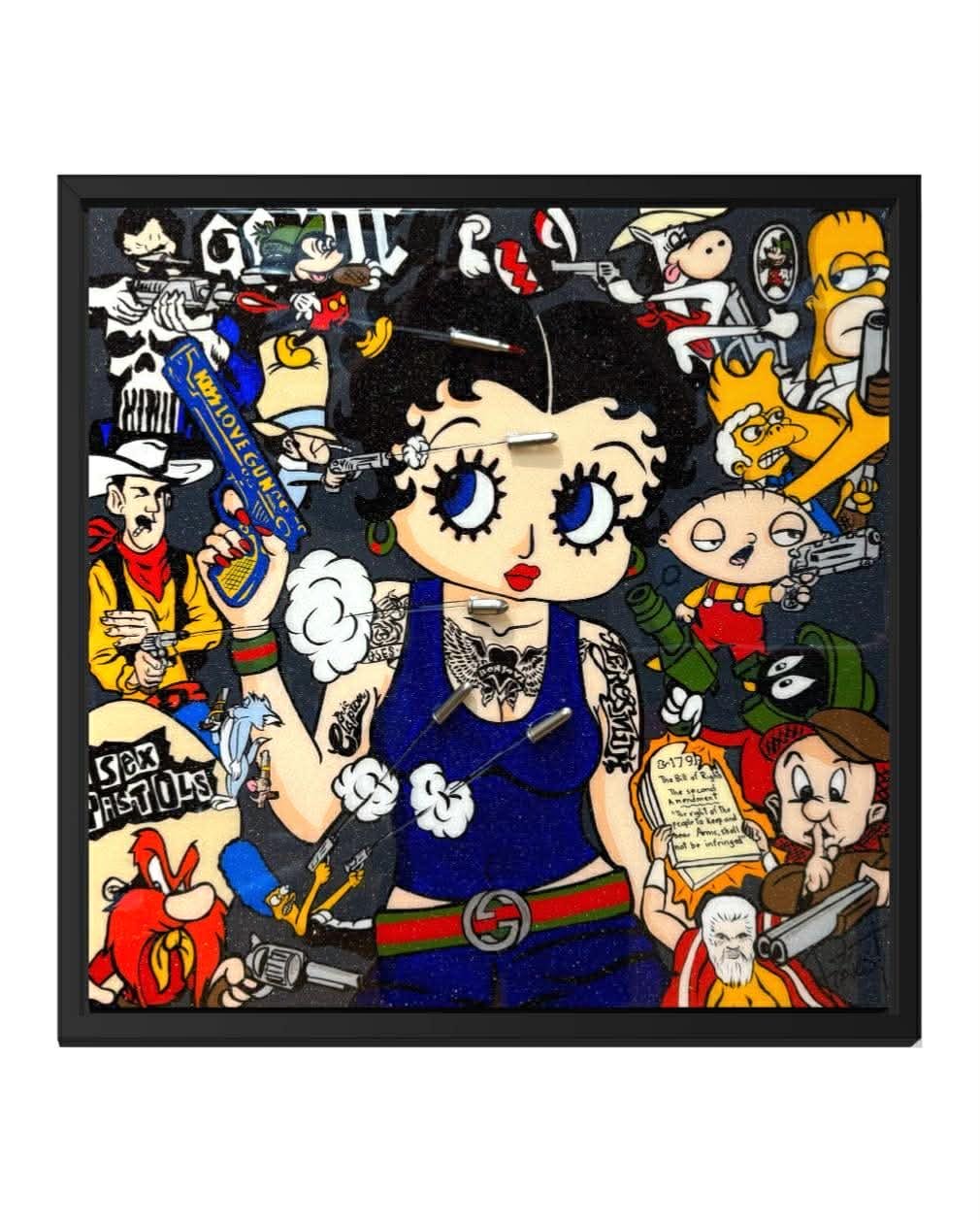
One of Prévost’s notable works, Guns for Hire, takes this approach into particularly provocative territory. The colorful and highly detailed composition examines the growing censorship surrounding the presence of firearms in cartoons and popular entertainment.
The work combines iconic animated characters with a graffiti-inspired aesthetic, creating an energetic visual environment filled with references to cartoons, music, film, and American culture.
At the center of the composition is Betty Boop, presented as a Lara Croft-inspired figure. Tattoos on the character reference musical groups associated with firearms in their songs or names, including Guns N’ Roses, while another reference connects to the iconic gun imagery associated with KISS’s Love Gun album.
These details demonstrate Prévost’s interest in creating connections between different forms of popular culture. Music, animation, fashion, cinema, and visual art become part of the same conversation.
Cartoon Icons in a New Context
Surrounding Betty Boop is an array of recognizable animated characters, including Mickey Mouse, Homer Simpson, Yosemite Sam, and Stewie Griffin. Each is depicted holding a firearm as originally portrayed by their respective creators.
The decision to bring these characters together creates a striking contrast between childhood and contemporary cultural debates. Many of these figures have been part of popular entertainment for generations, and their original appearances can evoke nostalgia and humor.
Within Guns for Hire, however, their imagery is placed under a different lens.
The painting asks viewers to consider how society’s relationship with cartoon violence and firearms has evolved over time. What was once presented as an ordinary element of animated entertainment can now become the subject of censorship and cultural discussion.
Rather than presenting a simple answer, Prévost uses the recognizable language of POP art to create a visual conversation around these changing attitudes.
Moses and the Second Amendment
One of the most significant elements in Guns for Hire is the inclusion of Moses holding two stone tablets inscribed with the Second Amendment.
The imagery creates an unusual connection between ancient history and modern American culture. Moses is traditionally associated with written law through the Ten Commandments, while the Second Amendment is connected to an ongoing American debate surrounding firearms and gun rights.
By placing the Second Amendment on stone tablets, Prévost creates a visual juxtaposition between ancient concepts of law and a modern constitutional discussion.
The unexpected combination encourages viewers to examine the relationship between history, law, popular culture, and contemporary social debates.
A Personal Tribute to Charlton Heston
The inclusion of Moses also has a personal significance for Prévost. He created Guns for Hire as a tribute to Charlton Heston, with whom he shared memorable conversations during the 1990s.
Heston is widely recognized for his portrayal of Moses and was also a former president of the National Rifle Association. These two aspects of his public identity intersect naturally within the painting.
Moses therefore becomes more than another recognizable figure in the composition. The character connects Prévost’s personal memories of Heston with the broader cultural themes explored throughout the artwork.
Through this tribute, Guns for Hire becomes both a commentary on popular culture and a reflection on personal history.
From POP Art to Cultural Conversation
Sylvain Prévost’s work demonstrates how familiar imagery can become a powerful vehicle for storytelling and reflection. His multidisciplinary background gives him the ability to combine the structure of film production with the visual freedom of contemporary POP art.
His use of iconic characters, original illustrations, sculptural elements, neon, objects, and cultural references creates works that reward closer examination. What initially attracts the viewer through color and recognizable imagery can reveal deeper layers of historical, personal, and cultural meaning.
Guns for Hire captures this approach particularly well. Through its combination of cartoon icons, music references, historical symbolism, censorship, and a personal tribute to Charlton Heston, the work transforms familiar popular culture into a larger conversation about how society remembers, interprets, and reconsiders its cultural imagery.
With more than three decades of creative experience, Prévost continues to explore the possibilities of POP art as both a visual language and a storytelling medium. His work demonstrates that popular imagery can be more than nostalgic it can also become a starting point for questioning cultural change, examining history, and connecting seemingly unrelated ideas.
For Prévost, the familiar is never simply familiar. Through research, experimentation, and an unmistakable sense of creative curiosity, he transforms recognizable cultural symbols into new narratives, inviting viewers to look again and discover what may exist beneath the surface.

