


Mary McCoy Critchley’s relationship with art is a story of rediscovery, resilience, and the unexpected return of a dream that had been set aside for decades. Now 56 and living in Ireland, Mary has come full circle with the creative ambition she carried as a young student, proving that an artistic journey does not have to follow a conventional timeline.
Her love of art began during her school years. She remembers being drawn to painting and dreaming of attending art college, imagining a future shaped by creativity. But one comment from an art teacher changed the direction of her life. She was told quite directly that she was not good enough to pursue art college.
For a young person with an emerging passion, those words were powerful enough to become a barrier. Mary decided not to apply and instead moved into corporate life. In time, she built a career, raised a family, created a home, and embraced the many responsibilities that come with adulthood. Art, however, remained quietly in the background.
What appeared to be the end of her artistic journey was actually only a pause.
Finding Her Way Back to Painting
Nearly three decades passed before Mary picked up a paintbrush again.
During the Covid pandemic, while caring for her elderly father, she found herself drawn back toward creativity. She became part of an online carers’ community, where an unexpected opportunity opened the door to painting once more. Mary was invited to participate in an online art class.
The experience quickly became transformative.
Rather than feeling like someone starting from the beginning, Mary discovered that the years away had not erased her artistic instinct. Her tutor noticed something distinctive in her work and told her that she had a recognizable style, one that made her paintings identifiable among those of other students.
For Mary, that observation carried enormous significance.
After spending much of her life believing the judgment she had received as a young student, hearing that another artist could recognize her individual style was deeply affirming. It suggested that the quality she had once been told she lacked had perhaps been there all along.
The experience became more than an art class. It became a reconnection with a part of herself that had been left behind.
A Folder From the 1980s
The most remarkable moment in Mary’s artistic rediscovery came later, while clearing out her parents’ home after their deaths.
Among the belongings, she discovered an old art folder hidden inside a chest of drawers. It had remained untouched for decades. Inside were paintings she had created during the 1980s, a time when she was still a young woman considering whether art could become part of her future.
Then came an extraordinary realization.
The paintings from the 1980s looked remarkably similar to the work she was creating again decades later.
Some of the old pieces were dated, allowing Mary to trace the creative path of her younger self. The final date she found was 1987, the same period when her teacher had told her she was not good enough.
The discovery must have been both emotional and revealing. Looking at those early paintings through the perspective of decades of life experience offered Mary something she could not have understood at the time. Her artistic voice had already been developing.
The folder became almost like a message from her younger self.
The dream had not disappeared. It had simply been waiting.
“Gentle Bloom”: A Tribute to Her Mother
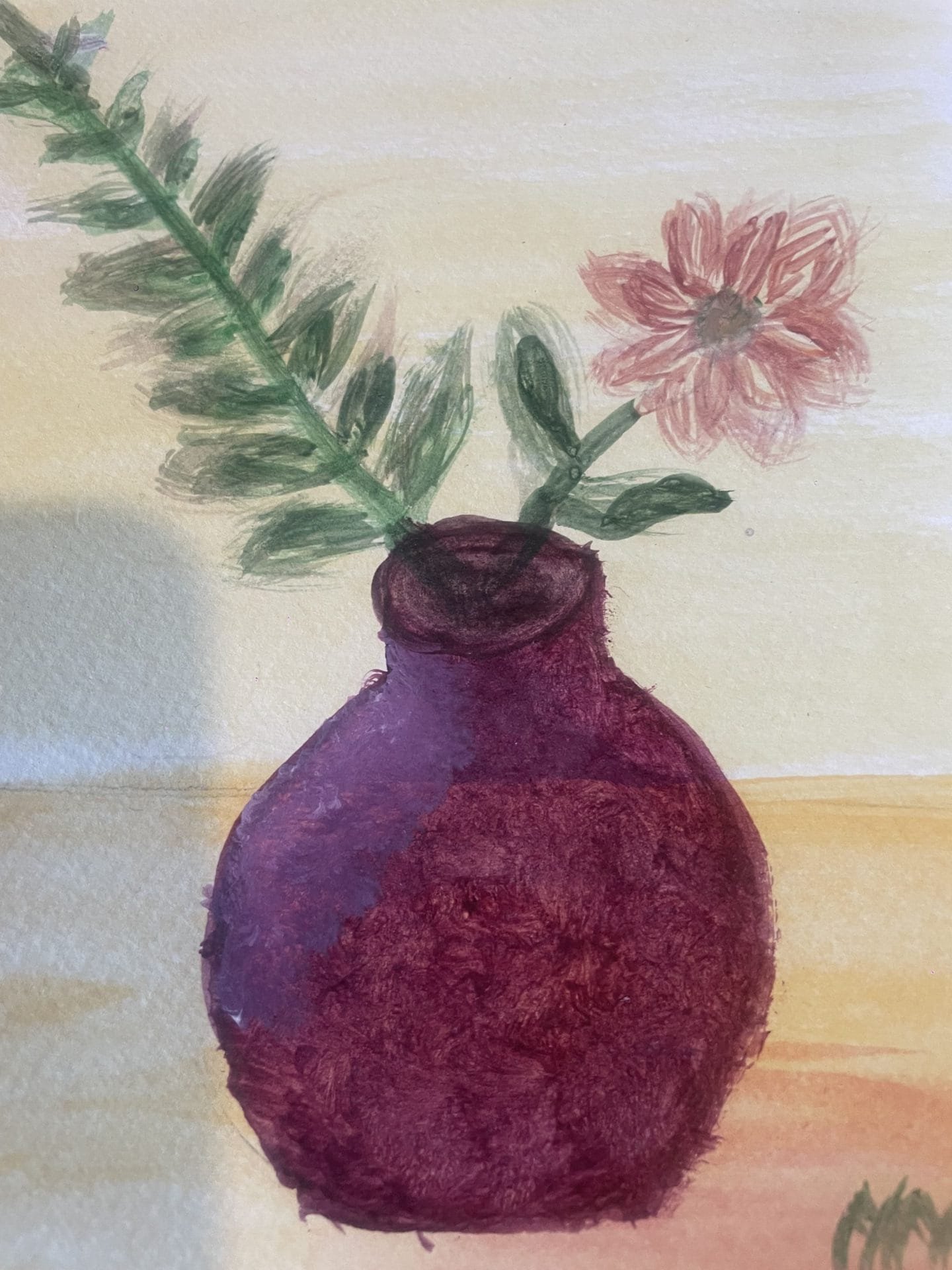
Among Mary’s more personal works is Gentle Bloom, painted in 2021 as a tribute to her mother, who passed away during the Covid pandemic.
The painting carries symbolism that is deeply connected to memory and grief. Purple was her mother’s favourite colour, but it also holds associations with mourning and loss. By bringing the colour into the work, Mary created a visual connection between the person she loved and the emotions surrounding her absence.
Flowers also hold particular importance in the painting because Mary’s mother loved them. This makes Gentle Bloom more than an arrangement of colour and form. It becomes a portrait expressed without relying on a literal likeness.
The painting reflects Mary’s memory of her mother’s nature, gentle, loving, and connected to the beauty found in flowers and quiet moments.
Through Gentle Bloom, Mary transforms personal grief into something contemplative. Rather than focusing solely on the pain of loss, the work searches for tenderness within it.
Finding Beauty in Quiet Moments
At the heart of Gentle Bloom is the idea that meaningful beauty does not always announce itself.
Mary approaches the painting through light, shadow, colour, and subject matter, using these elements to create an atmosphere rather than simply presenting an image. Her intention is to encourage the viewer to slow down and notice the quieter aspects of life.
That idea gives the painting a universal quality.
Although its origins are deeply personal, the emotions within it can be understood by anyone who has experienced love, loss, memory, or reflection. The flowers become more than flowers. The purple becomes more than a colour. Light and shadow become part of an emotional language.
There is something particularly fitting about this approach considering Mary’s own journey. Her artistic life has also been shaped by quiet spaces, years in which creativity existed beneath the surface while family, work, caregiving, and other responsibilities took priority.
Art as a Second Beginning
Mary McCoy Critchley’s story challenges the idea that artistic success has to happen at a particular age.
Her journey demonstrates that creativity can return after years, sometimes with greater emotional depth than before. The woman who once abandoned the possibility of art college eventually found herself painting again with a developed sense of identity, experience, and perspective.
The discovery of her old artwork makes this return even more meaningful. Her current work is not simply a new beginning. It is also a continuation of something that began when she was young.
The teacher’s words from the 1980s may have influenced Mary’s decisions for many years, but they ultimately failed to define her artistic potential.
Instead, decades later, another teacher saw something different. She saw an identifiable artistic style.
That contrast is at the centre of Mary’s story.
When the Past Meets the Present
There is a quiet power in realizing that the person we once were is still present within us.
For Mary, the paintings hidden away in her parents’ house offered tangible proof of that connection. Her younger self had created work decades earlier that shared similarities with the paintings she was making in her fifties.
It is as though the artistic voice that had been interrupted in 1987 eventually found its way back into the conversation.
Her experience also offers encouragement to anyone who has ever been discouraged from pursuing something creative. A single opinion, particularly when received at a formative age, can feel definitive. But artistic development is not always measurable at one particular moment in time.
Sometimes the voice needs time to mature.
Sometimes life itself becomes part of the creative education.
And sometimes a forgotten folder in an old drawer can reveal that the dream was never really gone.
A Future Still Being Written
Mary’s artistic journey is ultimately not about correcting the past. It is about embracing the future.
The dream she carried as a young student is once again part of her life, now informed by decades of experience, relationships, responsibility, caregiving, loss, and personal growth. Her paintings therefore emerge from a much broader emotional landscape than they could have when she was a teenager.
Gentle Bloom embodies this evolution particularly well. Created from grief and remembrance, it turns a deeply personal experience into a meditation on tenderness and beauty.
Mary hopes viewers will take a moment to look at her work with an open mind, to pause, reflect, and perhaps find their own meaning within it.
Her story reminds us that creativity does not have an expiration date. Dreams can be delayed without being destroyed, and an artistic voice can remain dormant for years before finding its way back into the world.
For Mary McCoy Critchley, the journey that began decades ago is still unfolding. What was once dismissed as a dream that was not good enough has become a living part of her present and perhaps, finally, the future she always imagined.

