


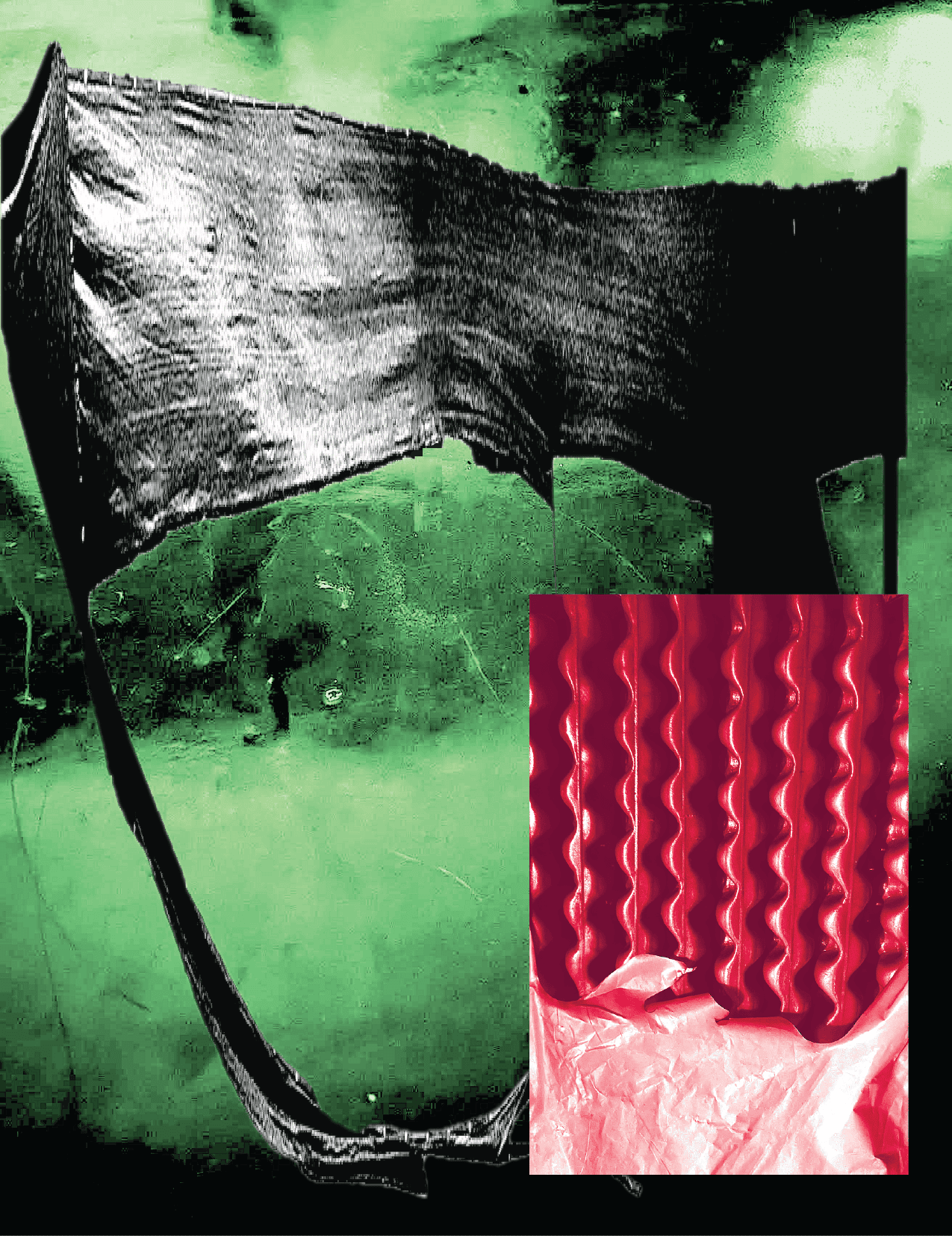
Mitchell Kane is an interdisciplinary artist whose practice moves fluidly between painting, drawing, photography, graphic design, and curatorial methodology. Rather than confining his work to a single medium or established visual language, Kane explores how different forms of representation can interact to create complex impressions of contemporary experience. His work is grounded in observation, experimentation, and an ongoing interest in the uncertain relationship between images, information, and meaning.
At the center of Kane’s practice is an interest in visual narratives and what he describes as the slippery nature of meaning. His subjects often emerge from the vernacular, everyday surroundings, and cultural and environmental observations. Familiar things can become unfamiliar through changes in context, juxtaposition, scale, texture, or representation. In this way, Kane’s work encourages viewers to reconsider how they interpret the visual information that surrounds them.
His approach reflects an understanding of contemporary life as an accumulation of images, experiences, environments, and digital encounters. Rather than presenting these elements as a straightforward narrative, Kane allows them to coexist, overlap, and sometimes contradict one another.
The Foundation of i-o-i-p
In 2009, Kane founded i-o-i-p as an artistic platform through which he could expand his interests in visual narratives and the unstable relationship between images and meaning. The platform became an extension of his interdisciplinary thinking, providing a framework for exploring ideas that might not fit comfortably within the boundaries of a conventional studio practice.
The development of i-o-i-p is closely connected to Kane’s broader interest in the ways images communicate. His practice does not simply use visual materials to illustrate predetermined ideas. Instead, the materials themselves become part of the process of discovery. A photograph can carry the recognizable qualities of the world, while a drawing may introduce something more subjective. A texture study can record an ordinary detail of daily life while simultaneously transforming it into an abstract visual experience.
These different forms of representation create a space where meaning remains open rather than fixed.
A History of Curatorial Experimentation
Kane’s interdisciplinary practice also has deep roots in his curatorial work. Between 1990 and 2000, he focused much of his artistic activity on the Hirsch Farm Project, serving as Curator, Director, and Moderator of the arts-based think tank.
The Hirsch Farm Project was conceived as a traveling, private, immersive project that explored the relationship between Contemporary Art, Conservation, and Conversation within a speculative social environment. Taking place during the final decade of the 20th century, the project offered a distinctive framework for thinking about art not simply as an object, but as an experience involving people, ideas, environments, and dialogue.
This period was significant in developing Kane’s interest in the relationship between art and lived experience. The Hirsch Farm Project emphasized participation, exchange, and observation, ideas that continue to resonate with his current artistic practice.
Kane originally worked from Chicago during the 1980s and 1990s, a period that contributed to the development of his artistic and curatorial identity. Today, he lives and works in Los Angeles, where his practice continues to investigate the constantly changing relationship between physical environments and contemporary visual culture.
Nature, Culture, and Technology
In Kane’s current work, experience comes first. His central subject can be understood through the relationship between Nature, Culture, and Technology, three forces that increasingly shape how people perceive and navigate the world.
The artist draws from experiences that emerge out of place, using a variety of materials and forms of representation to record and reinterpret those encounters. His handmade drawings are subjective and personal. His photographs retain connections to recognizable objects and environments. His texture studies draw attention to the surfaces and details embedded in everyday life.
Each approach offers a different way of experiencing the same world.
Yet Kane is interested in what happens when these approaches are brought together. Rather than separating the physical world from mediated experience, his work considers how the two increasingly exist alongside one another. A person may spend part of the day responding to a physical environment and moments later enter a completely different space through a screen, a social media platform, or another form of technology.
These transitions have become such a normal part of contemporary life that they can easily go unnoticed. Kane gives visual form to this condition.
The Idea of the “Post-Experiential”
Kane describes navigating between tangible, physical observations and technology-driven social spaces as “post-experiential.” The term captures a contemporary condition in which experience is no longer limited to direct physical encounters.
An observation can begin in a real environment and continue through a photograph. A photograph can become an image on a screen. That image can then be shared, interpreted, modified, or encountered by someone far removed from the original place. The experience changes as it moves between different contexts.
Kane’s work responds to this shifting process without attempting to provide a simple conclusion. Instead, he allows multiple experiences to remain visible at once.
This is particularly evident in the way his images are constructed. Individual elements may appear familiar, but their relationships are deliberately less predictable. The viewer is invited to navigate the work much as one navigates contemporary life itself, moving between fragments of information and forming connections along the way.
Images as Fragments of a Larger Story
A defining characteristic of Kane’s current work is his refusal to force every image into a traditional narrative structure. Each picture follows its own internal, formal, and intuitive logic and sensibility. Rather than functioning as isolated statements with singular interpretations, the works operate as fragments.
The images are intentionally conflated, with different elements appearing to happen simultaneously. Colors are fugitive, contributing to a sense of instability and movement. The resulting compositions can feel like records of perception rather than fixed descriptions of a particular moment.
This approach reflects the way information is encountered in everyday life. People rarely experience the world as one continuous, perfectly organized narrative. Instead, impressions accumulate: a landscape, a texture, a conversation, an image on a screen, a memory, a visual detail, or a passing observation. Over time, these fragments become part of a larger understanding.
Kane’s work embraces this accumulation.
“Sigmoidal” 2026
In Sigmoidal, 2026, Kane continues this investigation into the relationship between perception, representation, and experience. The work can be approached as part of his broader exploration of how seemingly different forms of information can coexist within a single visual field.
The title itself suggests movement and transformation, while Kane’s broader practice provides a context in which the work can be considered less as a conventional narrative and more as an encounter. The viewer is not necessarily being given a predetermined story to decode. Instead, the work creates an environment for observation, association, and interpretation.
This openness is central to Kane’s artistic language. The image does not need to resolve every question it raises. Its fragments can remain fragments, allowing the viewer to participate in constructing relationships between them.
Finding Meaning in the In-Between
Mitchell Kane’s practice ultimately occupies a space between categories. It is simultaneously concerned with the physical and the digital, the familiar and the subjective, the individual image and the larger story. Painting, drawing, photography, texture, design, and curatorial thinking become interconnected tools for examining how contemporary experience is formed.
His work recognizes that meaning is rarely stable. It shifts according to context, memory, technology, environment, and personal perception. By bringing different visual experiences together without forcing them into a conventional narrative, Kane creates works that reflect the fragmented nature of contemporary life.
Rather than telling viewers exactly what to see, he gives them fragments from which to construct their own understanding. In this sense, his images function not as definitive answers but as accumulated observations: pieces of experience gathered from the world and transformed through an intuitive visual process.
Through this approach, Kane continues to explore a fundamental question of contemporary art: how can an image represent experience when experience itself is constantly changing? His answer lies in embracing ambiguity, allowing multiple forms of information to coexist, and recognizing that sometimes the most meaningful story is the one that remains open.

