


Marit Otto is a Dutch multidisciplinary artist whose work examines the complexities of contemporary life through images that combine visual precision with social and philosophical inquiry. Working across painting, collage, installation, digital art, photo manipulation, video art, and three-dimensional forms, she creates compositions that challenge familiar perceptions and invite viewers to reconsider what they see. Her practice moves between aesthetic appeal and underlying unease, exploring the contradictions that shape human experience and contemporary society.
“I make contemporary engaged art. It has a certain urgency. It is reflecting us, people and the zeitgeist,” Otto explains. “Images speak louder than words and basically appeal very directly to our feelings.” This conviction informs a body of work that brings together elements of activism and philosophy, using visual language to initiate dialogue rather than provide straightforward answers.
Born in Hoorn, North Holland, in 1970, Otto has worked as a visual artist since 1994. Her studio is located at Gelijkheid 3 in Zwolle, where she develops her autonomous practice alongside commissioned and project-based work. Across these different contexts, she remains interested in the ability of images to communicate complex ideas through direct visual encounters.
Familiar Images, Unsettling Realities
The human figure occupies a central position in Otto’s autonomous work. Through the shape and behaviour of people, she investigates contemporary social themes alongside everyday experiences and personal concerns. Her figures inhabit situations that may initially appear recognisable but gradually reveal tensions beneath the surface.
Otto often introduces small interventions, repetitions, inversions, or architectural forms that disrupt an otherwise familiar image. These alterations transform the viewer’s experience, creating compositions that balance recognition with uncertainty. What seems ordinary can acquire an unfamiliar significance, while an aesthetically composed scene may conceal an unsettling undercurrent.
This tension between attraction and discomfort is fundamental to her visual language. Otto’s work can be carefully constructed and visually appealing without offering an entirely comfortable experience. Her approach embraces ambiguity, allowing beauty and unease to coexist within the same image.
“Do you see what you see?” is a question that encapsulates her artistic concerns. It encourages viewers to look beyond the immediate appearance of an image and consider how perception is shaped by expectation, context, and personal experience. Her compositions frequently occupy the boundary between fiction and realism, using recognisable forms to explore realities that are difficult to confront directly.
Painting Through Layers and Contrasts
Acrylic painting provides Otto with an effective medium for developing her precise and controlled visual approach. She builds her paintings in layers, alternating thick applications with transparent passages to create accumulated nuances of colour. Although acrylic dries quickly and offers relatively limited surface texture, she uses these characteristics to establish depth and complexity within a predominantly smooth finish.
Her graphic background also informs the structure of her paintings. Otto brings together the graphic artist’s preference for a strong, carefully organised image and the visual artist’s interest in eloquence and expressive meaning. This combination allows compositional clarity to coexist with psychological and conceptual depth.
Her paintings are not simply exercises in visual arrangement. Their formal qualities contribute to the way meaning develops, directing attention toward particular relationships between figures, objects, and environments. A seemingly controlled composition can become the setting for uncertainty, contradiction, or emotional intensity.
Otto typically spends one or two months working on a canvas. This extended process gives an initial idea time to mature alongside the development of the painting. She works in series, revisiting themes and allowing different images to establish relationships with one another. Her belief that “Art is fluid” reflects an understanding of creativity as an evolving process rather than a fixed destination.
Beyond a Single Artistic Tradition
Although Otto’s work incorporates surrealistic elements and occasional abstraction, she does not identify her practice with a single artistic movement. Contemporary realism remains an important reference point, particularly in her use of figurative imagery and recognisable environments. However, her interventions frequently unsettle the apparent stability of these forms.
The result is a visual language in which realistic details can coexist with situations that feel psychologically charged or subtly dislocated. Rather than abandoning reality, Otto modifies its appearance to reveal tensions that might otherwise remain unnoticed.
Her multidisciplinary approach extends this exploration across different formats. Painting, collage, installation, digital manipulation, video, and three-dimensional work offer distinct possibilities for examining the relationship between image and meaning. Each medium becomes a means of responding to the subject rather than a boundary that restricts her expression.
Otto’s refusal to settle into a fixed style reflects her belief that artistic development remains open-ended. While figurative work has provided her with the most effective means of expression so far, she remains receptive to other possibilities. Her practice is sustained by experimentation and an ongoing interest in how images can communicate the complexities of contemporary experience.
The Abyss: Civilisation and Human Vulnerability
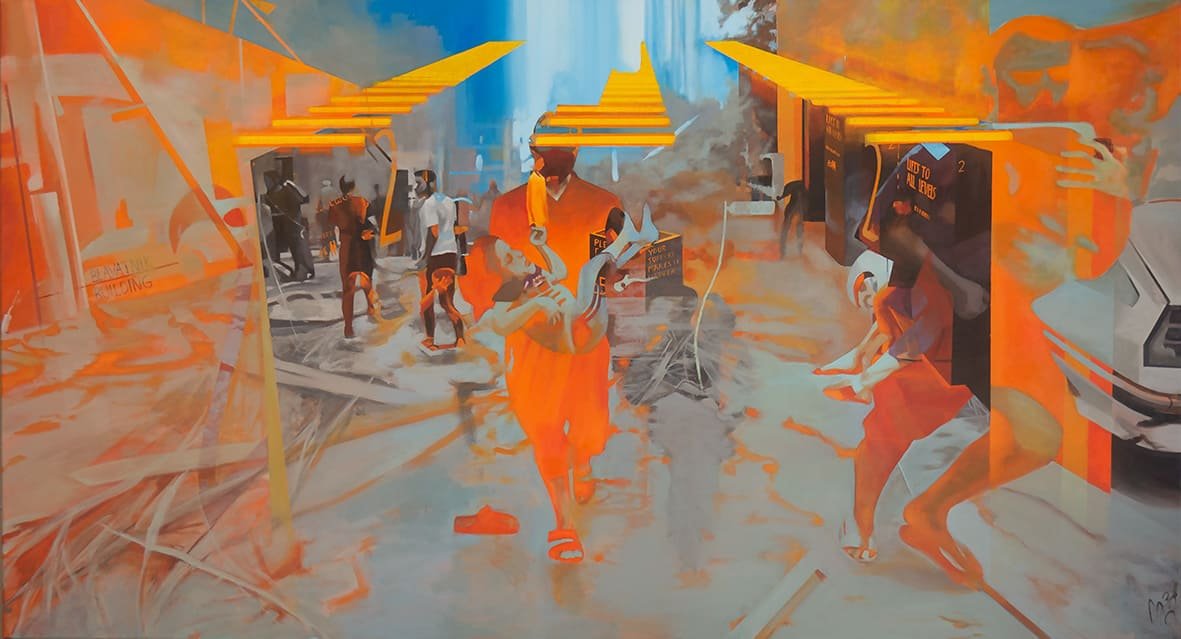
These concerns converge in The Abyss (2026), an acrylic painting on canvas measuring 180 × 100 centimetres. Part of her Sublime Comedy series, the work explores the intersection between what society perceives as the highest and lowest stages of civilisation.
The painting presents glimpses of a museum-like setting inspired by Tate Modern. This institutional environment suggests cultural achievement, architectural grandeur, and the preservation of artistic accomplishment. Yet it also functions as a façade, disrupted by the intrusion of real life and its inescapable demands. The contrast raises questions about the distance between the structures through which societies celebrate civilisation and the suffering that continues beyond their walls.
At the centre of the composition, a running man carries a young girl in an image Otto describes as a modern, melancholic Pietà. The reference evokes the traditional representation of Mary holding the dead Christ, bringing associations of grief, sacrifice, and human vulnerability into a contemporary setting.
The running figure introduces urgency into this visual relationship. Rather than presenting suffering through a static or idealised arrangement, Otto suggests a moment of movement and powerlessness. The man and child become figures through which the viewer encounters the fragility of life and the difficulty of responding to circumstances beyond individual control.
Otto describes these images as urgently demanding to be seen. Their vulnerability is inseparable from the possibility that they may be overlooked, erased, or rendered invisible. By insisting on their presence, the painting challenges the distance between witnessing suffering and acknowledging its significance.
Dedicated to the victims of Gaza and the West Bank, The Abyss carries an explicit humanitarian dimension. Its juxtaposition of a cultural institution and human vulnerability questions the moral contradictions that can exist within societies that celebrate their achievements while confronting profound human suffering.
Otto describes morality as a waterbed with a deadly ambiguity. The metaphor suggests an unstable ethical landscape in which responsibility, comfort, and complicity remain difficult to separate. Rather than resolving these contradictions, the painting holds them in tension, asking viewers to consider what civilisation means when its accomplishments are placed alongside the suffering of vulnerable people.
Art as an Urgent Conversation
Marit Otto’s practice demonstrates how aesthetic precision can become a vehicle for critical reflection. Her images attract attention through their visual construction while introducing questions that resist easy interpretation. By moving between realism, surrealism, and different artistic media, she creates encounters that encourage viewers to reconsider familiar assumptions.
In The Abyss, this approach becomes particularly urgent. The relationship between cultural grandeur and human suffering transforms the painting into an inquiry about visibility, responsibility, and the moral contradictions of contemporary life. Its figures insist on being seen, while the surrounding environment complicates the viewer’s understanding of civilisation and its obligations.
For Otto, art is not simply about presenting an image but about creating the conditions for dialogue. Her work invites viewers to look more carefully, question their first impressions, and recognise the uneasy realities that may exist beneath an apparently familiar surface. Through this sustained engagement with ambiguity and contemporary concerns, she develops a visual practice that seeks not merely to reflect the world but to challenge how it is perceived.

