


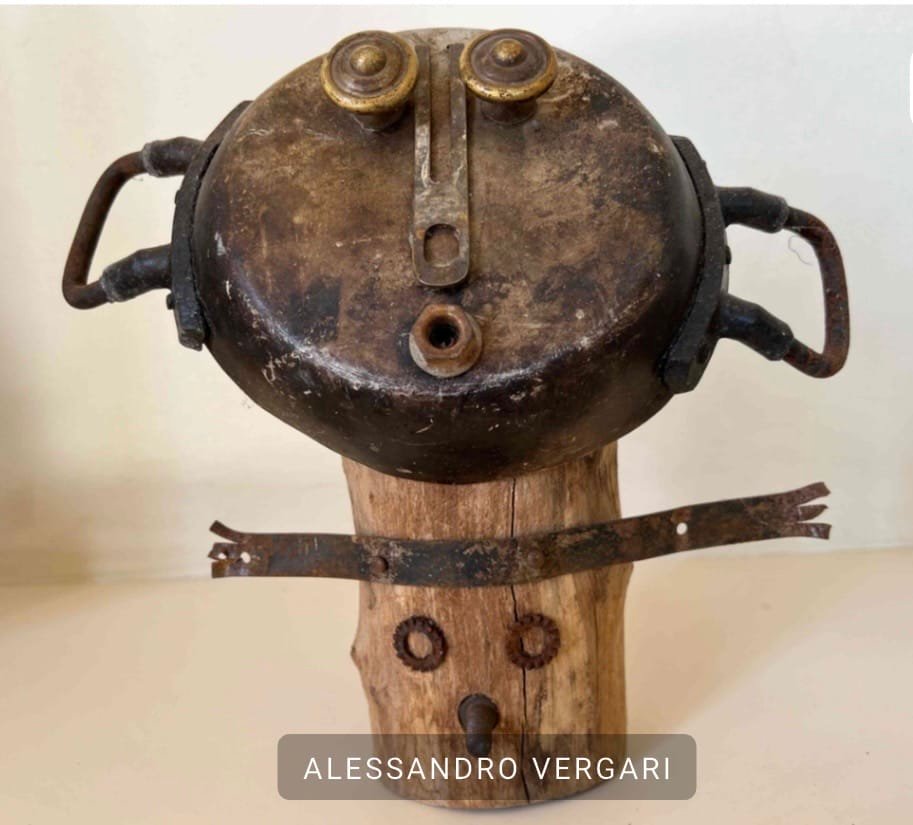
Alessandro Vergari has always been creative in every aspect of his life. Born in Florence, Italy, his natural inclination toward creativity has gradually developed into an artistic practice that brings together nature, discarded materials, travel, imagination, and storytelling.
A few years ago, Vergari began creating his distinctive “Ritotems,” a collection of unusual upcycled sculptures that transform dead wood and discarded materials into fantastical creatures. His approach begins with an appreciation for materials that might otherwise be overlooked. During his travels abroad, he regularly collects something unique from the places he visits, later incorporating these discoveries into the creation of new creatures.
Each Ritotem therefore carries traces of different experiences and encounters. A fragment collected during a journey can become part of a sculpture, while the natural shape of an old piece of wood can suggest the personality or form of a new creature. The result is a body of work that feels spontaneous, imaginative, and deeply connected to the artist’s way of seeing the world.
Giving Dead Wood a New Life
At the heart of Vergari’s practice is the transformation of dead wood into something unexpected. His Ritotems are created by combining dead trees and other discarded materials to form creatures that seem to exist somewhere between the natural world and an imaginary universe.
Rather than treating old wood as waste, Vergari recognizes its potential. Every branch, trunk, and fragment carries a history, and instead of allowing that history to disappear, he gives the material another life through sculpture.
The process is also deliberately open to imagination. Vergari describes his creatures as being born partly from a touch of the artist’s own madness. This sense of playful unpredictability is central to the character of the Ritotems. They are not intended to simply reproduce something found in nature. Instead, they reinterpret nature through humor, fantasy, and the artist’s personal vision.
Preserving the Memory of Significant Trees
Although Vergari creates smaller pieces that can be displayed inside the home, he particularly enjoys working with significant dead trees. Their scale allows him to create imposing sculptures while retaining a visible connection to the material’s original identity.
For Vergari, this process has an almost symbolic quality. He seeks to sanctify these trees and preserve their memory, giving them a new role after their natural life has ended.
This idea recalls an older relationship between communities and trees. In the past, an old tree could be at the center of village life, serving as a recognizable meeting point and a witness to generations of human activity. Vergari’s work echoes this idea by allowing old trees to continue occupying a meaningful place within the lives of people who encounter his sculptures.
The tree may no longer be alive, but its presence continues in another form.
A Woodland Filled With Art
Vergari’s artistic vision extends beyond individual sculptures. He has created a woodland area where visitors can follow a trail and encounter more than 50 artworks positioned throughout nature.
The setting becomes an essential part of the experience. Rather than presenting the sculptures inside a conventional gallery, Vergari places them among trees, paths, vegetation, and the natural landscape. Visitors discover the artworks as they move through the woodland, creating a sense of exploration and surprise.
This environment also changes the relationship between artwork and viewer. Each sculpture becomes part of its surroundings, allowing nature to function almost like an enormous exhibition space without walls.
The woodland site has gained attention beyond its local setting and has also been featured by Atlas Obscura, reflecting the unusual and immersive character of Vergari’s artistic world.
Where Reality Meets Fantasy
The Ritotems are not only visual objects. Each creature is accompanied by a description or story that expands its identity and gives the viewer another way to understand the work.
Vergari draws on diverse areas of knowledge when developing these descriptions, but he does not remain entirely within the boundaries of reality. Instead, his stories move between factual references, imagination, and subtle irony.
This combination creates a distinctive tone. The creatures can appear mysterious at first, but their stories often reveal a playful and humorous side. Everyday experiences and recognizable human behaviors become the foundations for fictional characters with their own personalities and roles.
Through these stories, Vergari encourages viewers to spend more time with each sculpture. The question is no longer simply “What is this?” but also “Who is this creature, and what story does it have to tell?”
Spadellino, the God of Petty Screw-ups
One of the most entertaining examples of this approach is Spadellino, the God of Petty Screw-ups.
Spadellino represents those small mistakes that can suddenly become much bigger problems. Perhaps someone breaks a treasured vintage glass belonging to their wife or accidentally scratches their husband’s brand-new SUV. In such moments, Spadellino provides a wonderfully absurd solution: make a face like his, declare, “It’s not my fault!”, and hope that everything will be forgiven.
The humor is simple, familiar, and deliberately exaggerated. A minor everyday mishap is transformed into a mythical concept, giving human imperfection its own imaginary deity.
Spadellino captures what makes the Ritotems so engaging. The sculpture itself creates curiosity, while the story gives the creature personality. The combination of visual character and playful mythology encourages viewers to connect with the work on a more personal level.
A World Built From the Overlooked
Vergari’s work demonstrates how discarded materials can become much more than objects waiting to be reused. Through his imagination, they become characters, symbols, and storytellers.
His Ritotems bring together the memory contained within old wood, objects gathered from travels, the unpredictability of found materials, and stories inspired by both knowledge and everyday human behavior. The result is a distinctive artistic universe in which nature and fantasy constantly overlap.
There is also a deeper idea within this playful approach. By giving dead trees and discarded objects a new existence, Vergari asks viewers to reconsider the things they might normally ignore. A piece of dead wood is no longer simply a remnant of a tree. It can become a creature with a personality. A discarded object can become an essential part of a sculpture. An ordinary mistake can even become the responsibility of a mythical god.
An Invitation to See Differently
Alessandro Vergari’s Ritotems ultimately celebrate transformation. They transform materials, but they also transform perception.
His woodland trail offers visitors an opportunity to step away from the traditional gallery environment and encounter art through movement, discovery, and nature. His sculptures preserve the memory of old trees while giving them new identities. His stories add humor and imagination to physical forms, creating a world where reality and fantasy can comfortably coexist.
What begins with dead wood and discarded materials becomes something far more alive: a collection of characters, memories, and stories.
Through the Ritotems, Vergari invites viewers to look more closely at what has been forgotten or discarded and imagine what it could become. His work suggests that even the oldest tree, the most unexpected object, or the smallest human mistake can contain the beginning of a new story.

