


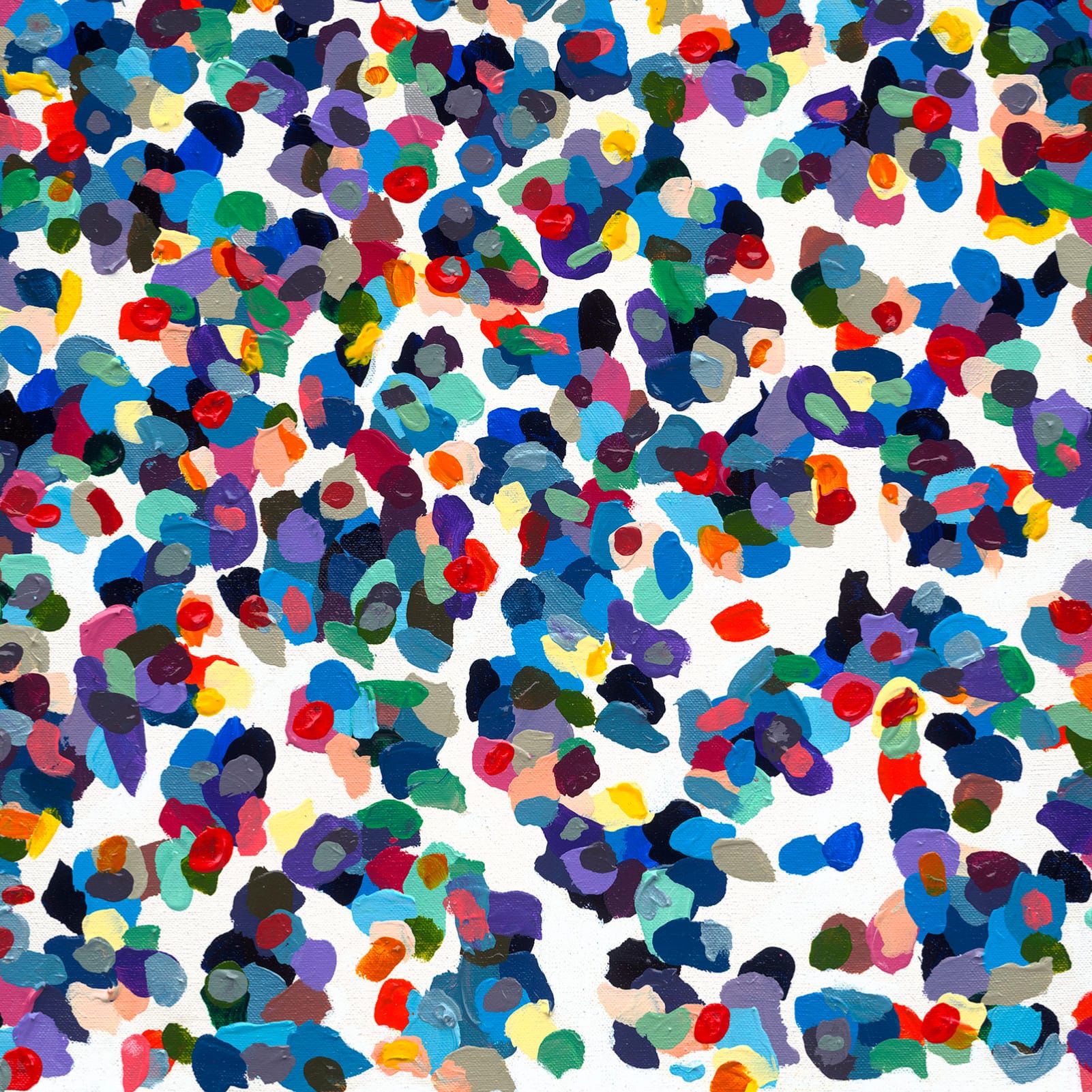
Michael Murphy is an emerging Irish artist whose practice explores the origins of visual language and the ways simple marks can communicate complex ideas. With more than a decade of experience in art education, Murphy brings an informed understanding of artistic expression to a developing practice shaped by primitive and minimalist mark-making.
His transition into full-time art has already led to significant early opportunities. Within his first year, Murphy exhibited at Art Source at Dublin’s prestigious Royal Dublin Society (RDS), an event that attracted an audience of approximately 15,000 people. His work has also been presented internationally at Expo Metro in Plaza Callao, Madrid, alongside group exhibitions in Ireland.
These early exhibitions mark an exciting beginning for an artist whose work is visually restrained yet conceptually ambitious. Drawing on the origins of human mark-making, Murphy is interested in how visual elements develop meaning and how contemporary art can offer new ways of approaching ideas that are often difficult to express through conventional language.
The Origins of a Visual Language
At the foundation of Murphy’s practice is an interest in the history of visual communication. Long before modern written language developed, humans used marks, symbols, patterns, and images to record experiences and communicate with others. These early forms of expression represent some of the most fundamental ways people have attempted to understand and describe the world.
Murphy’s work draws from this history without attempting to recreate it literally. Instead, he considers what can be learned from the simplicity of early visual language and how those principles might be reinterpreted through contemporary artistic practice.
The dot is particularly significant within this exploration. As one of the simplest possible marks, it can represent a beginning or a point of origin. Yet its meaning can change through context and repetition. A single dot may appear isolated, while multiple dots establish relationships, patterns, rhythm, and structure.
This interest connects Murphy’s practice to the development of semiotic language in art. His work considers how visual signs communicate and how meaning can emerge through the relationship between individual elements. The simplicity of the mark becomes a starting point for exploring a much wider visual vocabulary.
Representing Complex Scientific Ideas
Murphy’s interest in visual language extends into his exploration of complex scientific ideas. Much of modern scientific knowledge is communicated through specialized terminology, mathematical models, diagrams, and technical systems. While these methods are essential within scientific fields, they can sometimes make complex concepts difficult for a wider audience to access.
Murphy approaches this challenge through visual art. Rather than attempting to illustrate scientific theories directly, he explores whether complex ideas can be approached through a more primitive and instinctive form of visual communication, reinterpreted through contemporary means.
This creates an interesting relationship between simplicity and complexity. The marks themselves may be fundamental, but they can be used to suggest broader ideas about systems, patterns, relationships, and the natural world.
The work therefore operates as a form of visual translation. Scientific thought is not presented as a literal diagram or explanation. Instead, Murphy creates an opportunity for viewers to engage with the underlying ideas through visual experience.
This approach also leaves room for individual interpretation. Viewers may respond to the patterns and structures they encounter without needing specialist scientific knowledge. The work encourages them to consider how information can be communicated and how visual language can provide an alternative route toward understanding.
Repetition, Time, and Process
Repetition plays an important role in Murphy’s creative process. The repeated use of a simple motif transforms an individual gesture into a sustained act of making, requiring time, concentration, and patience.
This process gives the work a sense of duration. Each mark records a moment within the creation of the piece, while the accumulation of marks reflects the extended effort required to bring the composition into existence.
There is also a meditative quality to this method. Repetition encourages attention to small differences and subtle relationships, allowing the artist to work gradually rather than relying on a single immediate gesture.
For the viewer, this can create a similarly slower experience. Instead of encountering the artwork as a single image, the eye can move between individual marks and the larger composition. Details become important, but so does the way those details interact as part of a complete visual structure.
In this way, process is not separate from the finished work. The physical act of creating and accumulating marks contributes to the meaning and experience of the artwork.
Ancient Influences in a Contemporary Context
Murphy’s practice exists within a productive tension between the primitive and the contemporary. His visual language recalls the earliest forms of human expression, yet the ideas he explores are connected to modern science and the technological world.
This contrast raises questions about how much human communication has truly changed. Technology has transformed how information is created and distributed, but the basic desire to communicate remains constant. Humans continue to use signs, symbols, images, and patterns to express ideas that cannot always be easily communicated through words.
By returning to fundamental marks, Murphy creates a connection between these different periods. The primitive becomes a point of departure for considering contemporary questions, while modern ideas are approached through a visual language that feels instinctive and universal.
His work consequently reflects both the past and the present. It looks toward the origins of communication while considering how visual art might respond to the complexity of the modern world.
From Education to Full-Time Practice
Murphy’s more than decade-long experience in art education provides an important context for his artistic development. Working within education has involved engaging with how people observe, interpret, and respond to visual information, experiences that naturally connect with his interest in communication and meaning.
Moving into full-time artistic practice has allowed him to focus more closely on developing his own visual language. His early success demonstrates the momentum behind this new chapter, with exhibitions in Ireland and international exposure arriving within his first year.
His appearance at Art Source introduced his work to a substantial audience at one of Ireland’s prominent art events, while his participation in Expo Metro brought his practice to Madrid. Alongside these opportunities, group exhibitions in Ireland have continued to support the development of his profile.
A New Collaboration in 2026
Murphy’s practice is also beginning to extend into areas beyond traditional gallery exhibitions. Later in 2026, he will collaborate with a sustainable fashion brand on a limited-run project.
The collaboration offers an opportunity to explore how his visual language might translate into another creative context. Fashion and art share an interest in visual identity, pattern, repetition, and symbolism, creating natural possibilities for an exchange between the two disciplines.
Working with a sustainable fashion brand also introduces a contemporary environmental dimension to the project. As sustainability becomes increasingly important within creative industries, such collaborations can connect artistic expression with more responsible approaches to production and consumption.
Looking Ahead
Michael Murphy is establishing a distinctive position within emerging contemporary Irish art through a practice that brings together primitive mark-making, semiotic language, scientific ideas, and contemporary artistic methods.
His work begins with some of the simplest elements of visual expression but uses them to consider much broader questions about communication, knowledge, and our understanding of the natural world. Rather than providing straightforward explanations, Murphy’s artworks invite viewers to look closely, consider relationships, and interpret meaning through visual experience.
With his first year of full-time practice already including exhibitions in Dublin and Madrid, as well as group shows in Ireland, Murphy’s artistic journey is gaining momentum. His upcoming sustainable fashion collaboration will offer another opportunity to expand his practice and introduce his visual language to a new context.
As his career develops, Murphy’s exploration of the relationship between ancient forms of communication and contemporary ideas promises to remain central to his artistic direction. Through the humble mark, he creates a visual space where questions of science, language, process, and human understanding can meet.

