


For Dutch artist Wim de Groot, the decision to become a painter came remarkably early. Born in Aalst, the Netherlands, in 1949, he discovered his calling as a teenager. At just fifteen years old, he expressed a clear and unwavering ambition: “I want to become a painter!” More than six decades later, that early declaration has developed into a lifelong artistic practice shaped by observation, intuition, cultural encounters, and a deep interest in the human condition.
De Groot first presented his work publicly in 1977 in Lochem, where his paintings attracted attention from the regional press. The response captured something essential about his approach to art, describing works in which “all the artist’s fears, doubts, and moments of joy are incorporated into it,” rising beyond ordinary reality while confronting its deepest emotional dimensions.
Although De Groot developed as an autonomous, self-taught artist, his artistic path has never existed in isolation. His practice has been nourished by encounters with the work of other artists and by a broad engagement with culture. Painting and drawing remain central, but his sources of inspiration extend into photography, theatre, and music, as well as the work of masters from different periods of art history.
Looking, Learning, and Developing a Personal Language
Alongside his work as an artist, De Groot worked as a conservator at the Rijksmuseum. His professional engagement with art history gave him an opportunity to look closely at important works and artistic traditions. One particularly significant area of research involved the cartoons for the sixteenth-century stained-glass windows of Sint-Janskerk in Gouda. His involvement with this material eventually contributed to the anthology The Seventh Window.
This sustained attention to historical art has become part of the foundation of De Groot’s own visual language. Yet his work is not simply an extension of the past. Instead, he has developed a distinct approach that brings together vision, technique, and the physical experience of looking.
Model drawing has played an important role in this development. For De Groot, drawing from the model is immediate and physical, a gesture made in the moment. He sees it as a counterpoint to painting, offering a different rhythm and a direct relationship between observation and mark-making.
His paintings and portraits similarly emerge from an attentive engagement with the world around him. The city, current events, personal encounters, and individual experiences converge within his recognizable visual language. Colour, figure, and environment are not isolated elements but interact to create images that feel rooted in both personal experience and the wider world.
In 2025, at the age of 75, De Groot brought together a new collection that reflects the breadth of this journey, including paintings, figure drawings, spontaneous works, and portraits. Together, these works demonstrate the continuing vitality of an artist who has remained committed to looking, questioning, and expressing what he sees.
The Journey Behind He Ain’t Heavy, He’s My Brother
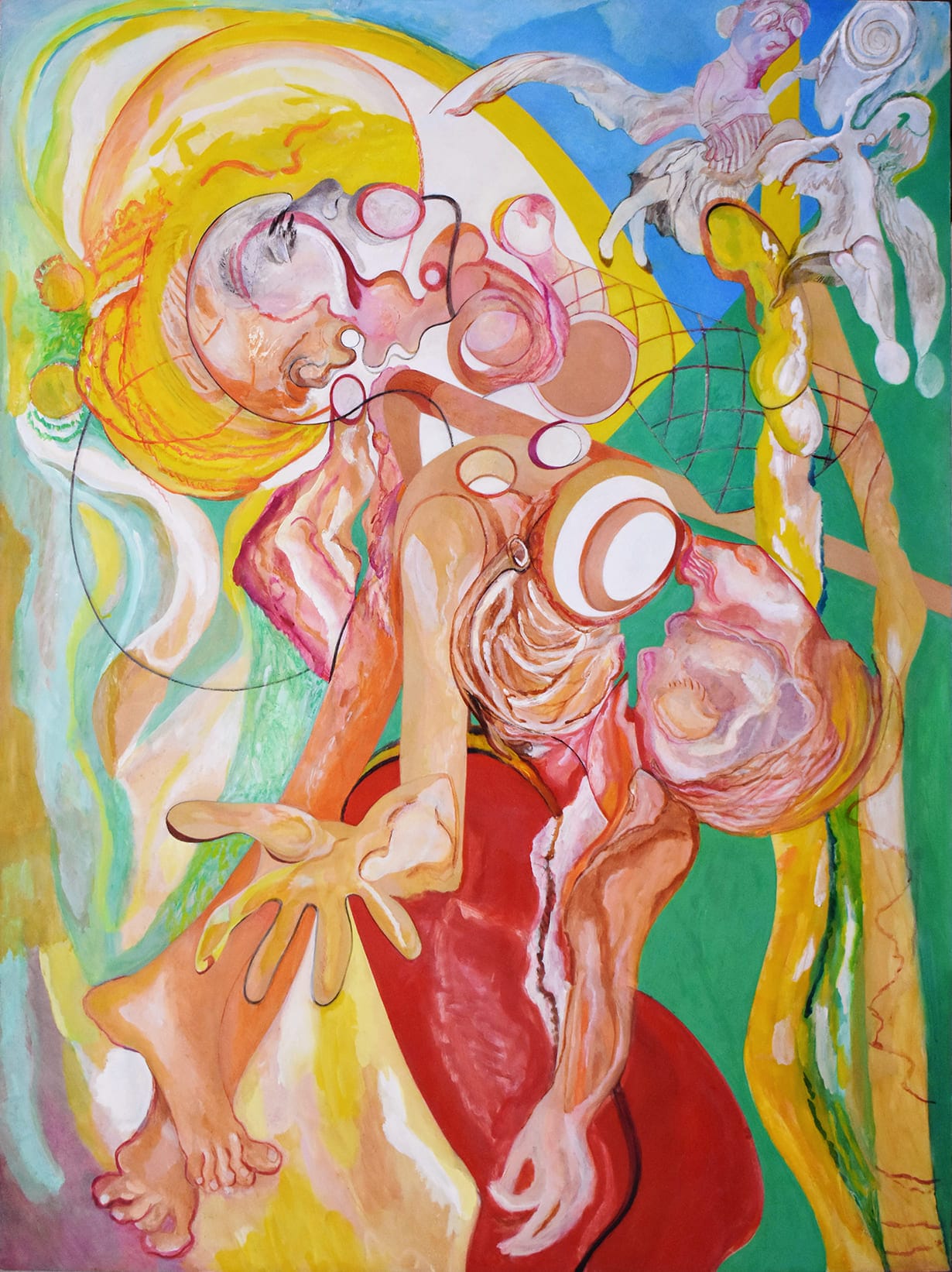
Among De Groot’s works, He Ain’t Heavy, He’s My Brother offers an especially revealing insight into the way his ideas develop. The painting is the result of a creative process that unfolded gradually over many years, bringing together photography, painting, art history, music, personal memories, and philosophical reflection.
De Groot began developing the image in 2009 after encountering the work of American art photographer Philip Trager, born in 1935. A particular photograph depicting a theatre performer made a strong impression on him. The expressive emotion contained within the image became the starting point for an oil sketch on panel.
However, the sketch did not immediately become a finished painting. Instead, it remained in De Groot’s studio, waiting. This period of waiting is characteristic of his creative process. Rather than forcing a work toward completion, he allows it to remain open until intuition and emotion call him back to it.
Years later, another encounter provided a new direction. While looking through his bookcase, De Groot returned to an old favourite, The Works of Picasso: Blue and Rose Periods. His attention settled on Picasso’s 1906 painting of two brothers. The image stayed with him, and he carried its influence back into the studio, where it gradually began to intertwine with the earlier sketch.
The painting was therefore not born from a single moment of inspiration. Instead, it emerged through a layered process in which images encountered years apart became connected. The photograph, Picasso’s painting, and De Groot’s own unfinished work slowly entered into conversation.
When Music Becomes Part of the Painting
Music provided another essential piece of the work’s development. De Groot describes working and listening to music as second nature, and one day, while painting, he was listening to The Hollies’ song He Ain’t Heavy, He’s My Brother.
The song’s message resonated deeply with him. Its familiar phrase originates from a story associated with Father Flanagan and the Boys Town orphanage in the United States. The story tells of a boy carrying a younger child with physical disabilities. When asked whether the child was too heavy to carry, the boy replied, “He ain’t heavy, he’s my brother.”
For De Groot, the words connected with ideas that had been present throughout his life and artistic thinking. The image of one person carrying another became a powerful metaphor for mutual care, responsibility, compassion, and the obligations people have toward one another.
The painting ultimately reflects De Groot’s belief that human beings do not live entirely for themselves. We exist alongside others, connected through relationships and shared responsibilities. Through his art, he seeks not only to express his own experiences but also to invite viewers into a broader reflection on what it means to care for another person.
Childhood Memories and the Weight of Responsibility
The emotional foundation of He Ain’t Heavy, He’s My Brother is also connected to De Groot’s childhood. Growing up as the middle child in a large family taught him from an early age that attention must be shared. The world, he learned, does not revolve around one individual.
This experience contributed to his quiet and observant nature. It also shaped his understanding of responsibility. De Groot believes that older siblings should be attentive to younger ones, sharing responsibilities and offering care when needed. Over time, this childhood perspective expanded into a broader philosophy about society and the ways people should care for one another.
These ideas gradually entered the painting. What began as an image connected to brotherhood became a more complex reflection on the relationship between carrying and being carried, giving and receiving, strength and vulnerability.
Who Carries Whom?
At first glance, He Ain’t Heavy, He’s My Brother may appear to celebrate the uncomplicated act of supporting another person. Yet De Groot’s painting reaches into more complicated territory. The person carrying the other is also placed at risk. The burden may be an expression of love, but it can also become a source of physical and emotional exhaustion.
This tension gives the work its emotional power. Care is essential, but it is not always simple. Compassion can become painful when responsibility is unevenly distributed. Empathy can begin as an act of generosity and, under certain circumstances, become a source of bitterness or strain.
The painting therefore refuses to offer an easy conclusion. Instead, it leaves viewers with a question that extends beyond the image itself: Who carries whom in the end?
That unresolved question captures much of what makes Wim de Groot’s artistic practice compelling. His work grows from observation but reaches toward reflection. Personal memories become universal questions, while influences from photography, painting, music, and lived experience merge into something distinctly his own.
After a lifetime devoted to looking and creating, De Groot continues to explore the fragile connections that hold people together. His art reminds us that behind every gesture of support lies a complex human story, and that sometimes the greatest questions are not about who is strong enough to carry another, but about how we learn to share the weight.

