



Yi Zhu is a contemporary artist whose practice explores the shifting boundaries between life, the body, technology, and systems. Working primarily with oil on canvas, Zhu deconstructs familiar bodily and technological structures, reconstructing them into unstable hybrid forms that exist between the organic and the artificial.
Rather than presenting the human body as a complete and autonomous entity, Zhu approaches it as something continuously evolving, shaped by perception, memory, desire, technology, space, and connection. In his paintings, organs, nerves, conduits, mechanical structures, vegetal forms, and artificial interfaces intersect and penetrate one another, creating visual forms that resist clear categorization.
At the center of Zhu’s artistic practice is a fundamental question: How does life become life?
For the artist, existence does not begin with an already complete individual who then enters into relationships with the world. Instead, life takes shape through connection, exchange, rupture, and reconfiguration. This understanding provides the foundation for his exploration of deconstruction and reconstruction.
Deconstructing the Familiar
For Zhu, deconstruction is not simply the destruction of an existing form. It is a way of questioning structures that are often accepted as natural or fixed.
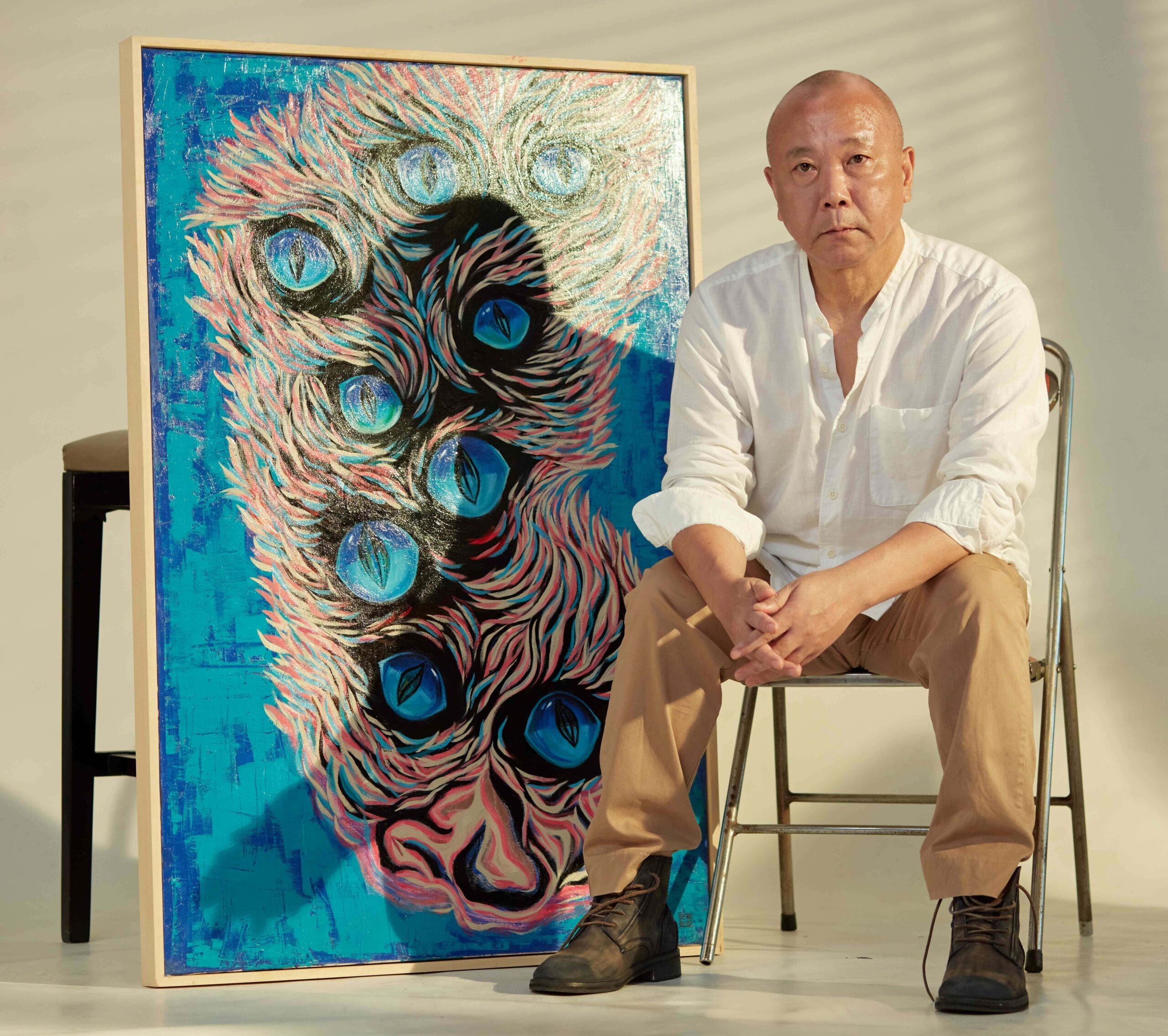
The boundaries of the body, the conventional functions of organs, the distinction between nature and technology, and established ideas about what life should look like all become subjects of investigation within his practice.
When these familiar structures are loosened, the body begins to take on new possibilities. An organ may no longer serve only its traditional function. A conduit can resemble a nerve. A mechanical structure may take on the qualities of living tissue. Natural forms can become embedded within artificial systems, while technological elements appear to behave as though they possess their own organic life.
This creates a sense of instability within Zhu’s paintings, but the instability is intentional. His work does not seek to restore the familiar boundaries it has dismantled. Instead, it explores what might exist beyond them.
The paintings therefore do not depict a world that is already complete. They construct environments that appear to be continuously forming, where identities and structures remain open to change.
From the Body to an Expanding System
Zhu’s practice has gradually moved from depicting the body as an individual form toward imagining existence as a broader system of interconnected relationships.
In this vision, the body has no single center and no completely fixed boundary. Instead, it becomes part of an expanding network in which life, matter, technology, consciousness, and space influence one another.
This perspective reflects the conditions of contemporary life, where human existence is increasingly shaped by systems and technologies that influence how people communicate, perceive, work, and relate to the world.
Technology is no longer simply an external tool. Digital interfaces, networks, and mechanisms of connection have become deeply integrated into everyday experience. Zhu responds to this reality by creating visual forms that blur the distinction between biological and technological structures.
His hybrid forms suggest a world in which the natural and artificial are no longer entirely separate. They exist in a state of mutual influence, producing unfamiliar configurations that challenge conventional ideas of identity and embodiment.
503: Service Unavailable
This exploration of systemic instability is central to Zhu’s ongoing series 503: Service Unavailable.
The title draws from the language of HTTP error codes, transforming a familiar technical message into a metaphor for contemporary human experience. In the digital world, a 503 error indicates that a service is temporarily unavailable. The system has not necessarily disappeared or permanently collapsed. Something has interrupted its ability to function normally.
For Zhu, this condition offers a metaphor for contemporary life.
The body continues to function. Society continues to operate. People remain connected through increasingly complex networks. Yet beneath this apparent continuity, certain capacities may become unavailable. Perception, communication, emotional response, and our ability to experience life fully can all be affected by exhaustion, disconnection, and systemic pressure.
The technical language of system failure thus becomes a way of examining deeper questions about human existence.
What happens when the structures that organize our lives can no longer function according to their original logic?
What happens when the systems we depend upon become exhausted or disconnected?
And what possibilities might emerge when established structures are no longer able to contain the realities they were designed to support?
These questions form the conceptual foundation of 503: Service Unavailable.
Error and the Possibility of Transformation
Within Zhu’s practice, error represents a moment of uncertainty in which established structures are exposed, and their limitations become visible.
The related concept of 500: Internal Server Error points toward a condition in which an existing structure can no longer operate according to its established logic. For Zhu, such a breakdown raises questions about what comes next.
Reconstruction, in this context, does not mean restoring a damaged structure to its previous state. It means allowing new relationships to develop from the conditions created by change.
This idea is reflected in 503: Service Unavailable, created in 2026 using oil on canvas and measuring 80 × 100 cm. The work belongs to Zhu’s ongoing examination of contemporary systems, interruption, and transformation, translating the language of technological failure into a visual exploration of unstable forms and evolving relationships.
The painting can be understood as part of a larger artistic investigation into what happens when established systems become uncertain. Its hybrid structures suggest that the failure of one arrangement may reveal connections that were previously hidden or overlooked.
Rather than offering a clear resolution, Zhu leaves these relationships open, allowing the viewer to encounter a world that is still taking shape.
A New Understanding of Existence
At the heart of Yi Zhu’s practice is the belief that existence is not static.
Rather than defining life through isolated individuals with fixed boundaries, Zhu understands existence through connection. A being becomes what it is not simply because it possesses a complete and independent form, but because it can enter into relationships with other forms of existence.
This philosophy is reflected in the visual language of his paintings.
His hybrid forms connect, penetrate, transform, and exchange with one another. Nothing appears to exist entirely alone. The boundaries between one structure and another become fluid, suggesting that identity itself may be continuously produced through relationships.
This approach also changes the way we understand the body. Instead of a closed physical structure, it becomes a network, a constantly changing system influenced by both internal processes and external connections.
Through this perspective, Zhu’s work moves beyond an examination of anatomy or technology. His paintings become meditations on how existence is formed and how new relationships can alter what something is capable of becoming.
Toward New Forms of Existence
Yi Zhu’s practice invites viewers to reconsider the structures that shape contemporary life. The body, technology, nature, and systems are not presented as separate categories, but as interconnected forces that continually influence and transform one another.
Through deconstruction, Zhu makes familiar structures unfamiliar. Through reconstruction, he explores the possibilities that emerge when those structures are no longer fixed.
His paintings occupy the space between the organic and the artificial, the biological and the technological, the functioning system and the moment of failure. Within this space, forms remain open, and identities remain in motion.
Ultimately, Zhu’s work suggests that existence is not a finished state but an ongoing process. Life is shaped through connection, and new possibilities can emerge when established relationships are disrupted and reconsidered.
The question that begins his practice therefore remains open: How does life become life?
For Yi Zhu, perhaps the answer lies not in the search for a complete or final form, but in the continuous process through which one form encounters another, changes, and becomes something new.

