


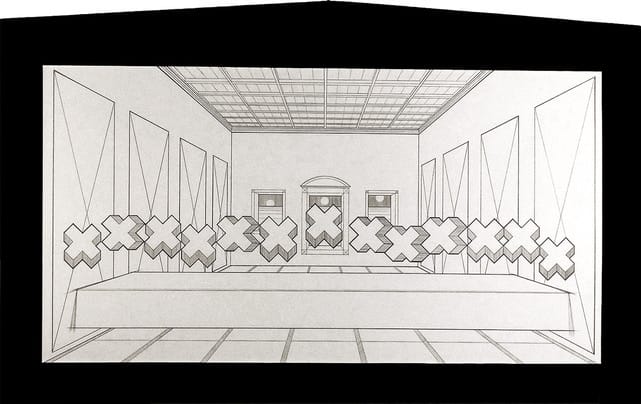
Born in 1938, Leonardo Sideri has spent much of his life moving between disciplines, ideas, and forms of making. His journey encompasses industrial design, architecture, interior design, product development, engineering, drafting, and, later in life, fine art. Rather than following a single, predetermined creative path, Sideri has embraced what he describes as a multidirectional life, driven by curiosity, restlessness, and a belief that drawing can become the foundation for building almost anything.
His philosophy can be summed up simply: “If I can draw it, I can build it.”
Today, based in Hudson, New York, Sideri approaches art through the perspective of a designer and draftsman. His primary medium is pencil on paper, and his work is rooted in an enduring commitment to analogue processes at a time when digital tools have transformed the worlds of design and architecture.
From Industrial Design to Architecture
Sideri earned a degree in Industrial Design at a time when the profession was still relatively unknown. During the 1960s, finding employment as an industrial designer was difficult, particularly in New York, where many job opportunities were advertised through the New York Times. Industrial design positions were so scarce that they rarely appeared in the newspaper.
There was another challenge. Industrial designers were expected to present impressive portfolios, and Sideri did not yet have the kind of portfolio that could open those doors. Even before graduating, he had begun questioning whether his degree would lead him toward the professional life he wanted.
His real interests were architecture and interior design. He therefore expanded his portfolio to include architectural work and began approaching architectural offices, presenting himself as an interior designer and industrial designer.
That decision eventually led him to Skidmore, Owings & Merrill, better known as SOM, in New York. Sideri describes getting the position largely as an act of luck. He filled out an application, and the firm hired him.
What followed would have a lasting influence on his creative development.
Discovering Design Intelligence at SOM
When Sideri joined SOM, the design world was entering an era increasingly associated with the idea of “Total Design.” Architecture was no longer necessarily limited to the structure of a building. Designers were becoming involved in the interiors and objects within those spaces as well.
At SOM, this meant working on an extraordinary range of elements, from ashtrays to boardroom tables and everything in between.
For Sideri, this environment became an education in what he calls “design intelligence.” It also strengthened his abilities as a designer-draftsman. Drawing was not merely a method of communicating an idea; it was a way of thinking, solving problems, understanding proportion, and translating imagination into something that could ultimately be constructed.
That relationship with drafting has remained central to his creative identity throughout his life.
Choosing Analogue Over CAD
While technology has transformed professional design, Sideri has remained committed to analogue drafting. He never wanted to trade the physical experience of drafting for computer-aided design.
For him, pencil and paper possess a directness that digital tools cannot completely reproduce. The line becomes evidence of the artist’s hand, thought, and movement. It is both technical and expressive.
This commitment became particularly important when Sideri began exploring fine art later in life. Rather than abandoning his decades of experience as a draftsman, he transformed it into the foundation of a new artistic practice.
The Inspiration of Sol LeWitt
At the age of 75, Sideri made a significant transition, moving from designer toward artist. A visit to the Dia Beacon museum in Beacon, New York, became a pivotal moment.
There, he encountered an installation by Sol LeWitt featuring pencil drawings covering large white walls. The simplicity and scale of the work immediately resonated with Sideri.
LeWitt’s relationship with drafting was particularly meaningful to him. The work reminded Sideri of architectural working drawings and specifications, where an artist or architect can create a system that others can follow and reproduce.
For Sideri, this represented a powerful connection between architecture and art. The drawing could function as both an artwork and a set of instructions, much like an architectural plan can be transformed into a physical structure.
The installation gave Sideri the inspiration to revisit an idea he had developed decades earlier.
From the Mayline to Drawall
In the 1980s, Sideri had worked with a Mayline drafting system on a horizontal surface. He began wondering whether the same concept could be adapted to a vertical wall.
The answer was yes.
He developed a device that allowed drafting directly onto a wall. The concept eventually became known as Drawall.net.
However, the invention spent years in storage because Sideri had not yet determined what he wanted to draw on such a large scale. The experience at Dia Beacon in 2013 provided the missing inspiration.
He returned to the idea and began creating large-scale drawings.
One of the distinctive characteristics of this approach is the way graphite residue falls away from the wall rather than accumulating heavily on the surface. The result is a remarkably clean background and a crisp quality of line, making the process particularly suited to full-scale drawings.
For Sideri, Drawall represents more than a personal drawing instrument. He sees it as a potential new tool for the art world and perhaps even a new genre of artistic practice.
The “X” and the Human Condition
Sideri’s artistic language developed around a recurring “X” motif. The symbol draws from the familiar X seen on legal documents and forms as a representation of “man.”
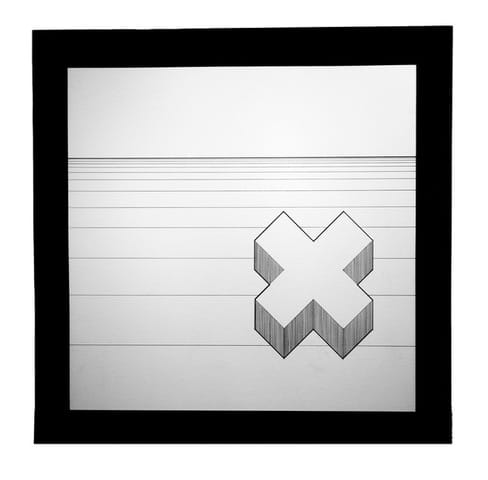
But within Sideri’s work, the symbol becomes something more expansive.
His favorite piece, “Man Alone,” explores the universal experience of loneliness. Through a simple geometric form, Sideri addresses an increasingly recognizable human condition: the feeling of isolation within contemporary society.
The simplicity of the imagery is intentional. Rather than relying on elaborate visual effects, he allows line, scale, space, and symbolism to carry the meaning.
Art, Invention, and the Future of Drawall
Sideri’s work reflects a continuous dialogue between invention and artistic expression. His background as an industrial designer naturally leads him to consider not only what an artwork can communicate but also how it can be created.
This is why Drawall remains important to his practice. He hopes the tool can eventually move beyond his own work and be adopted by other artists, allowing them to explore large-scale analogue drawing in new ways.
His small body of artwork serves, in part, as a demonstration of the possibilities he sees within the medium.
There is something characteristically Sideri about this approach. He does not simply create an artwork; he develops a method, questions its potential, and considers what others might build from it.
A New Chapter in Hands, Light, and Objects
As the physical demands of large-scale drafting have become more difficult, Sideri has continued to explore other creative outlets. His practice has expanded into what some might describe as folk art, including cast-plaster hands finished in a variety of ways.
Glitter has become one of his newer materials, bringing an unexpected decorative quality to these sculptural works.
He has also returned to his industrial design instincts through the creation and engineering of a new lamp. The object functions both as a wall-mounted sconce and as a table lamp, combining practical function with sculptural design.
These later works demonstrate that Sideri’s creativity has never depended on a single medium. Whether working with pencil, plaster, light, or engineered objects, he remains fundamentally a designer and maker.
A Life Built Through Drawing
Sideri’s artistic story cannot be separated from his professional history. Architecture taught him structure. Industrial design taught him problem-solving. Drafting taught him precision. Invention taught him to question how things could work differently. Fine art gave him a new space in which to bring all of those experiences together.
His journey also includes the creation of KeySure.net, a product he developed in 1982 that supported him through many of his subsequent endeavors and remains an active part of his life.
Now living in Hudson, Sideri continues to look at creativity through the eyes of an inventor, draftsman, and artist. His work is ultimately less about choosing between art and design than demonstrating how naturally the two can coexist.
At the heart of his practice is a belief in the enduring power of the hand-drawn line. In an increasingly digital world, Leonardo Sideri has chosen to defend the analogue process not as nostalgia, but as a living creative language. His pencil drawings, inventions, sculptures, and functional objects all emerge from the same impulse: to draw, to build, to experiment, and to discover what might be possible when an idea is given physical form.

