


Jean-Pierre Baud was born in France in 1953 and developed an interest in photography at a very young age. Like many artists driven by instinct rather than formal instruction, he taught himself the craft through curiosity, experimentation, and observation. Photography became more than a technical skill for him; it evolved into a way of understanding humanity and documenting the fleeting moments that often go unnoticed in everyday life.
Although photography had long been part of his personal journey, it was after his retirement in Nantes in 2015 that Baud fully immersed himself in digital photography. This new chapter allowed him to dedicate significant time to refining his visual language and exploring the world with renewed artistic freedom. Since then, his camera has become an extension of his perspective, capturing the pulse of cities, the rhythm of movement, and the emotional textures hidden within urban spaces.
Today, Baud’s work reflects years of observation and sensitivity toward human behavior. His photographs are not merely visual records; they are emotional interpretations of life unfolding in public spaces. Whether photographing crowded streets in France or scenes encountered abroad, he focuses on the interactions between individuals and their surroundings, revealing the invisible dialogue between people and architecture.
Humanity at the Center of the Urban Landscape
At the core of Jean-Pierre Baud’s photography lies a deep fascination with humanity in all its diversity. His preferred medium, street photography, allows him to observe spontaneous interactions without artificial staging or intervention. In his images, strangers become protagonists of silent narratives shaped by movement, emotion, and environment.
Urban settings play a vital role in his artistic vision. Cities are not presented as cold structures of concrete and steel; instead, they become living organisms animated by the people who pass through them every day. Baud’s photographs explore how individuals coexist with urban architecture, how they adapt to crowded environments, and how fleeting gestures can transform ordinary spaces into poetic moments.
His work often highlights contrasts: solitude within crowds, speed against stillness, anonymity alongside individuality. Through careful composition and timing, he captures the subtle choreography of daily life. A passerby crossing a station platform, commuters rushing through tunnels, or silhouettes dissolving into city lights all become part of a broader reflection on contemporary human existence.
This ability to transform everyday scenes into emotionally resonant imagery is what distinguishes Baud’s photography. He does not seek spectacle; instead, he uncovers beauty within ordinary movement and transient encounters.
Underground Human Vibrations: A Dreamlike Urban Symphony
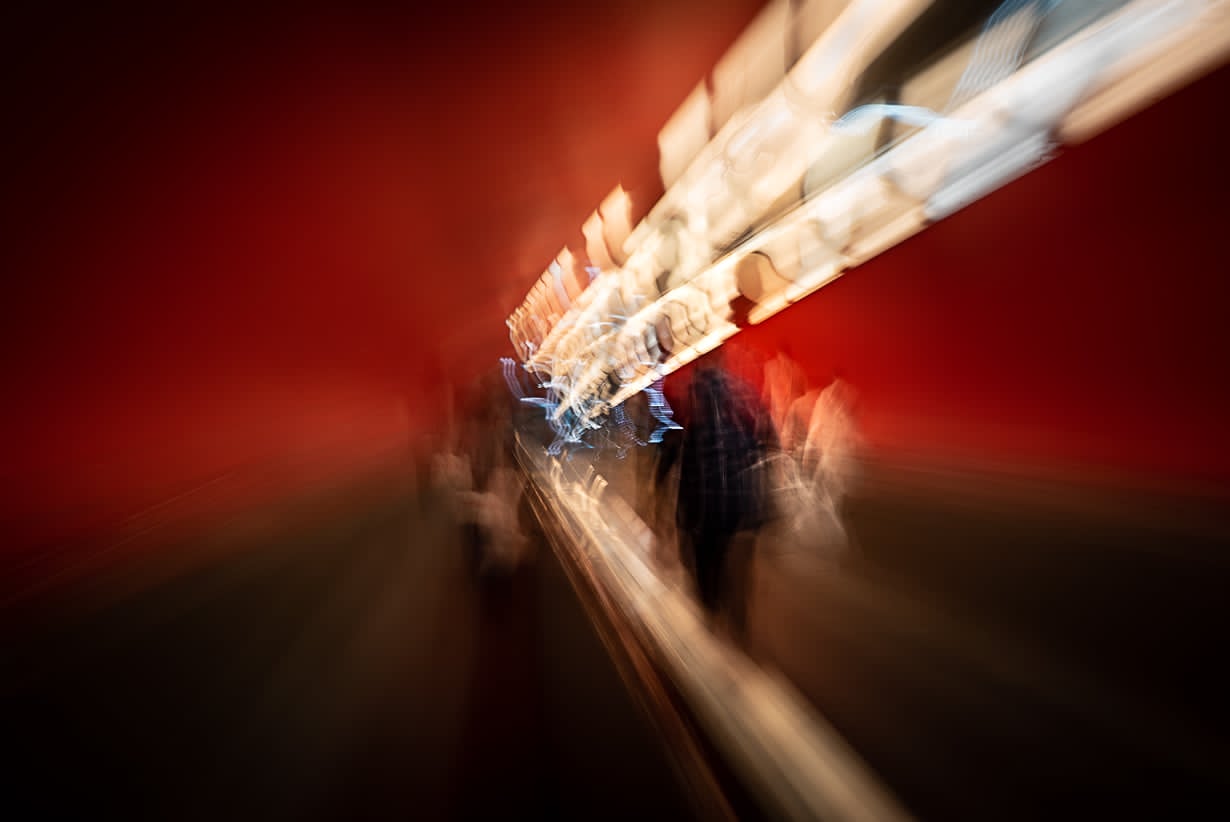
One of Baud’s most compelling works, Underground Human Vibrations, perfectly embodies his artistic philosophy. Set within the corridors of the Paris metro, the series transforms a familiar urban environment into a poetic exploration of movement, color, and human energy.
The Paris metro is traditionally associated with speed, routine, and anonymity. Travelers move rapidly through underground corridors, often disconnected from their surroundings and focused solely on reaching their destinations. Baud reimagines this environment through the lens of artistic abstraction. Rather than freezing motion with sharp precision, he intentionally embraces blur and fluidity through the use of slow shutter speed photography.
This technical decision becomes central to the emotional power of the work. Faces lose their exact features, bodies merge into streams of movement, and figures appear almost ghostlike as they pass through the station corridors. The result is a dreamlike visual experience where reality becomes softened and transformed.
In Underground Human Vibrations, human beings become an integral component of urban architecture itself. Travelers are no longer separate from the metro environment; instead, they merge with the decorative walls, lights, and textures surrounding them. The boundaries between people and place dissolve, creating images that feel both dynamic and poetic.
The blurred movement also symbolizes the transient nature of modern urban life. In cities, encounters are often brief and anonymous. Thousands of people cross paths without truly seeing one another. Baud captures this phenomenon not with cold detachment, but with empathy and artistic sensitivity. His photographs suggest that even within the chaos of crowded transit systems, there exists an underlying rhythm and beauty.
The colorful tones within the series further enhance its emotional atmosphere. Vibrant wall decorations and artificial metro lighting blend with moving silhouettes to create compositions that resemble paintings more than traditional documentary photography. This fusion of abstraction and realism invites viewers to pause and contemplate the emotional layers hidden within ordinary urban experiences.
The Artistic Power of Slow Shutter Photography
Baud’s use of slow shutter speed is not merely a stylistic experiment; it is a conceptual tool that reflects his understanding of movement and time. In conventional street photography, photographers often aim to capture decisive moments with sharp detail. Baud moves in a different direction. He embraces imperfection, motion blur, and visual ambiguity as a way to communicate emotional truth rather than literal representation.
This technique introduces a sense of fluidity into his images. Instead of isolated frozen moments, viewers experience continuous motion and evolving energy. The city becomes alive, vibrating with invisible currents created by human presence.
The blurred figures in Underground Human Vibrations also evoke memory and imagination. Because faces and forms are partially obscured, viewers are encouraged to project their own emotions and interpretations onto the images. The photographs become open-ended narratives rather than fixed stories.
In many ways, Baud’s work challenges the modern obsession with clarity and precision. By allowing movement to distort the image, he reveals something deeper about urban existence: life is constantly shifting, unstable, and impossible to fully control. His photographs embrace this uncertainty and transform it into visual poetry.
International Recognition and Artistic Presence
Beyond his personal artistic exploration, Jean-Pierre Baud actively shares his work with audiences through exhibitions and international photography competitions. His participation in solo and group exhibitions reflects the growing recognition of his unique visual language within contemporary photography circles.
Through his online platforms and ongoing projects, he continues to expand his artistic dialogue with viewers around the world. His website and social media presence provide insight into an evolving body of work dedicated to observing humanity through an empathetic and artistic lens.
What makes Baud’s photography particularly compelling is its universality. While many of his images are rooted in specific locations such as the Paris metro, the emotions they evoke transcend geography. Movement, isolation, connection, routine, and urban coexistence are experiences shared across cultures and cities worldwide.
Capturing the Invisible Poetry of Everyday Life
Jean-Pierre Baud’s photography reminds us that art can emerge from the most ordinary environments. In crowded metro stations, busy streets, and fleeting urban encounters, he discovers moments of quiet beauty and emotional resonance. His work encourages viewers to slow down and reconsider spaces they might otherwise ignore.
Through Underground Human Vibrations, Baud transforms the Paris metro into a living canvas where architecture and humanity merge into a poetic visual symphony. The blurred figures moving through colorful corridors become symbols of modern existence itself — transient, interconnected, and constantly in motion.
Rather than documenting reality in a literal sense, Baud captures the emotional atmosphere of urban life. His photographs exist somewhere between reality and dream, between observation and imagination. In doing so, he reveals the hidden vibrations that connect people to the spaces they inhabit every day.

