


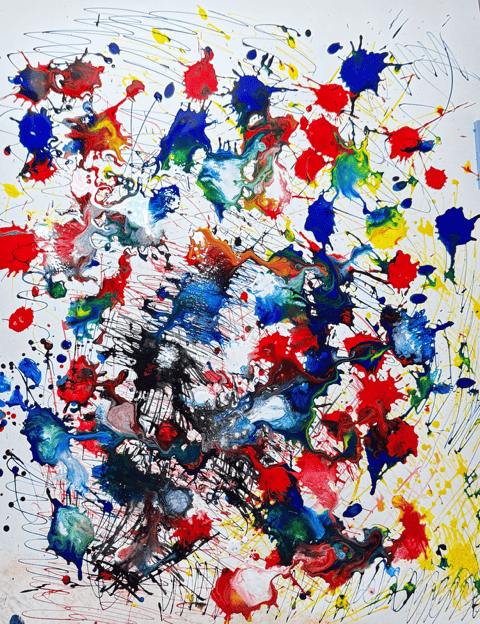
Andrew Freeman is an emerging contemporary artist whose emotionally charged abstract paintings confront themes of psychological instability, fractured memory, emotional confinement, and the fragile nature of perception. Based in Houston, Freeman has developed a body of work that feels both deeply personal and unsettlingly universal. Through layered mixed media surfaces, aggressive color relationships, fragmented structures, and symbolic architectural imagery, he creates paintings that operate like emotional environments rather than static compositions.
Freeman’s work exists in the space between abstraction and psychological narrative. His paintings do not simply depict emotions; they immerse the viewer inside unstable mental landscapes where memory collapses, structures dissolve, and perception becomes uncertain. The result is a visual language that feels haunting, intense, and deeply introspective.
His artistic practice reflects a broader investigation into the unconscious mind and the emotional residue left behind by trauma, isolation, and psychic tension. Every composition appears to hold traces of hidden stories, fragmented recollections, and unresolved psychological states.
The Influence of Literature and Psychological Suspense
A defining characteristic of Freeman’s work is the strong literary influence that shapes his visual approach. Writers such as Sylvia Plath, Megan Abbott, Patricia Highsmith, and Lois Duncan have played an important role in informing the emotional atmosphere surrounding his paintings.
Like Plath’s poetry, Freeman’s work often explores confinement, psychological pressure, and emotional fragmentation. From Highsmith and Abbott comes a sense of tension, paranoia, and hidden danger, while Duncan’s influence can be felt in the uncanny emotional energy that appears throughout his imagery.
These literary inspirations allow Freeman to create paintings that feel cinematic and psychologically layered. Rather than offering clear narratives, his compositions resemble moments suspended between dream and reality. Viewers are encouraged to interpret shifting symbols and emotional clues in their own way.
This connection to literature gives Freeman’s paintings a narrative depth rarely found in purely abstract work. His canvases function almost like psychological novels translated into color, texture, and spatial disruption.
Themes of Emotional Lockdown and Fractured Memory
Many of Freeman’s paintings explore what might be described as emotional lockdown, the internal experience of feeling trapped within one’s own thoughts, memories, or psychological states. His compositions frequently suggest enclosed spaces, blocked passages, divided rooms, or collapsing structures that mirror emotional confinement.
Recurring motifs such as glowing windows, fragmented figures, surveillance-like grids, and unstable architectural forms reinforce this atmosphere of tension and uncertainty. These images appear repeatedly throughout his work, acting as symbolic fragments that point toward themes of observation, isolation, fear, and transformation.
Freeman’s paintings often feel like incomplete memories reconstructed through emotional distortion. Layers of paint and mixed media obscure and reveal information simultaneously, creating surfaces that resemble damaged recollections or unstable mental images. This fragmented approach reflects the way trauma and memory frequently operate, partial, distorted, and emotionally charged.
His interest in psychic perception, divination, religious vision, and ascension further deepens the psychological complexity of the work. Rather than approaching these themes literally, Freeman uses them as metaphors for heightened emotional awareness and altered states of consciousness.
The result is artwork that feels deeply immersive and emotionally raw, inviting viewers to confront instability, uncertainty, and vulnerability within themselves.
Mixed Media and Material Experimentation
Freeman’s practice extends beyond traditional painting techniques. His work incorporates collage materials, sculptural textures, layered surfaces, and unconventional media that blur the line between painting and installation.
These physical textures play an essential role in communicating emotional intensity. Thick accumulations of material create surfaces that appear wounded, eroded, or unstable. Collaged fragments interrupt visual continuity, reinforcing themes of fractured memory and disrupted perception.
The aggressive use of color is another defining element of his visual language. Freeman often juxtaposes harsh tones with dark atmospheric fields, creating tension between attraction and discomfort. His compositions feel volatile and unstable, as if they are constantly shifting under emotional pressure.
This combination of abstraction, texture, and material experimentation allows Freeman to construct environments that feel psychologically alive. The paintings become more than images; they become emotional experiences.
Structures hallucinated and the Collapse of Stability
One of Freeman’s significant works, Structures hallucinated, reflects many of the themes central to his artistic practice. The title itself suggests instability, illusion, and altered perception. Structures, symbols of order, safety, and permanence, become hallucinated, uncertain, and psychologically distorted.
The work embodies Freeman’s fascination with collapsing environments and fractured realities. Architectural imagery within his paintings rarely appears stable. Walls divide, interiors fragment, and spaces seem suspended between construction and destruction.
In Structures hallucinated, viewers encounter an atmosphere where reality appears emotionally altered rather than physically grounded. The painting functions almost like a visual manifestation of anxiety or memory distortion. Its fragmented composition and layered materiality reinforce the sensation that the viewer is witnessing a mental or emotional landscape rather than a literal scene.
The artwork captures Freeman’s ability to transform abstraction into psychological storytelling without relying on direct representation.
Artistic Development and Exhibition History
Freeman continues to refine his practice as a current student at the Glassell School of Art in Houston. His education has provided an important foundation for experimentation, critique, and conceptual development within his evolving body of work.
He has participated in numerous exhibitions and student programs that demonstrate his growing presence within contemporary art spaces. These include exhibitions at Art League Houston and the Glassell School of Art’s Kinder Morgan exhibitions.
His recent exhibition history includes:
- Spring Fling, Art City Chicago, Chicago, 2026
- Fresh Terrain, Chicago Fine Art Salon, Chicago, 2025
- The Five Senses: Smell, Vision, Glassell School of Art, Kinder Morgan Exhibitions, 2025
- Student Exhibitions and Critiques, Glassell School of Art, Houston, 2024–2026
- Student Exhibition, Art League Houston, Houston, 2024
- Corporate Exhibitions, Kinder Morgan, Houston, 2024–2025
- Chicago Fine Art Salon, 2023
These exhibitions reveal an artist actively building momentum while continuing to experiment with increasingly ambitious emotional and conceptual themes.
Beyond Painting: Multimedia and Creative Expansion
Freeman’s creative work extends beyond visual art into music, writing, and multimedia projects. His Closing Cell music projects and fragmented literary works demonstrate a multidisciplinary approach rooted in emotional exploration and introspection.
This broader creative practice helps explain the cinematic and narrative quality of his paintings. His work often feels connected to sound, memory fragments, and psychological storytelling rather than isolated visual composition alone.
By moving fluidly between mediums, Freeman creates a larger artistic universe centered around emotional intensity, perception, and the unconscious mind.
A Rising Presence in Contemporary Abstraction
Andrew Freeman represents a new generation of abstract artists who use emotional vulnerability and psychological depth as central elements of their practice. His work refuses decorative simplicity and instead confronts viewers with instability, introspection, and unresolved tension.
Through fragmented structures, layered textures, literary influence, and emotionally charged abstraction, Freeman transforms personal struggle into compelling visual language. His paintings ask viewers to navigate uncertainty, memory, and perception while questioning the stability of the spaces, both physical and psychological, that surround them.
As his practice continues to evolve through exhibitions, experimentation, and interdisciplinary projects, Freeman is establishing a distinctive artistic voice within contemporary abstraction. His work stands as both an exploration of inner experience and a meditation on the fragile architecture of the human mind.

