


Ashley Gray (b. 1986) is a British contemporary artist whose practice occupies a compelling space between digital technology, painterly abstraction, psychology, and existential philosophy. Working through a synthesis of 3D digital modelling and painterly approaches, Gray creates visually striking works that explore some of the most universal and complex aspects of human experience.
His artistic journey has been shaped by an interest in both technology and visual expression. Holding a Master’s degree in Computer Games Art from Teesside University, Gray brings an understanding of computational processes and digital environments into a practice that is ultimately deeply human. Rather than treating technology simply as a tool for producing images, he uses it as a means of questioning how people understand themselves, one another, and the world around them.
Gray’s work frequently considers emotional states that are difficult to articulate through conventional representation. Grief, isolation, vulnerability, hope, and the search for meaning all emerge as recurring themes. Through digital figures that appear to exist somewhere between formation and disappearance, he creates images that feel simultaneously tangible and elusive.
Figures in States of Emergence and Dissolution
One of the defining characteristics of Gray’s oeuvre is his treatment of the human figure. His subjects often appear faceless, fragmented, glowing, or partially dissolved, removing many of the identifying features traditionally associated with portraiture.
This deliberate ambiguity allows the figures to become more universal. They are not necessarily portraits of individual people, but representations of emotional and psychological experiences shared by humanity. By reducing the figure to essential forms, Gray encourages viewers to project their own memories, emotions, and interpretations onto the work.
The tension between emergence and dissolution is particularly significant. A figure appearing from darkness may suggest the formation of identity, consciousness, or hope, while a dissolving figure can evoke loss, uncertainty, mortality, or the gradual transformation of the self.
These opposing states create an important tension within Gray’s work. His figures can appear vulnerable while simultaneously possessing an unusual sense of resilience. They seem to exist on a threshold between presence and absence, reality and imagination, physicality and abstraction.
“Ethereal Blue” and the Light Within Darkness
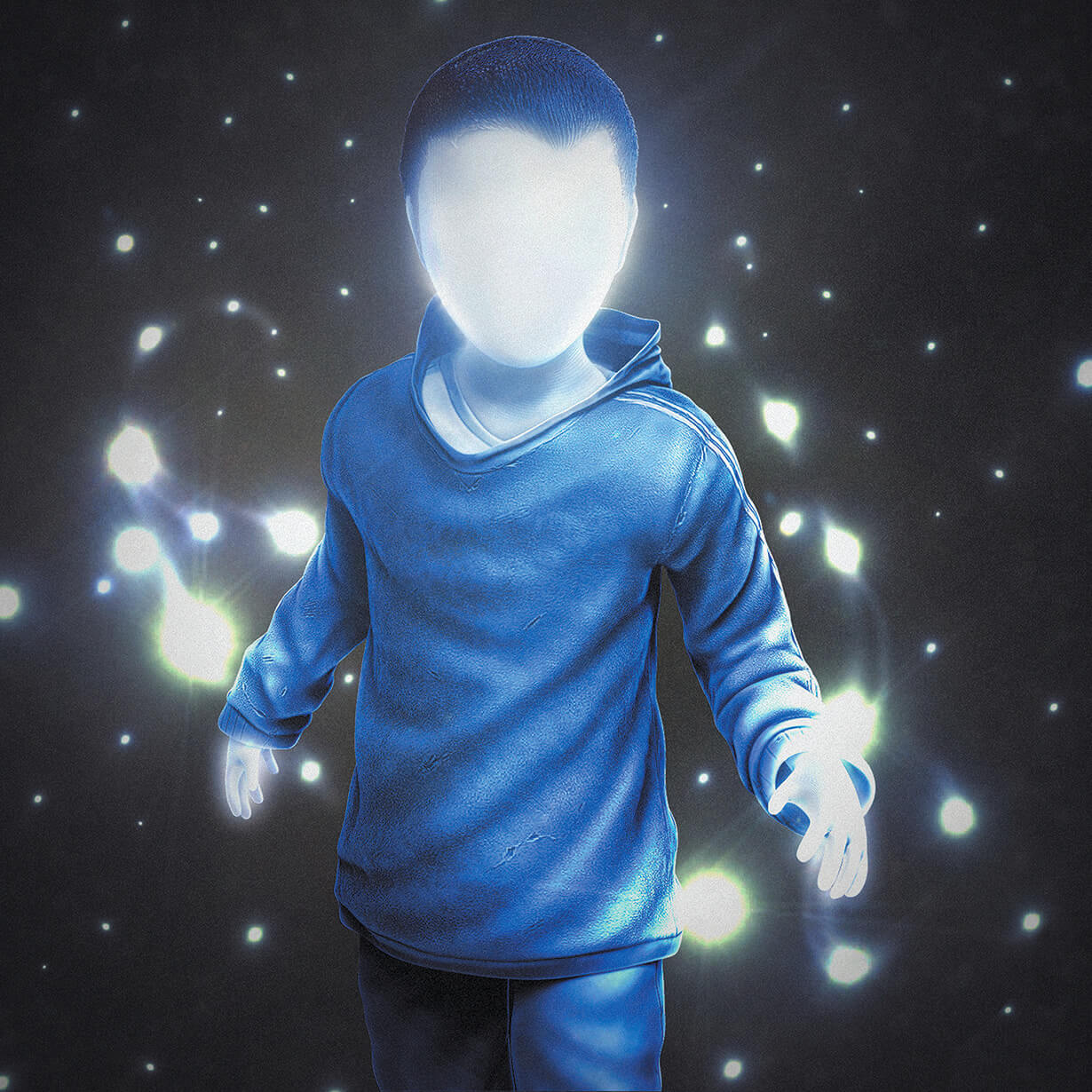
A powerful example of Gray’s approach is Ethereal Blue (2015), a work depicting a faceless, glowing figure dressed in a blue hoodie and surrounded by the immense darkness of space.
At first glance, the image presents a striking contrast: a solitary human presence positioned against an apparently infinite void. Yet the darkness does not simply function as a symbol of emptiness. Instead, it creates the conditions for the figure’s light to become visible.
The glowing figure can be understood as a reflection on the human spirit, bringing light into both the darkness of space and the darkness that can exist within humanity itself. Its faceless quality makes the figure open-ended and universal, allowing the viewer to see it not as a specific individual but as a representation of human potential.
The work ultimately carries a message of hope. Within an environment defined by darkness and isolation, the figure continues to emit light. That light becomes a metaphor for humanity’s enduring capacity for possibility, resilience, and connection.
The idea of common unity is equally important. Although the figure appears alone, its anonymity allows it to represent something shared. The work suggests that beneath individual identities and experiences, people remain connected through universal emotions and the common challenges of being human.
Digital Processes with a Painterly Sensibility
Gray’s background in Computer Games Art provides an important foundation for his technical approach. His knowledge of 3D modelling and computational methodologies enables him to construct environments and figures that would be difficult to achieve through traditional methods alone.
However, the technology in Gray’s work does not overshadow its emotional character. Instead, digital modelling becomes part of a broader visual language that incorporates painterly abstraction.
This combination creates an interesting balance between precision and ambiguity. Three-dimensional modelling can provide structure, depth, and spatial definition, while abstraction introduces uncertainty and emotional openness. The result is imagery that can feel highly constructed while still retaining a sense of spontaneity and psychological depth.
Gray’s practice demonstrates how digital tools can be used not simply to create futuristic imagery, but to explore timeless questions. Technology becomes a pathway into discussions about identity, emotion, existence, and the fragile nature of human experience.
Investigating Grief, Isolation, and Vulnerability
At the heart of Gray’s practice is a sustained investigation into the complexities of human psychology. His work does not avoid difficult emotional experiences. Instead, it gives visual form to feelings that can often remain invisible.
Grief, for example, can be understood as both a deeply personal and universal experience. Isolation can exist physically, socially, or psychologically. Vulnerability can represent weakness, but it can also be the starting point for empathy and connection.
Gray’s figures embody these contradictions. They can appear isolated within expansive environments, yet their presence creates a sense of emotional communication between the artwork and the viewer. They may seem fragile, yet they continue to exist, glow, emerge, or transform.
This approach gives his work a contemplative quality. Rather than providing straightforward answers, Gray creates spaces in which viewers can pause and consider their own experiences.
Art, Existential Philosophy, and the Search for Meaning
Gray’s practice is particularly compelling because it connects visual experimentation with existential questions. His work asks viewers to consider what it means to exist, to experience loss, to search for identity, and to maintain hope in uncertain circumstances.
The vastness of space that appears in works such as Ethereal Blue can be read as a metaphor for the existential condition itself. Against an immense and seemingly indifferent universe, the individual can appear incredibly small. Yet Gray’s glowing figures suggest that smallness does not mean insignificance.
A single point of light can transform an otherwise dark environment. In this sense, Gray’s art presents existence not simply as a confrontation with uncertainty, but also as an opportunity for meaning, connection, and possibility.
Recognition and International Acclaim
Gray’s conceptual and technical approach has received significant recognition internationally. His achievements include receiving the Premier Artist Prize in both 2025 and 2026, demonstrating continued recognition of his contribution to contemporary art.
His work has also been selected for Editors’ Choice by CGSociety in 2011 and 2017, highlighting his ability to work at a high level within the field of digital art and 3D visual practice. In 2024, Gray received Creativepool’s People’s Choice award in his category, further reflecting the impact of his work among creative audiences.
These recognitions form an important part of a broader artistic trajectory in which Gray has continued to explore the possibilities created by the intersection of technology and contemporary art.
A Contemporary Vision of the Human Experience
Ashley Gray’s work demonstrates that digital art can be deeply philosophical, emotional, and human. By combining 3D digital modelling with painterly abstraction, he creates a visual language capable of addressing experiences that transcend time, culture, and individual identity.
His faceless figures, dissolving forms, glowing bodies, and expansive environments become vessels for larger questions. They speak of grief and isolation, but also of resilience. They explore vulnerability while suggesting strength. They confront darkness while repeatedly searching for light.
Ethereal Blue remains a particularly clear expression of this philosophy. The solitary illuminated figure surrounded by darkness becomes more than an image of isolation. It becomes an image of possibility. Its light suggests that even within uncertainty, humanity retains the capacity to hope, connect, and imagine something beyond the present moment.
Through this balance of technological innovation and emotional introspection, Gray continues to develop a practice that challenges the boundaries between digital art, abstraction, and contemporary figurative expression. His work ultimately reminds viewers that technology can be more than a medium for creating new images. It can also be a means of examining the oldest questions humans continue to ask about themselves and their place in the world.

