


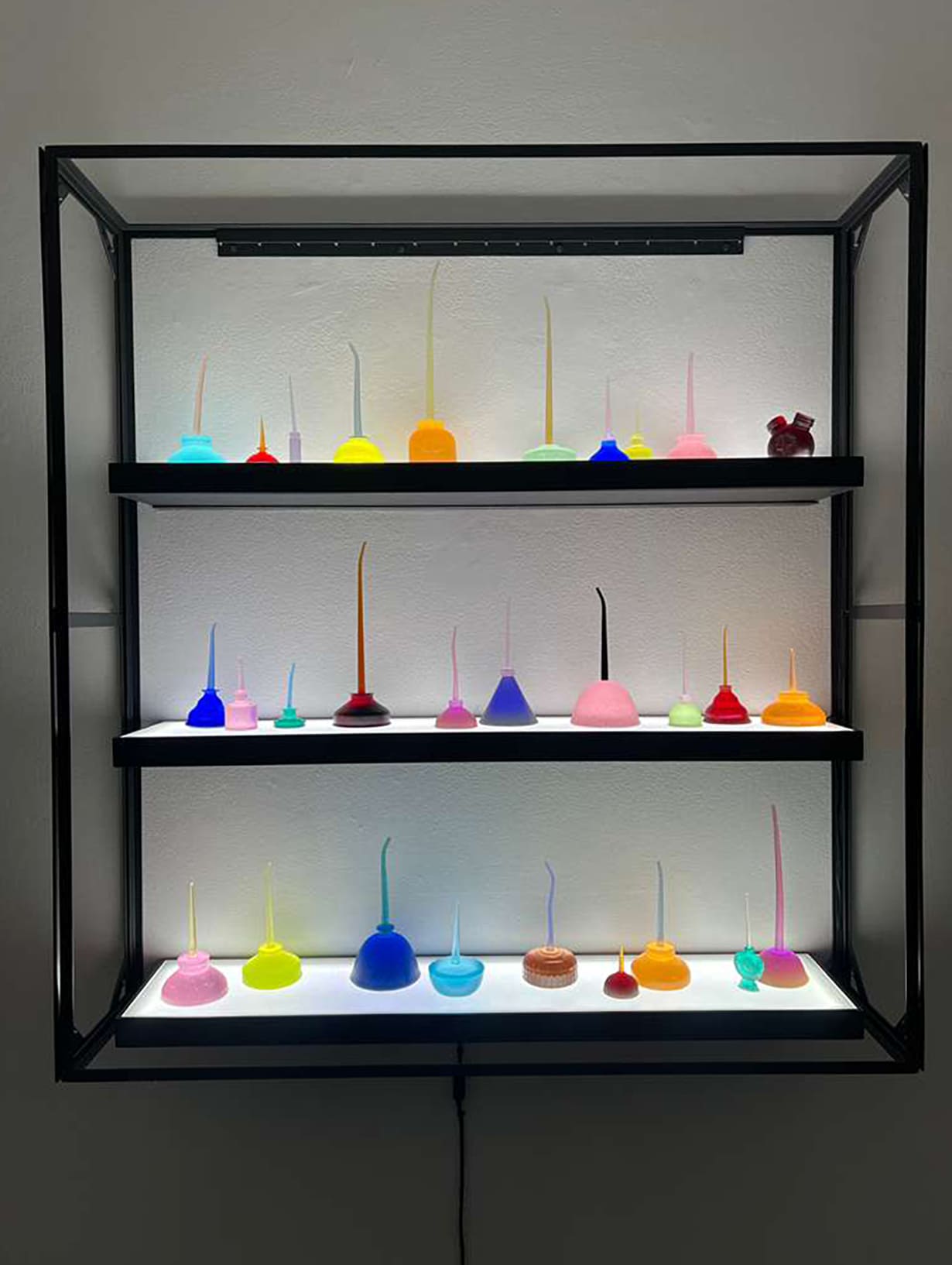
Katherine Jackson is a Brooklyn-based artist whose work moves fluidly between glass, light, technology, and drawing. Her artistic practice is rooted in experimentation, combining traditional craftsmanship with contemporary media to create immersive visual experiences. Over the years, Jackson has developed a distinctive language that transforms everyday materials into poetic reflections on history, memory, and perception.
Her work is not confined to a single medium or format. Instead, she embraces a multidisciplinary approach, allowing her ideas to evolve organically across installations, vitrines, and public art projects. This openness has enabled her to engage audiences in a deeply sensory way, where light becomes both a material and a metaphor, and objects become vessels of meaning.
A Global Exhibition Presence
Jackson’s work has been exhibited extensively across the United States and internationally. From museums and galleries to universities and public spaces, her installations have reached diverse audiences in cities such as New York, Berlin, Rome, Venice, and locations across Japan. This wide-ranging exposure reflects both the universality of her themes and the adaptability of her artistic approach.
Among her most notable achievements are two large-scale, long-term public exhibitions commemorating the 100th anniversaries of two iconic New York City landmarks, the 42nd Street New York Public Library and the Manhattan Bridge. These projects demonstrate her ability to work within public contexts, creating art that resonates not only aesthetically but also historically and culturally.
In addition, Jackson received a grant for a six-month light and glass installation at New York’s Tenement Museum. This project addressed themes of immigration, using the museum’s windows as a canvas to explore stories of movement, identity, and belonging. By integrating her work into a site deeply connected to immigrant history, she created a dialogue between past and present, personal and collective narratives.
Recognition and Recent Exhibitions
Jackson’s vitrine installations have gained significant recognition in recent years. Her work has been featured at major international events such as the Venice Architectural Biennale 2021 and the Venice Art Biennale 2022, where her innovative use of glass and light captured the attention of global audiences.
Her installations have also been shown in academic and institutional settings, including Southern Connecticut State University. More recently, her work was included in the 2024 Volta Art Fair and the Brooklyn Museum’s 200th Anniversary Brooklyn Artists Exhibition. These exhibitions highlight her continued relevance and evolution as an artist, as well as her ability to engage with both contemporary art discourse and broader cultural conversations.
The Language of Vitrine Installations
At the core of Jackson’s practice lies her exploration of vitrines, glass-enclosed displays that blur the line between object and artifact. Traditionally associated with museums and archives, vitrines suggest preservation, value, and historical significance. Jackson reinterprets this format, transforming it into a dynamic space where light, material, and meaning intersect.
Her vitrines are not static displays but living compositions. Through the interplay of illumination and transparency, she creates environments that shift with the viewer’s perspective. Lightboxes play a crucial role in this process, casting a glow that enhances the material qualities of glass while also evoking a sense of reverence and introspection.
The 2026 Installation Relics of an Industrial Imagination
In her recent 2026 vitrine installation, Jackson continues to build on themes present in her earlier works while introducing new layers of complexity. The installation features solid glass casts of vintage oil cans, each one unique. These objects, once commonplace tools of an industrial era, are reimagined as luminous sculptures.
Set atop lightboxes, the glass oil cans emit a soft, internal glow. This illumination transforms them from utilitarian objects into almost sacred forms, relics that invite contemplation. Their individuality, no two alike, underscores the artist’s attention to detail and her commitment to preserving the uniqueness of each object’s history.
Nostalgia, Memory, and Metaphor
The choice of vintage oil cans is both deliberate and evocative. These objects carry connotations of a bygone era characterized by mechanical ingenuity and optimism. By casting them in glass, Jackson freezes them in time, turning them into artifacts of memory.
Within the installation, the oil cans function as reliquaries of the Industrial Age. They hold not only their physical form but also the intangible narratives associated with their use, stories of labor, innovation, and everyday life. Arranged together, they form constellations that suggest connections between past and present, individual and collective memory.
This sense of nostalgia is not merely sentimental. Instead, it is layered with reflection and inquiry. What does it mean to preserve objects from an era that has largely disappeared? How do these remnants shape our understanding of progress and loss? Jackson’s work invites viewers to consider these questions without offering definitive answers.
Transforming Time into Still Life
One of the most compelling aspects of the 2026 installation is its conceptual framing as a composition in oil. This phrase operates on multiple levels. On one hand, it references the original function of the oil cans. On the other, it alludes to the tradition of oil painting, particularly the genre of still life.
By presenting these objects within a carefully arranged composition, Jackson transforms them into a contemporary still life. However, unlike traditional paintings, her work exists in three dimensions and incorporates light as an active element. The result is a hybrid form that bridges historical artistic practices with modern technological possibilities.
In this context, time itself becomes a material. The objects, once functional, are now static yet illuminated, caught between past use and present interpretation. Through this transformation, Jackson creates a visual language that speaks to the persistence of memory and the ways in which art can reframe our relationship with time.
Conclusion A Practice of Light and Reflection
Katherine Jackson’s work stands at the intersection of material innovation and conceptual depth. Through her use of glass, light, and found forms, she creates installations that are both visually striking and intellectually engaging. Her ability to transform ordinary objects into carriers of meaning reflects a deep sensitivity to history, memory, and the passage of time.
The 2026 vitrine installation exemplifies her ongoing exploration of these themes. By reimagining vintage oil cans as luminous relics, she invites viewers to reflect on the legacy of the Industrial Age and its impact on contemporary life. In doing so, she continues to expand the possibilities of her medium, offering new ways of seeing and understanding the world around us.
Her work ultimately reminds us that even the most ordinary objects can hold extraordinary stories, waiting to be illuminated.

