


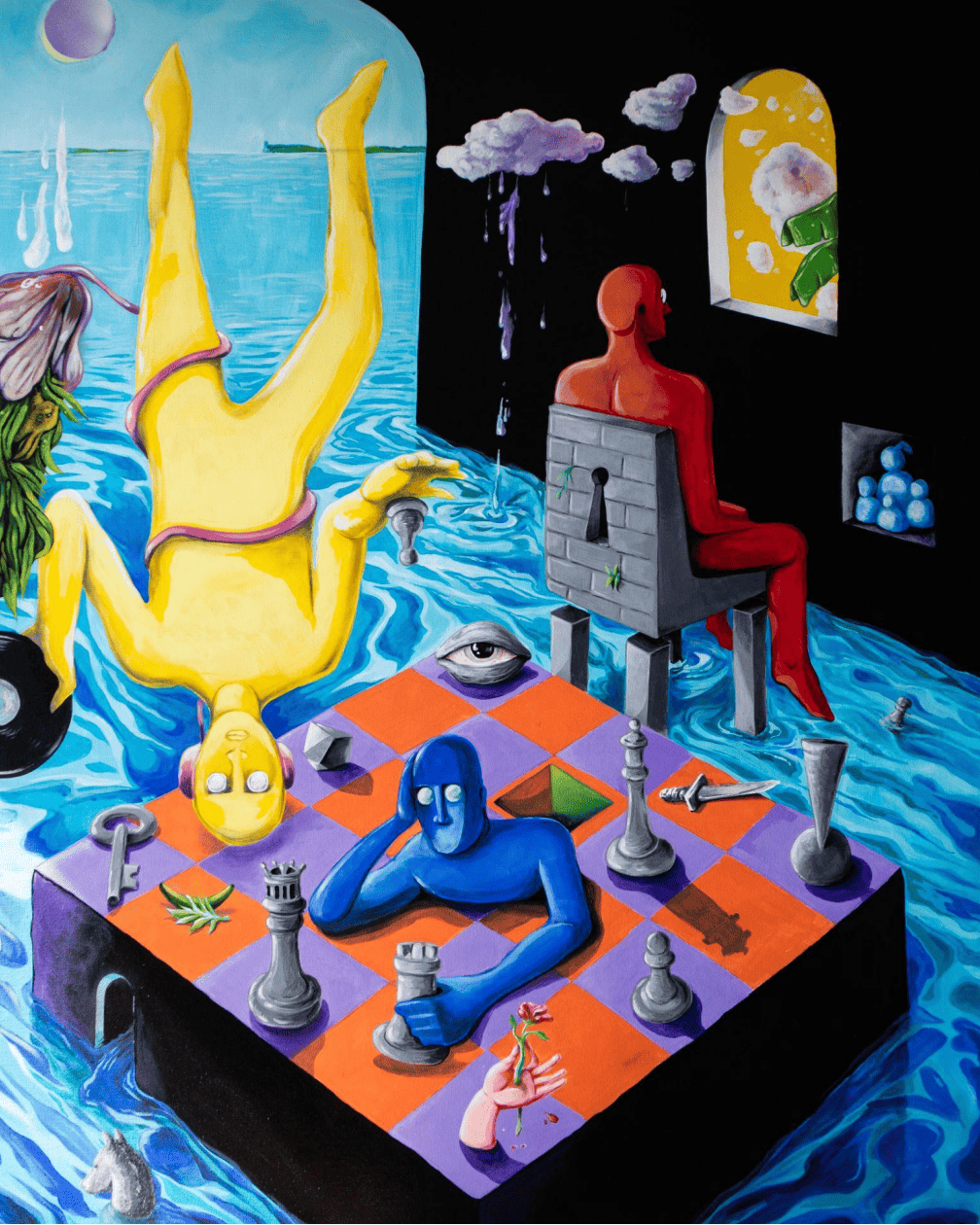
Etienne Class develops a distinctive visual practice rooted in the expressive energy of graffiti and informed by a multidisciplinary approach to contemporary art. Working across painting and illustration, Class combines stylized characters, graphic forms, surreal imagery, and personal symbolism to create compositions that move between recognizable experience and imagined worlds. His work carries the immediacy of urban visual culture while maintaining a strong interest in storytelling, identity, and the emotional associations that images can hold.
Rather than following a rigid visual formula, Class allows each composition to develop through an intuitive process. Symbols, colors, characters, and forms emerge as the work takes shape, creating a sense of discovery within the finished image. This spontaneity is balanced by an understanding of design and structure, allowing unexpected elements to coexist within carefully considered compositions.
The resulting paintings invite viewers to look beyond their immediate visual impact. Beneath their graphic surfaces are references to personal history, cultural experience, memory, and emotion, leaving space for individual interpretation.
From Santurce to a Multidisciplinary Practice
Born in Santurce, Puerto Rico, Etienne Class established his artistic foundation through formal studies at the School of Visual Arts of San Juan, where he earned a Bachelor of Fine Arts degree. His education encompassed painting, illustration, sculpture, and design, giving him a broad understanding of different approaches to visual expression.
This multidisciplinary background remains central to his practice. Class approaches the canvas not simply as a surface for painting but as a space where different visual languages can intersect. The compositional awareness of graphic design, the physical possibilities of fine art, and the imaginative potential of illustration all contribute to his evolving approach.
His interest in fashion further expands this vocabulary, introducing an awareness of style, silhouette, attitude, and visual identity. Rather than keeping these influences separate, Class brings them together within a contemporary practice that remains visually immediate while retaining a deeply personal character.
Graffiti, Illustration, and Contemporary Urban Aesthetics
Graffiti provides an important point of departure for Class, particularly in the energy, immediacy, and graphic quality associated with the form. His work reflects an understanding of how simplified shapes, expressive figures, and strong compositional gestures can communicate ideas while maintaining visual complexity.
At the same time, Class moves beyond a direct interpretation of graffiti aesthetics. His paintings incorporate surreal elements and personal symbols that shift the work toward a more introspective territory. Characters can function as imagined personalities, visual metaphors, or fragments of an internal narrative, while unusual combinations of forms encourage viewers to construct their own interpretations.
This intersection between urban aesthetics and personal mythology gives Class’s work its particular identity. The paintings may initially appear playful, graphic, or spontaneous, yet their symbolic possibilities create opportunities for deeper engagement.
The Intuitive Process Behind the Image
For Class, creating is closely connected to intuition. Rather than determining every visual decision in advance, he allows the work to evolve organically. Imagery and symbols emerge through the process, responding to the direction of the composition as it develops.
This method creates a productive tension between spontaneity and control. Individual marks can retain the immediacy of a gesture, while the overall arrangement demonstrates an awareness of balance, proportion, and visual rhythm. Elements that initially appear independent become part of a larger pictorial structure.
Color and line play important roles in this process. Painted passages establish visual weight and atmosphere, while drawing introduces a more direct and gestural dimension. The resulting interaction reflects Class’s ability to move fluidly between painting and illustration without treating them as entirely separate disciplines.
Personal Experience as Visual Narrative
A central quality of Class’s practice is his ability to transform personal experience into imagery without closing the work to a single interpretation. His cultural background, memories, emotional experiences, and observations can enter the composition through symbols and characters rather than through straightforward representation.
This approach allows his paintings to operate as visual narratives without requiring a literal storyline. A figure, gesture, object, or abstract form can suggest a particular emotion or memory while remaining open-ended. The viewer becomes an active participant in constructing meaning.
In this sense, Class’s work reflects the complexity of contemporary identity. Personal history is present, but it is filtered through imagination, design, and visual experimentation. Reality becomes a starting point rather than a boundary, allowing individual experience to be transformed into something more expansive.
Subconscious Balance
Created in 2023, Subconscious Balance exemplifies Class’s interest in the space between intuitive expression and deliberate composition. Executed in acrylic and graphite on canvas, the work measures 36 inches wide by 48 inches high, with a depth of 1.5 inches.
The title introduces a psychological dimension to the work, suggesting an exploration of the forces that operate beneath conscious awareness. The idea of balance can be understood not simply as a formal consideration but as an internal state, where instinct, emotion, memory, and conscious thought coexist.
The combination of acrylic and graphite reinforces this dialogue. Acrylic provides a versatile medium for establishing areas of color, shape, and pictorial structure, while graphite brings a more immediate, linear quality to the surface. Their interaction reflects Class’s broader practice, where painting and illustration continually inform one another.
Subconscious Balance can therefore be approached as an investigation of opposing impulses finding a point of coexistence. Its imagery remains open to interpretation, allowing viewers to connect the work with their own experiences of uncertainty, instinct, reflection, or emotional equilibrium.
The vertical 36-by-48-inch format gives the composition a substantial presence while providing room for its visual elements to interact across the canvas. The work is unframed, maintaining a direct relationship between the viewer and the painted surface. Rather than imposing a singular narrative, Class allows the title and visual language to work together as an invitation to look inward.
Between Reality and Fantasy
Class’s work occupies a space where reality and fantasy continually overlap. His stylized characters and surreal components are not merely decorative additions; they provide a means of examining ideas that may be difficult to communicate through conventional representation.
This imaginative dimension gives his paintings a sense of openness. Viewers may recognize references to urban culture, popular imagery, personal experience, or familiar forms, but these elements are transformed through Class’s individual visual language.
The resulting compositions resist a single fixed interpretation. Instead, they encourage curiosity and invite viewers to consider how symbols acquire meaning through context, memory, and personal association. The familiar can become strange, while the imaginary can feel emotionally recognizable.
An Evolving Visual Language
Now based in Florida, Etienne Class continues to develop a practice centered on creativity, identity, and storytelling through image-making. His background in painting, illustration, sculpture, design, and fashion provides a broad foundation from which to experiment, while his connection to graffiti and urban visual culture gives his work a contemporary sense of energy.
What distinguishes Class’s approach is the balance between immediacy and intention. His imagery can feel spontaneous without becoming uncontrolled, while his compositions retain enough structure to support multiple layers of interpretation. Stylized figures, graphic forms, expressive marks, and surreal elements become components of a visual vocabulary through which personal experience can be transformed.
His work also demonstrates how contemporary painting can draw from multiple cultural and creative sources without being confined to a single category. Fine art, illustration, design, graffiti, and fashion converge within his practice, producing imagery that is both visually accessible and conceptually open.
The Power of Image-Making
Ultimately, Etienne Class treats painting as a form of visual storytelling. His canvases do not simply document experience; they reinterpret it through symbolism, imagination, and instinct. The energy associated with graffiti provides an expressive foundation, while his academic training and multidisciplinary background bring structure and versatility to the work.
Through this combination, Class creates visual spaces where memory, identity, emotion, and imagination can intersect. Subconscious Balance captures this approach particularly well, using the meeting of acrylic and graphite to explore an internal equilibrium while leaving the precise meaning open to the viewer.
As his practice continues to evolve in Florida, Class remains committed to the possibilities of image-making as a means of exploring both personal experience and universal ideas. His work invites viewers into compositions where reality and fantasy are not opposites, but interconnected parts of the same visual language.

