


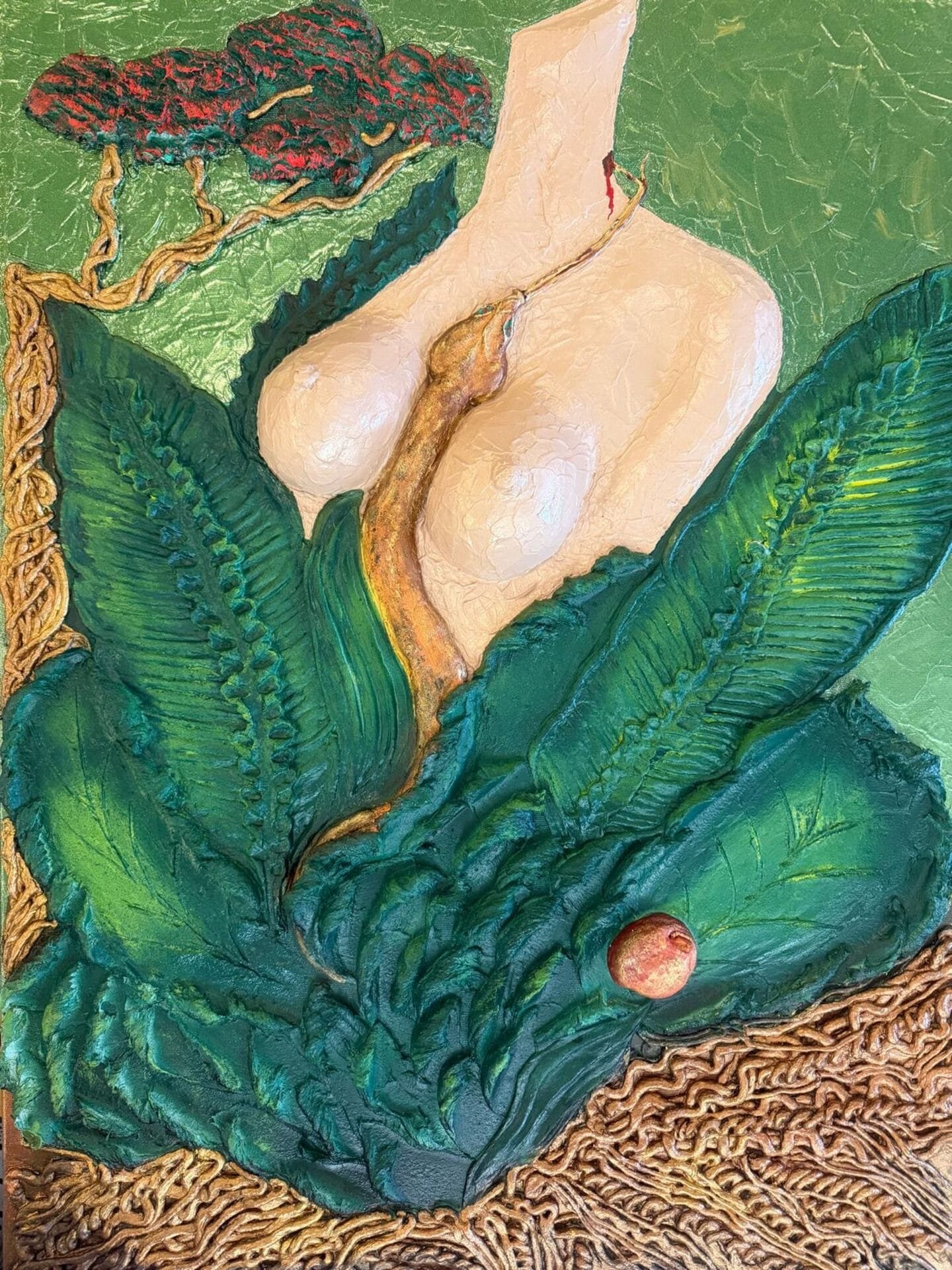
For Romanian contemporary visual artist Gabriela Văduva, painting is a space where discipline and instinct can coexist. As the founder of AVUDAV ART, she has developed a practice grounded in the tension between structure and emotional freedom, drawing together the precision of her legal background with an intuitive engagement with colour, texture and form. Her works do not simply occupy the surface of a canvas. Through impasto and contemporary sculptural relief, they acquire a physical presence that invites the viewer to consider painting as both image and object.
Drawing and colour have accompanied Văduva since childhood, gradually developing from an early fascination into a sustained artistic pursuit. Her practice is guided by a desire for authenticity, with each work emerging from an internal response rather than a predetermined formula. The result is a body of work in which tactile surfaces and expressive gestures become vehicles for ideas about human experience, vulnerability and transformation.
A defining feature of Văduva’s process is its deliberate construction. Each painting begins with an original pencil sketch, establishing an initial framework before the composition is translated into layers of texture. Texture paste is carefully modelled across the canvas, creating relief that gives the eventual image dimensionality. Traditional artistic tools are combined with unconventional objects and, at times, her own hands. This tactile approach allows the material itself to participate in the making of the work.
Light becomes particularly important within these raised surfaces. As it moves across the sculpted areas, it produces subtle variations in shadow and illumination, allowing the painting to change according to the viewer’s position and the surrounding atmosphere. Colour operates within the same dialogue, not merely describing forms but contributing to the emotional temperature of the composition. Văduva’s paintings therefore depend as much on their physical construction as on their imagery.
Eve and the Moment of Transformation
At the centre of EVE lies a figure whose significance extends far beyond the boundaries of the biblical narrative. Eve has been interpreted for centuries as a symbol of temptation, disobedience and transgression, but Văduva approaches the character through a more human lens. Her Eve becomes an embodiment of the individual confronted with a decisive moment: the point at which innocence gives way to consciousness.
The Garden of Eden represents an ideal state, but one whose apparent perfection is ultimately fragile. Within this setting, the serpent, the fruit and the surrounding vegetation become symbols within a larger meditation on human development. The work places these elements in a conceptual relationship with one another, transforming the familiar story of the Fall into a reflection on what it means to become aware of oneself and the consequences of one’s choices.
Knowledge, in this interpretation, is neither wholly liberating nor wholly destructive. It carries a cost. The awakening of self-awareness can bring freedom, but it can also introduce uncertainty, vulnerability and responsibility. Eve stands at this threshold, embodying the complicated condition of being human.
Texture as Emotional Language
The sculptural character of EVE gives this conceptual framework a physical dimension. Rather than relying exclusively on painted imagery, Văduva builds the surface so that texture becomes part of the work’s emotional vocabulary. Raised passages catch light differently from recessed areas, producing a changing interplay between illumination and shadow.
This approach reflects the artist’s broader understanding of materials. Texture is not merely decorative or technical. It becomes a means of expressing psychological weight. The physical density of the surface can suggest tension, movement or instability, while the relationship between smooth and heavily modelled passages creates moments of visual contrast.
Her use of acrylic paint alongside texture paste further allows the work to occupy an intermediate territory between painting and relief. The canvas remains rooted in pictorial language, while its surface pushes outward into three-dimensional space. This expanded understanding of painting is central to Văduva’s artistic identity.
Between Discipline and Instinct
Văduva’s background in the legal field provides an intriguing counterpoint to the freedom of her artistic practice. Law is associated with systems, structure and carefully defined parameters, whereas artistic expression often depends on ambiguity, intuition and emotional openness. Rather than treating these qualities as opposites, Văduva brings them together.
The discipline of her working process is visible in the preparation of each piece, beginning with the pencil drawing and continuing through the deliberate construction of the textured surface. Yet within this framework, there remains room for spontaneity. Unconventional tools, direct physical contact with the materials and an emphasis on feeling allow the work to evolve beyond its initial plan.
This relationship between control and release is perhaps one of the most compelling aspects of her practice. The artist establishes a structure, then allows the material to become an active participant in the process. The resulting works retain a sense of intention without appearing overly constrained.
A Contemporary Dialogue with Ancient Narratives
In EVE, this methodology allows Văduva to revisit an ancient narrative without reducing it to a fixed interpretation. The biblical story becomes a starting point for contemporary questions: What does innocence mean once it has been lost? Is knowledge a form of liberation, burden or both? How does an individual live with the consequences of a choice that cannot be reversed?
These questions remain relevant because the experience they describe is universal. Every person encounters moments in which greater awareness changes the way the world is perceived. Childhood gives way to maturity; certainty becomes complexity; choices produce consequences. Eve therefore functions not simply as a historical or religious figure, but as a metaphor for the human condition.
The work’s combination of colour, relief and tactile construction reinforces this universality. Its subject is rooted in a familiar story, while its material language belongs firmly to contemporary painting.
An Art Practice Rooted in Authenticity
Across her practice, Gabriela Văduva approaches art as a form of inner translation. The materials provide the vocabulary, while emotion and personal perception determine what is ultimately expressed. Her works emerge from an intersection of technical discipline and intuitive response, creating compositions in which physical surface and conceptual meaning remain closely connected.
Her participation in national and international exhibitions has further situated her work within a broader contemporary art context, while AVUDAV ART reflects her commitment to developing an artistic identity of her own. At the heart of that identity is a belief that painting can move beyond representation and become an experience of material, sensation and thought.
With EVE, Văduva demonstrates how a familiar narrative can be reconsidered through contemporary material practice. The work transforms the Garden of Eden into a psychological landscape, where the serpent, the fruit and the figure of Eve point toward larger questions of vulnerability, choice and self-awareness.
Ultimately, Văduva’s art is concerned with transformation: the transformation of a pencil line into a finished composition, of flat canvas into sculptural surface, and of inherited narratives into personal reflection. Her practice turns rigour into expressive freedom, allowing texture, colour and light to carry the emotional complexity of what cannot always be articulated in words.

