


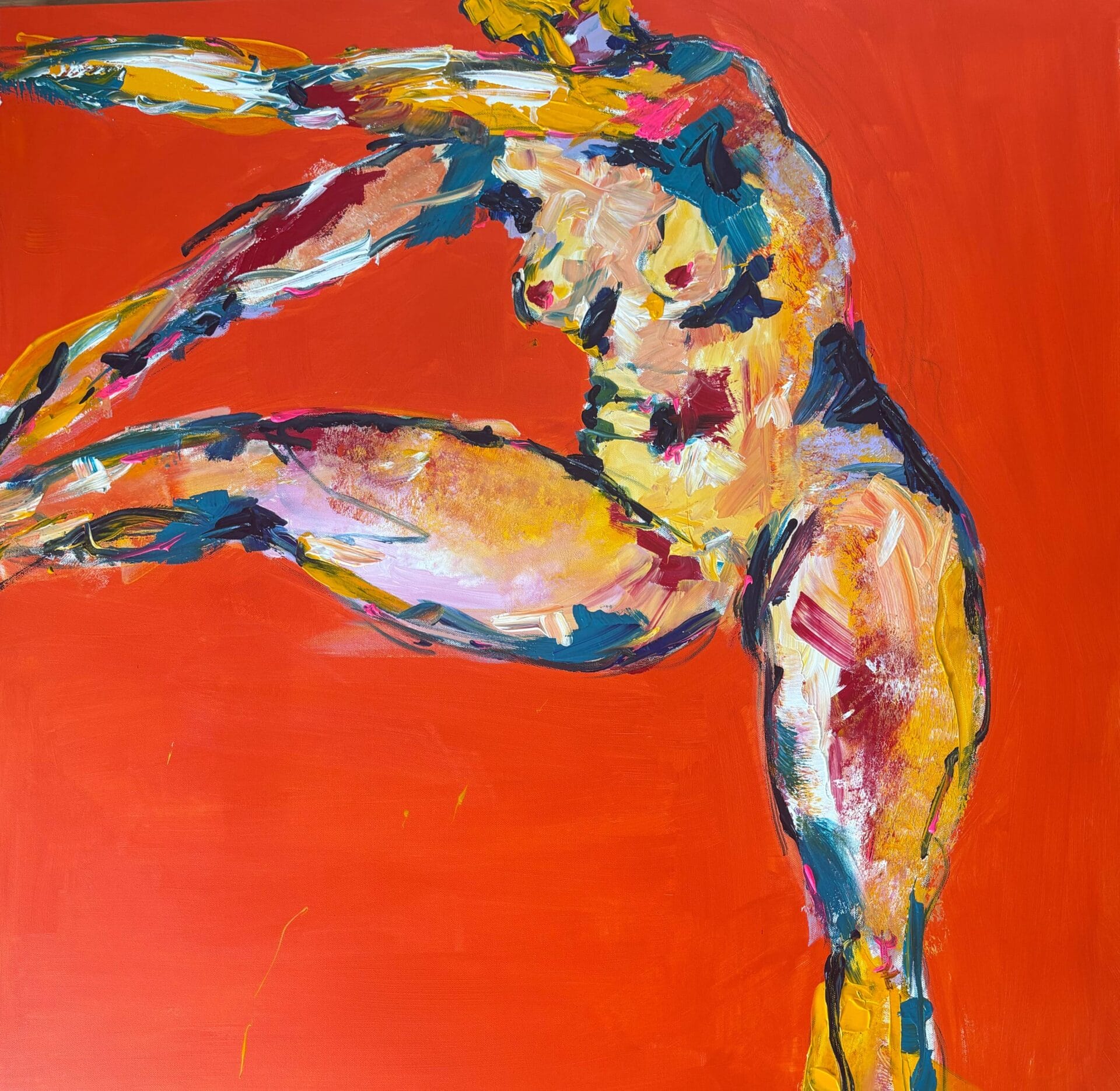
René Jacobsen is a Danish contemporary artist whose paintings occupy a compelling space between figurative art, neo-expressionism and Color Field. His practice is deeply rooted in an exploration of the human condition, examining the body not simply as a recognizable physical form, but as a vessel for movement, emotion, vulnerability and existential experience.
Working primarily with acrylic on canvas, Jacobsen creates paintings in which the human figure seems to exist in a constant state of transformation. His subjects can appear recognizable at first, yet the longer one looks, the more the boundaries of the body begin to shift. Limbs fragment, forms expand, and figures dissolve into surrounding fields of colour. The result is a visual language that moves naturally between representation and abstraction.
At the centre of Jacobsen’s work is a fundamental question: what does it mean to inhabit a body? His paintings consider physical presence while simultaneously suggesting the invisible emotional and psychological forces that shape human existence.
Painting Movement Through Gesture and Colour
Movement is one of the defining elements of René Jacobsen’s artistic language. His connection to athletics and the human body has played an important role in developing the way he approaches the figure. Rather than treating the body as static anatomy, he presents it as something continuously responding to gravity, balance, energy and limitation.
This understanding can be felt in the physical quality of his brushwork. Jacobsen builds his compositions through energetic gestures, expressive marks and layers of intense colour. Every stroke appears to contribute to a sense of motion, as though the painting itself is recording an action taking place across the canvas.
His use of colour is equally important. Colour does not merely describe skin, clothing or an environment. Instead, it becomes an emotional and structural force. Vibrant tones can intensify the psychological presence of a figure, while contrasting areas of colour create tension between the body and the surrounding space.
Through this approach, Jacobsen transforms movement into a visual experience. The viewer is not simply looking at a body; they are encouraged to sense its weight, energy and vulnerability.
When the Figure Begins to Dissolve
Although Jacobsen’s paintings often begin with the human figure, he does not remain committed to traditional representation. Instead, he allows recognizable forms to gradually break apart. This process creates a productive tension between what the viewer can identify and what remains open to interpretation.
The body may be fragmented by expressive marks or partially absorbed into fields of colour. A figure can appear to emerge from the canvas while simultaneously disappearing into it. This ambiguity is central to Jacobsen’s work because it reflects the complexity of human existence itself.
We experience our bodies as physical realities, yet identity, emotion and consciousness cannot be reduced to anatomy. Jacobsen’s paintings communicate this contradiction through the relationship between figuration and abstraction. The recognizable body provides an entry point, while abstraction opens the work toward broader emotional and existential questions.
His figures therefore become more than portraits of individuals. They become carriers of energy, vulnerability and tension.
The Weight of Being
One of the works that particularly captures Jacobsen’s artistic concerns is The Weight of Being. The painting explores the human body as a force caught between gravity, movement and freedom. Rather than presenting the figure as a stable and clearly defined object, Jacobsen allows it to appear as though it is simultaneously forming and dissolving.
The vigorous gestures throughout the composition give the work a sense of physical immediacy. Intense colour adds emotional force, while the fragmented treatment of the figure brings the painting close to abstraction.
In The Weight of Being, flesh becomes paint and movement becomes line. The physical body is still present, but its boundaries are unstable. It seems to exist in negotiation with the forces around it, suggesting both resistance and surrender.
The title itself adds another dimension to the work. The “weight” can be understood literally through the physical effects of gravity, but it can also suggest the emotional and existential burdens carried by human beings. The figure becomes a metaphor for existence: grounded by the physical world while continually reaching toward movement and freedom.
This balance between weight and liberation is one of the qualities that makes the work particularly compelling.
Between Strength and Vulnerability
Jacobsen’s artistic approach does not romanticize the human body. Instead, it acknowledges its limitations. The body can move, resist and express itself, but it is also subject to gravity, aging, imbalance and physical boundaries.
This awareness creates an important emotional dimension in his paintings. Strength and vulnerability are not opposites; they coexist within the same figure. A gesture that communicates power can simultaneously suggest fragility. A body in motion can also appear exposed.
Jacobsen’s connection to athletics provides an especially meaningful foundation for this exploration. Athletic movement makes the body’s relationship with gravity and limitation highly visible. Every movement requires balance, effort and control, while every physical achievement exists within the boundaries of the body.
These ideas find their way into his paintings without becoming literal illustrations of sport. Instead, they become part of a broader visual meditation on what the body can endure, express and become.
A Dialogue Between Figuration and Abstraction
Jacobsen’s position between figurative painting, neo-expressionism and Color Field gives his work a distinctive visual identity. He draws from the expressive possibilities of gesture and colour while retaining an interest in the human form.
The result is neither purely figurative nor completely abstract. Instead, his paintings exist in the space between the two. The viewer can recognize a body, but that body is continually being transformed by paint.
This creates an active relationship between artist, artwork and viewer. Rather than providing every answer, Jacobsen leaves room for perception and interpretation. Each viewer may respond differently to the balance of colour, gesture and form, bringing their own experiences of embodiment, movement and emotion to the work.
The paintings therefore remain open-ended. They are images of bodies, but they are also images of states of being.
An International Artistic Presence
René Jacobsen’s work has reached audiences beyond Denmark, with exhibitions in internationally recognized cultural centres including New York, Paris, Berlin, London, Madrid, Stockholm, Seoul and Monaco.
This international presence reflects the universal nature of the questions explored within his practice. Although his work emerges from his own artistic background and relationship with the human body, its themes are not limited by geography. Gravity, movement, vulnerability, freedom and the search for identity are shared human experiences.
His paintings communicate through visual elements that can be understood across cultural boundaries: the gesture of a body, the force of colour, the tension between movement and stillness, and the transformation of recognizable form.
The Continuing Search for Human Presence
At its heart, René Jacobsen’s practice is an investigation into presence. His figures are physically present on the canvas, yet they are never completely fixed. They move, fragment, expand and disappear. Through this instability, Jacobsen captures something essential about human experience.
We are simultaneously physical and emotional beings. We occupy space, experience gravity and move through the world, while also carrying memories, feelings, fears and desires that cannot be seen. Jacobsen’s paintings bring these visible and invisible dimensions together.
His use of acrylic, energetic gestures and intense colour allows him to transform the traditional figure into something more fluid and expressive. The body becomes a starting point for exploring much larger questions about existence.
In works such as The Weight of Being, this approach becomes especially powerful. The figure stands between gravity and freedom, between recognition and abstraction, between strength and vulnerability. It is precisely within these tensions that Jacobsen finds his artistic language.
René Jacobsen’s work ultimately invites viewers to look beyond the surface of the body and consider the forces both physical and invisible that shape our experience of being alive. His paintings do not simply depict movement; they make movement felt. They do not merely represent the human figure; they use the figure to explore what it means to exist.
To discover more of René Jacobsen’s artwork and follow his latest creative work, visit his Instagram account: https://www.instagram.com/artbyrejac

