


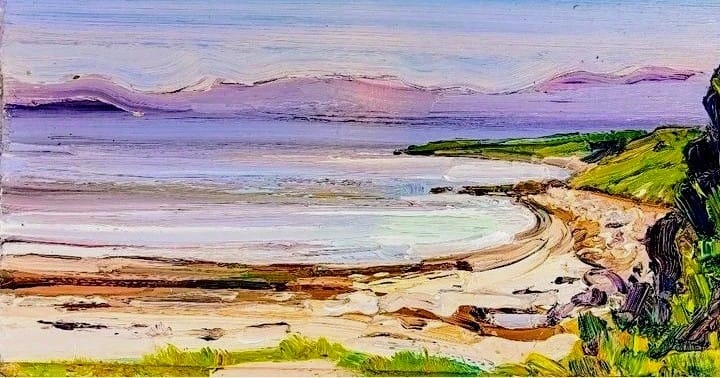
Lawrie Quigley is a British artist whose career has been shaped by a sustained commitment to painting, landscape, and the expressive possibilities of the medium. His artistic journey began in Birkenhead on Merseyside, where he was born and brought up and first attended Art School. He later continued his studies on the BA Hons Fine Art Degree course at Loughborough University before completing a postgraduate Master’s Degree at the Royal Academy Schools.
These stages of formal education provided Quigley with a strong foundation for his development as a painter. However, his practice has continued to evolve through years of observation, experimentation, teaching, and direct engagement with the landscape. Throughout his career, he has maintained an active presence in the art world, exhibiting his work in London-based and regional galleries while also teaching part-time at various art colleges and universities.
His career reflects a balance between artistic practice and education, with painting remaining at the center of his professional life. Through his work, Quigley explores the relationship between direct visual experience and the physical act of painting, creating works that respond to the changing character of the natural environment.
A Career of Recognition and Achievement
Quigley’s artistic achievements have been recognized through numerous awards and opportunities throughout his career. While studying at the Royal Academy, he received the Turner Gold Medal and the British Institution Fund, significant distinctions that marked important stages in his artistic development.
He has also been a prize-winner of the Stowell’s Trophy, further reflecting the recognition his work has received. These accomplishments form part of a career that has remained closely connected to the traditions of British painting while developing a distinctive and personal approach to landscape.
Quigley’s work is held in numerous public and private collections across the United Kingdom and internationally. The presence of his paintings in these collections demonstrates the lasting interest in his approach and the ability of his work to connect with audiences beyond the immediate experience of an exhibition.
In addition to awards, Quigley has received a number of bursaries that have supported his artistic development and provided opportunities to work in different creative environments. Among these were artist residencies at the Birmingham Royal Ballet and the Victoria Theatre in Bath. These experiences expanded his engagement with artistic disciplines and environments beyond the traditional studio, offering new opportunities for observation and creative response.
Finding Inspiration in the Landscape
Landscape occupies a central position within Quigley’s artistic practice. His work is particularly concerned with the changing atmosphere of the natural environment and the fleeting visual experiences that can transform a scene from one moment to the next.
The romantic fervour and immediacy associated with the work of J.M.W. Turner and John Constable are prominent influences on his approach. Both artists demonstrated the power of responding directly to nature, capturing not only the physical appearance of a landscape but also its atmosphere, energy, and emotional character.
Quigley continues this tradition through his own contemporary interpretation of the landscape. Rather than treating nature as a fixed subject, he is drawn to its constant movement and transformation. Changes in light, weather, colour, and atmosphere become essential elements of his visual experience.
A landscape can appear entirely different as clouds move across the sky or as sunlight suddenly illuminates a particular area. These fleeting moments are central to Quigley’s practice, encouraging him to work with sensitivity and immediacy.
The Importance of Painting in Situ
One of the defining characteristics of Quigley’s approach is his commitment to painting in situ. Working directly within the environment enables him to remain alert to the subtle changes taking place around him and to respond immediately to what he sees.
This method creates a direct connection between the artist and his subject. Instead of relying entirely on memory or photographs, Quigley can experience the changing landscape firsthand, responding to its atmosphere as it unfolds.
Painting in situation also demands a certain degree of spontaneity. The conditions surrounding the artist are never completely static. Light shifts, weather changes, and the visual character of a scene can alter within minutes. By working directly from observation, Quigley can capture something of that immediacy within the painting.
His approach is therefore not simply about documenting a particular location. It is about translating an experience. The finished work reflects the artist’s perception of a specific moment while retaining the energy and sensitivity of the process through which it was created.
Between Observation and Abstraction
While Quigley’s paintings are rooted in perceptual experience, his practice is equally concerned with the abstract qualities of painting itself. The landscape may provide the initial subject, but the marks made on the surface become an important part of the visual language.
Brushstrokes, gestures, textures, and the movement of paint contribute to the expressive character of each work. These elements are not merely used to describe trees, skies, fields, or water. Instead, they become part of the experience the painting seeks to communicate.
This creates a dynamic relationship between representation and abstraction. The viewer may recognize a landscape within the painting, yet the work also invites attention to the physical qualities of the paint itself.
For Quigley, the process of painting is therefore inseparable from the final image. The marks reveal something about the artist’s response to the environment, allowing the physical act of painting to become visible within the finished work.
When the Process Becomes the Subject
Quigley’s paintings can be understood as both records of visual experience and explorations of painterly expression. His interest lies not only in what the eye perceives but also in how that perception can be transformed through the act of painting.
The process itself becomes part of the subject. Every mark contributes to the translation of experience, carrying the immediacy of the artist’s response into the finished work. This approach gives his paintings a sense of movement and energy, allowing the viewer to sense the moment of creation behind the completed image.
In this way, Quigley’s work occupies a space between the recognizable and the abstract. The landscape remains present, but it is filtered through the artist’s personal perception and the physical language of paint.
His paintings encourage viewers to look beyond the literal appearance of a place and consider the experience of being within it. The atmosphere, changing light, and emotional qualities of the environment become intertwined with the gestures and marks that construct the painting.
A Continuing Relationship with Nature
Lawrie Quigley’s artistic career reflects a lifelong engagement with painting and a continuing fascination with the natural environment. From his early education in Birkenhead to his studies at Loughborough University and the Royal Academy Schools, his journey has been defined by a dedication to developing his artistic voice.
His exhibitions, awards, teaching career, residencies, and the inclusion of his work in public and private collections all contribute to a significant body of achievement. Yet the central focus of his practice remains his relationship with the landscape and the challenge of responding to its constantly changing character.
Influenced by the immediacy and romantic intensity of Turner and Constable, Quigley approaches landscape as something that must be experienced rather than simply observed from a distance. His decision to paint in situ allows him to remain sensitive to fleeting atmospheric changes, while his expressive mark-making transforms those experiences into works that exist between perception and abstraction.
Ultimately, Quigley’s paintings demonstrate that landscape is more than a subject to be represented. It is an experience that unfolds through light, weather, atmosphere, perception, and time. By bringing these elements together through the physical process of painting, he creates works that preserve something of a passing moment while allowing the act of painting itself to remain an essential part of the story.

