


Tara Verkuil’s artistic journey is rooted in a deep connection to nature, movement, atmosphere, and emotion. Her practice began with close observation of the visible world, shaped by her studies in plein air landscape painting while earning her BFA at Parsons School of Design. Working directly from the landscape gave Tara a strong foundation in understanding light, color, atmosphere, and the changing rhythms of the natural environment.
Over time, however, her artistic language began to shift. Rather than simply painting what she could see, Tara became increasingly interested in expressing what she could feel. Memory, movement, emotion, and atmosphere gradually took precedence over literal representation, guiding her toward abstraction.
This transition did not mean leaving nature behind. Instead, it allowed Tara to explore the natural world on a deeper level. Her paintings became less about depicting a particular place and more about capturing the sensation of experiencing it. Through expressive mark-making and richly developed surfaces, she creates works that encourage viewers to connect with the emotional qualities of a landscape rather than simply recognize its physical features.
A Nature-Rooted Abstract Language
Tara Verkuil’s paintings exist at the intersection of abstraction and the natural world. Her work remains deeply connected to landscape, but she approaches it through feeling, gesture, and memory rather than direct observation. The resulting compositions are immersive, with color, texture, and movement working together to create a distinct sense of atmosphere.
Her creative process incorporates acrylic, graphite, crayon, and mixed media, allowing her to build complex surfaces through an evolving combination of materials and marks. Each medium contributes something different to the finished work. Acrylic provides luminous color and depth, while graphite and crayon introduce a raw, tactile quality. Together, they create paintings that feel energetic, physical, and continually evolving.
Tara allows her artistic instincts to guide the development of each composition. Marks accumulate, overlap, and interact, creating a visual vocabulary that feels spontaneous while remaining carefully considered. Her paintings often suggest movement without illustrating it directly, giving the viewer the sense that something is shifting or unfolding within the composition.
This balance between control and instinct is central to her practice. Her paintings can be energetic and dynamic while also offering moments of quiet reflection. Through this contrast, Tara explores the space between what is seen and what is experienced.
The Emotional Landscape of Painting
At the heart of Tara’s work is an interest in emotional response. Her paintings are not simply interpretations of landscapes or natural forms; they are records of an encounter with the world. Light, atmosphere, movement, and memory become translated into color, texture, and gesture.
This approach allows her work to remain open to interpretation. A viewer may recognize a suggestion of landscape, movement, or an organic form, but the painting does not demand a single reading. Instead, it creates an opportunity for personal connection.
Tara’s abstract compositions invite viewers to slow down and spend time with the artwork. The longer one looks, the more details begin to emerge. A gestural mark may suggest motion, while a subtle shift in color can evoke a particular atmosphere or memory. Texture becomes a physical expression of emotion, giving the paintings a character that extends beyond their visual appearance.
The result is an artistic practice grounded in the natural world but ultimately concerned with human experience: how we remember places, how we respond to movement, and how certain moments can remain with us long after they have passed.
A Lifelong Connection to Horses
Horses hold a particularly meaningful place within Tara Verkuil’s artistic world. Her lifelong connection to these animals has informed her understanding of movement, sensitivity, strength, and freedom. In her work, the horse is not simply a subject to be depicted. It becomes a vehicle for exploring emotional and physical energy.
The relationship between horse and human is rooted in a form of communication that extends beyond words. It involves awareness, trust, sensitivity, and an ability to respond to subtle changes in movement and behavior. These qualities resonate with Tara’s broader approach to painting, where emotional perception and spontaneity play an important role.
Her horse-inspired works often move away from conventional portraiture. Instead of focusing on anatomical accuracy or a specific individual animal, she seeks to communicate something more essential. The horse becomes a symbol of strength and freedom while also representing vulnerability, sensitivity, and emotional depth.
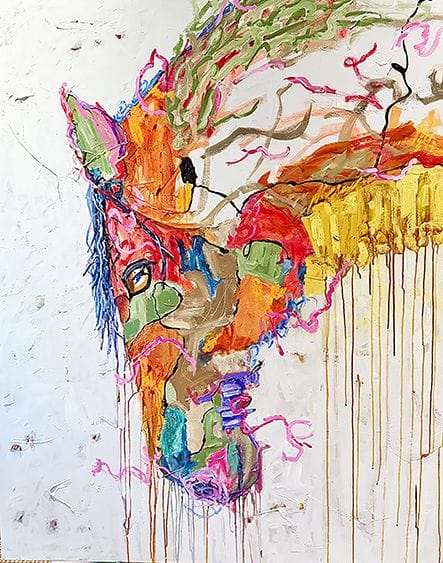
This perspective can be seen clearly in Wild Current, a work that brings together many of the central ideas within Tara’s practice.
Wild Current: The Energy Beneath Stillness
Wild Current captures the untamed energy that exists beneath the surface of calm. At first glance, the work may evoke the physical form of a horse, but its meaning extends beyond the representation of a particular animal.
Built through expressive mark-making, dynamic color, drips, and spontaneous gestures, the painting creates a sense of motion that feels both immediate and restrained. The horse emerges through the accumulated marks, suggesting an animal that is powerful without becoming aggressive and sensitive without appearing fragile.
The title Wild Current speaks to this tension. A current may not always be visible from the surface, yet it carries tremendous force beneath the water. In much the same way, the painting explores the invisible energy that exists within living beings and natural environments.
The expressive marks contribute to the feeling of motion, while variations in color and texture create depth and complexity. Drips and gestures suggest spontaneity, as though the image is continually forming and shifting. The horse does not appear as a static subject; instead, it seems to exist within a moment of movement and emotional connection.
Importantly, Tara does not seek to portray a specific animal in Wild Current. Her intention is to explore movement, feeling, and connection. The viewer is invited to experience the sensation of the horse rather than simply observe its physical appearance.
This distinction is central to understanding Tara’s artistic philosophy. She is interested in what lies beneath representation: the atmosphere of a place, the memory of a moment, or the emotional force carried by a living subject. In Wild Current, these ideas converge to create a painting that feels instinctive, energetic, and deeply connected to the natural world.
The Balance Between Energy and Calm
Across Tara Verkuil’s body of work, the relationship between energy and calm remains an important theme. Her paintings can be filled with vigorous marks and vivid color, yet they often retain a meditative quality. This duality reflects the complexity of nature itself, where movement and quiet coexist continuously.
A landscape can appear calm while remaining filled with invisible activity. Wind moves through trees, water shifts beneath its surface, and light changes from one moment to the next. Tara’s paintings respond to these subtle rhythms, transforming them into abstract visual experiences.
Her process mirrors this idea. New marks interact with earlier decisions, allowing traces of the painting’s development to remain visible. Nothing feels entirely fixed or predetermined. Instead, the work grows through a conversation between gesture, color, material, and response.
This approach gives her paintings a sense of movement through time. They feel as though they have been shaped by a series of discoveries, with each decision contributing to the final emotional landscape.
An Evolving Artistic Practice
Tara Verkuil’s journey from plein air landscape painting to abstraction reflects an ongoing search for a more personal way of expressing the natural world. Her work demonstrates that abstraction does not require abandoning the visible world. Instead, it can offer a way to move beyond appearances and explore the emotions, memories, and sensations that landscapes and living beings inspire.
Today, Tara lives and works in San Diego, California, where she continues to create nature-rooted abstract paintings that explore atmosphere, movement, light, and connection. Her work has been exhibited internationally and collected for its evocative and atmospheric quality.
Through her expressive surfaces and gestural marks, Tara creates paintings that ask viewers to look beyond what is immediately visible. Her art encourages us to consider the energy hidden within nature, the memories held within landscapes, and the emotional connections we form with the world around us.
In works such as Wild Current, this vision becomes especially powerful. The horse is not simply an image; it is a feeling. The landscape is not merely a place; it is an atmosphere. And the painting itself becomes an invitation to pause, look closely, and experience the untamed force that continues to move beneath the surface.

