


Michael Kaphengst has built an artistic career that reaches far beyond the traditional boundaries of painting. With a background spanning graphic design, media production, acting, education, and visual art, his creative path reflects an ongoing curiosity about how different forms of expression intersect. Every stage of his professional journey has contributed to the distinctive artistic language he has developed today.
His formal education began with training as a graphic designer while completing his university entrance qualification at the Kollegschule Minden. An internship in stage design at the Wilhelmshaven City Theatre introduced him to the power of visual storytelling within theatrical environments, while further training as a media designer for image and sound at the Chamber of Industry and Commerce in Hanover expanded his understanding of composition and communication. Experience at Studio Hamburg in both internship and production roles deepened this knowledge through work in film and television.
Alongside his visual arts education, he completed a three-year acting program at the Bühnensudio der Darstellenden Künste in Hamburg, graduating with a diploma in acting. His professional experience also includes teaching at the Hamburg Chamber of Crafts, serving as a certified lecturer for further and adult education at the Hanseatic Vocational Academy, and performing as a freelance actor in numerous theatre productions.
To support his artistic education, he worked in a wide variety of professions, including bartender, nursing assistant, tiler, postman, and bus driver. Rather than being separate chapters, these experiences became valuable observations of everyday routines and human behavior ideas that would later emerge as essential elements of his artistic philosophy.
Seeing Everyday Life as a Continuous Process
At the heart of his work lies a philosophy known as Linearism. Instead of focusing solely on finished images, this concept explores the continuous processes that shape daily existence.
Rather than viewing modern consumer culture through the lens of Pop Art, he sees it as an endless sequence of interconnected actions. Manufacturing, advertising, purchasing, working, and even leisure activities all become part of a larger chain of events that influences individual lives. These invisible systems fascinated him because they reveal how ordinary routines quietly shape personal experiences.
This perspective has become the foundation of his artistic practice. Through carefully developed techniques and concepts, he transforms invisible processes into visual experiences that encourage viewers to look beyond the surface of everyday objects and actions.
Consumptive Surrealism: Looking Beyond Consumer Objects
One of the most distinctive aspects of his practice is a body of work he describes as Consumptive Surrealism.
Instead of treating consumer products as symbols of popular culture, they become starting points for exploring the psychological and social processes behind consumption. Familiar objects are removed from their everyday context and placed within surreal visual environments, where they take on entirely new meanings.
By transforming ordinary items into unexpected artistic elements, these works invite viewers to question how consumer goods influence emotions, desires, and everyday decision-making. The result is neither a celebration nor a rejection of consumer culture but an exploration of the complex systems that surround it.
Through this approach, everyday objects become visual metaphors for the invisible mechanisms that shape modern society.
Linearism as Physical Movement
The concept of Linearism extends beyond subject matter and into the physical act of creating art itself.
In 2009, he developed an innovative technique called “Fencing Pictures – Absolute Linearism.” Instead of using a conventional brush, a paintbrush was attached to the tip of a rapier, allowing the controlled movements of fencing to generate expressive lines across the canvas.
This unusual process transforms painting into a performance in which movement becomes inseparable from the finished artwork. Every stroke records rhythm, balance, precision, and motion, creating compositions that feel energetic while remaining carefully controlled.
The technique reflects his belief that artistic creation is itself a process one that deserves to remain visible within the completed work.
Discovering Images Through Extreme Linearism
His exploration of movement continued with the development of Extreme Linearism in 2012.
This drawing technique begins with continuous circular motions across the paper rather than a planned outline. Layer after layer of revolving lines gradually condenses until recognizable forms begin to emerge naturally.
Instead of forcing an image into existence, the artwork develops through repetition and accumulated movement. The resulting compositions possess remarkable energy, with intricate networks of lines creating both structure and spontaneity.
Extreme Linearism represents one of the purest expressions of his artistic philosophy, demonstrating how process itself can become the primary creative force.
Stranger: Transforming Consumer Culture into Sculpture
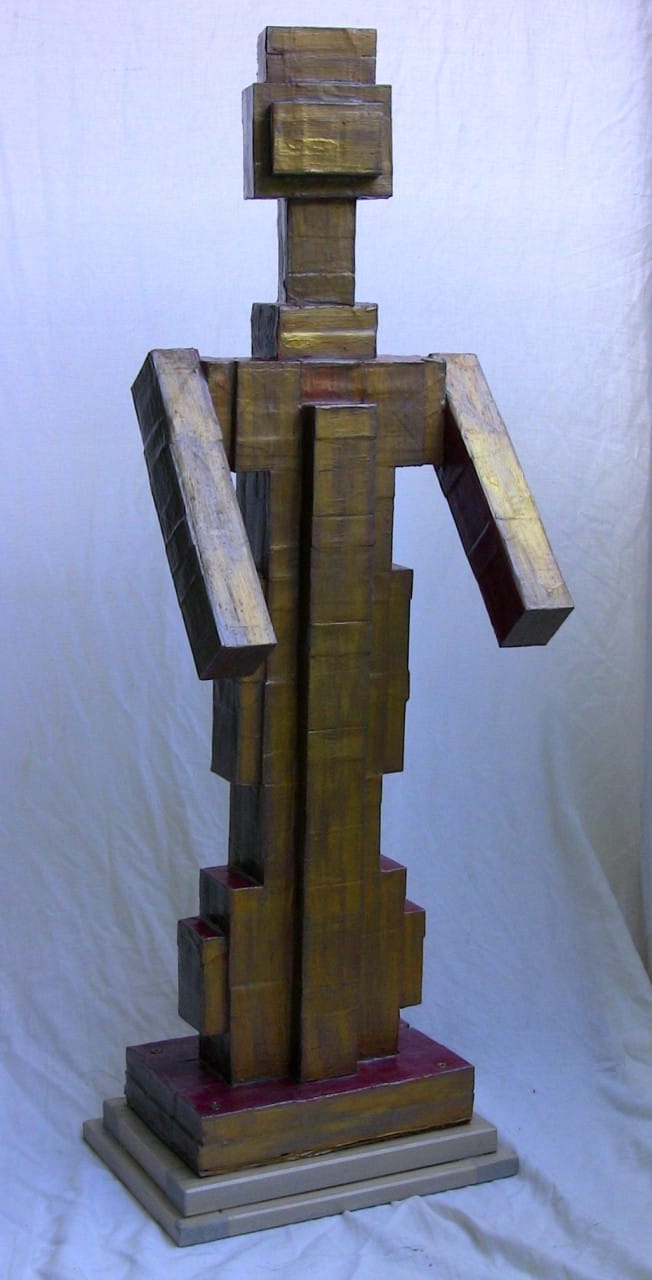
The sculpture Stranger, constructed entirely from cigarette packs, embodies many of the ideas that define his artistic practice.
For the artist, the work should not be understood as Pop Art. Instead, it represents the concept of consumptive thinking. Every cigarette pack carries with it an entire chain of production, packaging, marketing, transportation, and purchasing decisions. These interconnected processes ultimately exist to stimulate another process the impulse to buy.
By assembling these everyday materials into a sculptural figure, the work transforms disposable consumer packaging into a lasting artistic statement. The familiar becomes unfamiliar, encouraging viewers to reconsider the hidden systems behind the objects they encounter every day.
The sculpture illustrates how ordinary products can create surprisingly surreal situations when removed from their intended purpose and viewed from a different perspective.
International Recognition
This distinctive artistic vision has attracted attention both nationally and internationally. His work has been exhibited extensively throughout Germany, including Greetsiel, Berum, Hage, Dornum, Pewsum, Emden, Aurich, Wilhelmshaven, Norden, Minden, Ulm, Hanover, Berlin, Achim, and Ingolstadt.
International exhibitions have brought his work to audiences in Paris, Barcelona, Vienna, New York, Miami, Monte Carlo, Matera, Sanremo, and the Biennale Dei Normanni in Monreale. These exhibitions reflect the broad appeal of an artistic practice that addresses universal questions about human behavior, creativity, and the systems that shape contemporary life.
Redefining the Language of Contemporary Art
Throughout his career, Michael Kaphengst has consistently challenged conventional ways of thinking about both artistic practice and consumer culture. Whether working with paint, drawing, or unconventional sculptural materials, his focus remains on revealing the processes that often go unnoticed in everyday life.
His own words offer insight into the intensity behind this creative pursuit:
“During the manic phase, I can exaggerate beyond measure. Then I make art, which I normally can’t.”
This openness reflects an artist who embraces experimentation and continually pushes the boundaries of creative expression. By combining movement, philosophy, and innovative techniques, his work encourages audiences to look beyond appearances and recognize the invisible patterns that connect modern life. Through Linearism, Consumptive Surrealism, and works such as Stranger, he has established a distinctive artistic voice that continues to expand the possibilities of contemporary art.

