


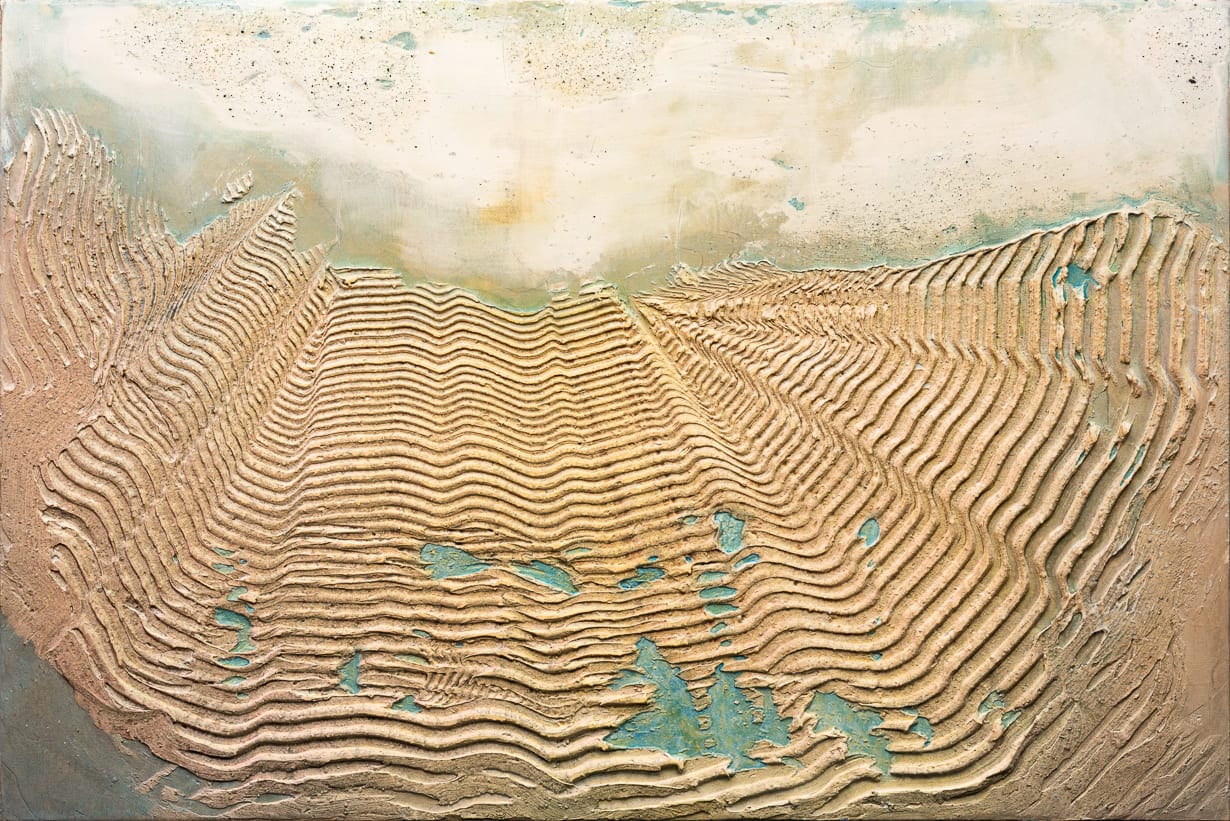
Ronald T. Crawford is a Canadian painter and sculptor whose work exists at the intersection of materiality and imagination. His artistic practice brings together the immediacy of painting with the enduring presence of stone, creating works that challenge the boundaries between image and object. With a career spanning decades and rooted in both academic training and hands-on craftsmanship, Crawford has developed a distinctive visual language that explores time, form, and perception.
Early Life and Artistic Formation
Crawford’s journey into the world of art began with formal studies in studio art and art history across institutions in both Canada and the United States. This dual academic foundation provided him not only with technical skill but also with a deep understanding of historical and contemporary artistic movements. His education fostered a curiosity about how images are constructed and how materials influence meaning.
Unlike many painters who remain confined to traditional media, Crawford’s early exposure to sculpture and art history encouraged him to think beyond the flat surface. He became increasingly interested in how physical materials could carry conceptual weight, leading him toward an exploration of stone as both a medium and a metaphor.
Life on Salt Spring Island
Since the early 1990s, Crawford has lived and worked on Salt Spring Island, a place known for its natural beauty and vibrant artistic community. This environment has played a crucial role in shaping his artistic vision. Surrounded by rugged landscapes, shifting light, and the tactile presence of natural materials, Crawford found inspiration not only in what he saw but also in what he could physically engage with.
On the island, he developed a parallel vocation in functional and sculptural stonework. This practice was not merely a side pursuit but a transformative influence on his painting. Working with stone required patience, precision, and an understanding of weight and permanence. These qualities began to inform his approach to painting, leading him to reconsider the surface not as a passive plane but as an active, sculptural field.
The Fusion of Painting and Relief
One of the defining aspects of Crawford’s work is his ability to merge painting with relief. His pieces often blur the line between two-dimensional and three-dimensional art, creating compositions that are both images and objects. This fusion allows viewers to experience his work in a more physical and immersive way.
The influence of stonework is evident in the textures and structures of his paintings. Surfaces appear carved, layered, or built up, suggesting a process that is as much about construction as it is about depiction. This approach challenges traditional expectations of painting, inviting viewers to consider how an image can occupy space and how material presence can alter perception.
Crawford’s work also explores the relationship between the momentary and the eternal. While painting is often associated with capturing fleeting impressions, his incorporation of sculptural elements introduces a sense of permanence. The result is a dynamic tension between immediacy and duration, between what is seen in an instant and what endures over time.
Representation and Recognition
Today, Crawford’s work is represented by respected galleries, including Paul Kyle Gallery in Vancouver and Matt Steffich Gallery on Salt Spring Island. These spaces provide a platform for his unique artistic voice, allowing audiences to engage with works that defy easy categorization.
His presence in both urban and island gallery settings reflects the dual nature of his practice. While his work is deeply connected to the natural environment of Salt Spring Island, it also resonates within broader contemporary art conversations. This balance between local influence and wider relevance has contributed to his sustained recognition in the art world.
“Just Before it Happens”: A Study of Anticipation
One of Crawford’s compelling works, titled Just Before it Happens, encapsulates many of the themes that define his practice. The painting is conceived as a single act, a moment captured in time, yet it extends beyond that instant to suggest something imminent and unresolved.
In this piece, Crawford proposes the painting as both a solid physical object and a fictional landscape. This duality is central to its impact. The viewer is invited to engage with the work on multiple levels, experiencing it as a tangible surface while also interpreting it as a space that exists within the imagination.
The idea of a “single quick act” is particularly significant. It speaks to the spontaneity of creation, the moment when intention and action converge. At the same time, the surface of the painting carries traces of this act, preserving it in a way that feels both immediate and enduring.
The title itself introduces a sense of anticipation. “Just Before it Happens” suggests a threshold, a point of transition where something is about to unfold. This creates a subtle tension within the work, as viewers are left to imagine what lies beyond the horizon or just outside the frame. The painting becomes not only a record of an action but also a prompt for speculation and narrative.
Material Intelligence and Artistic Philosophy
A key concept in Crawford’s work is what can be described as the “material intelligence” of stone. This idea acknowledges that materials are not passive but possess their own properties, histories, and possibilities. By working closely with stone, Crawford has developed an intuitive understanding of how materials behave and how they can be shaped without losing their inherent character.
This philosophy extends to his paintings, where surfaces are treated with a similar respect for material presence. Rather than imposing an image onto a neutral ground, Crawford allows the material qualities of the work to inform its development. This results in pieces that feel organic and responsive, as though they have evolved rather than been constructed.
The Dialogue Between Image and Object
At the heart of Crawford’s practice is an ongoing dialogue between image and object. His works resist being categorized as purely representational or purely abstract. Instead, they occupy a space where these distinctions become fluid.
By combining pictorial elements with sculptural techniques, Crawford challenges viewers to reconsider how they engage with art. The act of looking becomes more active, requiring attention to both visual composition and physical form. This dual engagement deepens the viewer’s experience, making each encounter with the work unique.
Conclusion
Ronald T. Crawford’s art is a testament to the power of interdisciplinary exploration. By bridging painting and sculpture, image and object, he has created a body of work that is both innovative and deeply rooted in material experience. His time on Salt Spring Island and his engagement with stone have profoundly shaped his artistic vision, allowing him to develop a practice that is as tactile as it is conceptual.
Through works like Just Before it Happens, Crawford invites viewers into a world where moments are suspended, surfaces come alive, and the boundaries between reality and imagination dissolve. His art reminds us that creation is not just about capturing what is seen, but about exploring what lies just beyond it.

