


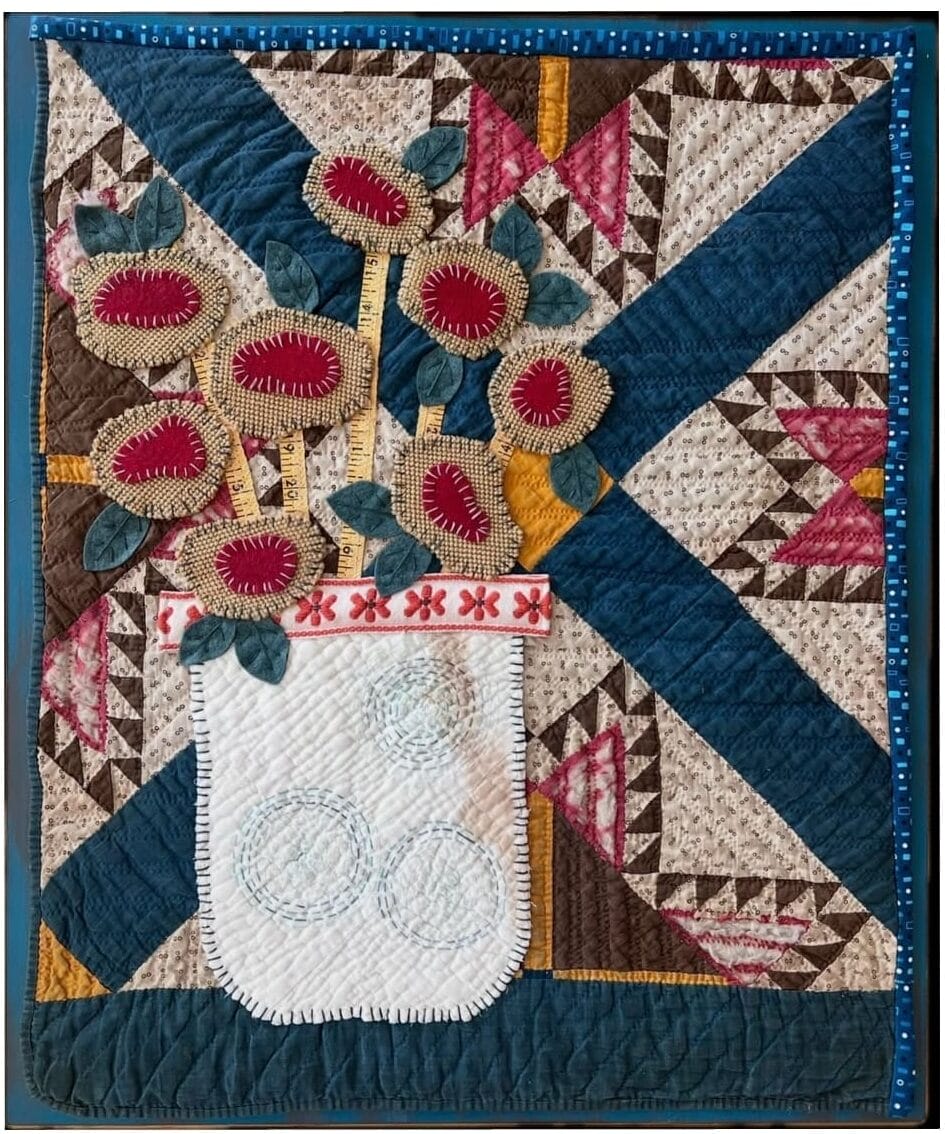
Alexa Lett’s artistic journey did not begin in a traditional studio or through formal training; it started in the quiet, in-between moments of everyday life. What began as a simple way to pass time and learn something new gradually evolved into a deeply personal and meaningful creative practice. Over the years, her work has become a constant companion through various phases of life, offering both joy and solace.
Her introduction to stitched art came during long hours spent on bleachers, supporting her athletic daughter. In those moments of waiting, Alexa turned to creativity as a way to stay engaged and productive. Without rigid plans or expectations, she began teaching herself to stitch, experimenting freely and embracing the process as it unfolded. This organic beginning laid the foundation for a philosophy that continues to define her work today, one rooted in flexibility, curiosity, and the freedom to create without constraints.
Embracing Imperfection as a Creative Force
One of the most distinctive aspects of Alexa Lett’s work is her embrace of imperfection. In a world that often values precision and polish, her art stands as a quiet rebellion against rigid standards. She believes that creativity flourishes when rules are loosened, allowing intuition and authenticity to take the lead.
Rather than striving for technical perfection, Alexa celebrates the irregularities that come with handmade work. Each stitch, each cut, and each layered piece carries a sense of humanity, an acknowledgment that beauty can be found in the imperfect and the unfinished. This approach not only defines her aesthetic but also invites viewers to reconsider their own perceptions of art and craftsmanship.
Her work becomes a reminder that creativity is not about achieving flawlessness but about expressing something real and meaningful.
The Story Within Vintage Textiles
At the heart of Alexa’s artistic process is her use of recycled vintage textiles. Unlike traditional painters who begin with blank canvases, she starts with materials that already hold history: quilts, unfinished needlepoints, linens, and fragments of fabric that once belonged to others.
These textiles are not merely materials; they are vessels of memory. Each piece carries traces of its previous life, whether it’s a grandmother’s quilt, a carefully stitched but incomplete needlepoint, or a piece of fabric worn and softened over time. Alexa collects these remnants and transforms them into new compositions, giving them a second life while honoring their past.
Her process is deeply intuitive. She layers textiles based on color, texture, and feeling rather than following a predetermined plan. Cutting and stitching become acts of discovery, allowing the work to evolve naturally. Through this method, the final piece emerges as a dialogue between past and present, a fusion of inherited memory and contemporary expression.
Art as a Companion Through Life’s Transitions
Alexa Lett’s creative practice has been more than just an artistic pursuit; it has also been a source of strength and comfort during life’s more challenging moments. What began as a mobile hobby eventually became a grounding force during deeply personal experiences, including caring for an aging parent.
In those quieter, often emotionally complex times, stitching offered her a sense of peace and focus. The repetitive motion of needle and thread became meditative, allowing her to process emotions while remaining present. Art, in this sense, became both an outlet and a refuge, a way to navigate life’s transitions with grace and resilience.
This connection between art and lived experience is evident in her work. Each piece carries not only the history of the textiles used but also the emotional imprint of the moments in which it was created. Her art becomes a layered narrative, reflecting both personal and collective stories.
The Emergence of Organic Forms and Floral Motifs
While Alexa’s process is largely intuitive, certain visual themes frequently emerge in her work, most notably, floral motifs. These forms are not rigid or botanically precise; instead, they flow organically, shaped by the movement of fabric and the rhythm of stitching.
The flowers that appear in her pieces feel alive, as though they have grown naturally from the materials themselves. They are guided more by instinct than by realism, resulting in compositions that feel both familiar and dreamlike. This balance between abstraction and recognition allows viewers to connect with the work on a personal level.
The use of layered textiles adds depth and dimension, creating surfaces that invite closer inspection. Each piece reveals subtle variations in color, texture, and form, encouraging viewers to engage with the work beyond a single glance.
A Shared Experience of Memory and Recognition
One of the most powerful aspects of Alexa Lett’s art is its ability to evoke memory. Viewers often find themselves recognizing something within her work, a pattern that resembles a grandmother’s fabric, a texture reminiscent of a childhood quilt, or a detail that recalls a familiar object from the past.
These moments of recognition are central to her artistic vision. When someone connects with a piece in this way, the artwork transcends its physical form and becomes a shared experience. It bridges the gap between artist and viewer, transforming personal memory into something collective and universal.
In these instances, her work becomes more than art; it becomes a conversation. It invites viewers to reflect on their own histories, to revisit forgotten moments, and to find meaning in the fragments of the past.
Resourcefulness and Sustainability in Practice
Alexa’s use of recycled textiles also speaks to a broader commitment to resourcefulness and sustainability. By repurposing materials that might otherwise be discarded, she not only reduces waste but also highlights the value of what already exists.
Her work challenges the notion that art must begin with new or pristine materials. Instead, she demonstrates that beauty and meaning can be found in what is worn, used, and overlooked. This perspective adds another layer of depth to her practice, aligning her creative process with a mindful and environmentally conscious approach.
Encouraging Creativity Without Boundaries
At its core, Alexa Lett’s artistic journey is an invitation. She encourages others to explore their own creativity, regardless of where they begin or what tools they have. Her story serves as a reminder that art does not require perfect conditions, formal training, or rigid structure.
Creativity can start anywhere, in a waiting room, on a set of bleachers, or during a quiet moment at home. It can grow slowly, shaped by experience and curiosity, and evolve into something deeply meaningful over time.
By sharing her work and her process, Alexa inspires others to embrace their own creative instincts. She shows that art is not about following rules but about discovering what feels true and allowing that truth to take shape.
Conclusion: Weaving Past and Present into Meaningful Art
Alexa Lett’s work is a testament to the power of storytelling through material, memory, and intuition. By transforming vintage textiles into layered, expressive compositions, she creates art that is both deeply personal and widely relatable.
Her journey, from a simple pastime to a meaningful artistic practice, highlights the transformative potential of creativity. Through her embrace of imperfection, her connection to lived experience, and her ability to evoke shared memory, Alexa has developed a body of work that resonates on multiple levels.
In every stitch and every fragment of fabric, there is a story waiting to be discovered, one that connects the past with the present and invites viewers to find their own place within it.

