


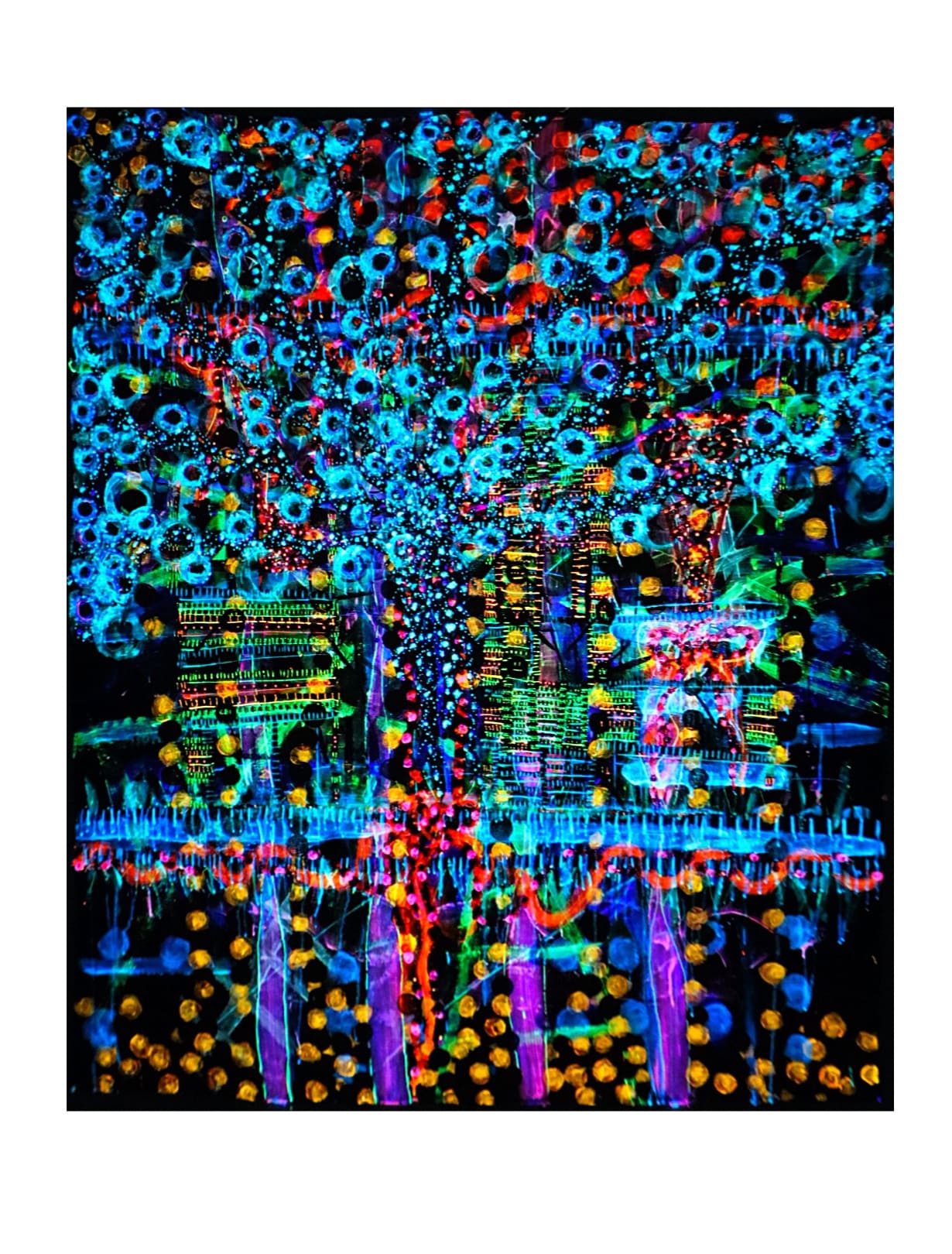
Yana Gordin is a Los Angeles based artist whose work exists at the intersection of art, psychology, and human experience. As both a practicing psychotherapist and an accomplished visual artist, she brings a rare depth of emotional and intellectual insight into her creative practice. Her art is not only something to be viewed, it is something to be felt, explored, and experienced on multiple levels.
Her work bridges internal and external worlds, drawing from psychological concepts such as transference, free association, and the ongoing dialogue between the conscious and unconscious mind. Through immersive, abstract compositions, Yana transforms intangible emotional landscapes into vivid visual narratives that invite viewers to reflect on their own inner experiences.
Early Life: Finding a Voice Through Art
Yana’s relationship with art began at a very young age, rooted in personal transformation and adaptation. At just five years old, she immigrated with her family from Moscow, Russia to Los Angeles, California. Arriving in a new country without the ability to speak English, she faced the challenge of navigating an unfamiliar culture and environment.
It was in art class that she discovered her first true language. Colors, textures, and shapes became her means of communication, tools that allowed her to express thoughts and emotions she could not yet verbalize. This early reliance on creativity as a bridge to connection would go on to define both her personal and professional life.
Art, for Yana, was never just about aesthetics. It was about survival, expression, and connection. These formative experiences laid the groundwork for a lifelong exploration of how creativity can serve as a powerful psychological tool.
Art as Healing: A Transformative Turning Point
A pivotal moment in Yana’s journey came in 2009 while she was pursuing her Bachelor’s degree in psychology at California State University, Northridge. During this time, she experienced the sudden loss of her father, a life-altering event that deeply impacted her emotional world.
In the midst of grief, she turned once again to art. Painting became a vital outlet, offering her a way to process complex emotions that words alone could not capture. It was during an abstract painting class that she encountered a profound sense of freedom, an ability to release, explore, and reconstruct her inner experience on canvas.
This period marked a significant turning point. Within a year, she held her first art show in Downtown Los Angeles, became a consignment artist with Artspace Warehouse in West Hollywood, and participated in a group exhibition at CSUN. These early successes affirmed her artistic voice and set the stage for a growing presence in the art world.
Academic and Professional Integration
Inspired by the healing power of art, Yana chose to deepen her understanding of the human psyche through advanced academic study. In 2014, she earned a Master’s degree in Psychology with a focus on Marriage and Family Therapy and Art Therapy. She continued her education, obtaining a Doctor of Psychology in Applied Clinical Psychology in 2017.
Both her MA thesis and doctoral dissertation centered on grief, an area that had already profoundly shaped her personal journey. Her research explored how individuals process loss and how alternative methods, including creative expression, can support healing.
In 2020, Yana became a licensed psychotherapist, formalizing her role in helping others navigate emotional challenges. Her dual identity as both therapist and artist allows her to approach creativity not just as a form of expression, but as a structured and transformative process.
In 2023, she expanded her reach further by publishing her book, “Beyond The Veil: Navigating Grief Through Spirituality, Religion, and Alternative Methods.” The work reflects her deep engagement with grief as both a personal and professional focus, offering readers insight into the many ways healing can unfold.
A Return to Abstract Expressionism
In 2024, Yana returned fully to her abstract painting roots, embracing abstract expressionism as a means of maintaining balance in her life. While continuing her psychotherapy practice, she found that painting allowed her to stay grounded, mentally, emotionally, and creatively.
Her current work is characterized by its dynamic, immersive quality. Each piece evolves under different lighting conditions, including UV light, natural light, and even total darkness. This unique feature transforms the viewing experience into something fluid and ever-changing, mirroring the shifting nature of human perception and emotion.
Rather than presenting a static image, Yana creates environments, spaces where viewers can engage with the work over time and discover new layers with each interaction.
Exploring the Unseen: Themes and Process
At the core of Yana’s practice is an exploration of the unseen. Her work delves into the subconscious, inviting viewers to engage with emotions, memories, and internal narratives that may not always be accessible through conscious thought.
Her process often reflects principles of free association, allowing forms and colors to emerge organically without rigid structure. This intuitive approach mirrors therapeutic techniques, where meaning is uncovered gradually through exploration rather than imposed from the outside.
Themes of transformation, resilience, and emotional complexity run throughout her work. By translating psychological concepts into visual form, she creates pieces that resonate on both an intellectual and emotional level.
Featured Work: Bloom Anyway (2026)
One of Yana’s most powerful recent works, Bloom Anyway (2026), exemplifies her ability to merge social commentary with deeply personal expression. Measuring 60 x 72 inches and created using acrylic, oil pastel, and pigments on canvas, the piece is both visually striking and conceptually rich.
At its core, Bloom Anyway confronts the realities of a world shaped by inequality, deception, and systemic imbalance. Layers of lines, bows, and ties weave across the canvas, symbolizing structures that bind, conceal, and control. These elements evoke systems of power where resources flow unevenly, where wealth accumulates at the top while those below remain constrained.
Yet, despite this heavy foundation, the painting is not one of despair. Emerging through these restrictive layers are vibrant, reaching forms, petals that refuse to remain buried. These organic elements represent life’s inherent drive toward growth and expression.
The message is clear and deeply resonant. Even within oppressive systems, there is an unstoppable force that pushes toward light, expansion, and self-realization. We bloom anyway.
The work captures a duality that is central to Yana’s practice, the coexistence of struggle and resilience, darkness and light. It invites viewers to reflect not only on external systems but also on their own capacity to grow and thrive despite adversity.
Art as an Ongoing Dialogue
Yana Gordin’s work stands as a testament to the power of art as both a personal and collective tool for understanding. By integrating her background in psychology with her artistic practice, she creates pieces that are not only visually compelling but also deeply meaningful.
Her art does not offer simple answers. Instead, it opens a dialogue between viewer and artwork, between conscious and unconscious, between pain and healing. It encourages introspection, challenges perception, and ultimately reminds us of the complexity and resilience of the human experience.
In a world that often feels fragmented and overwhelming, Yana’s work offers a space for reflection and connection, a place where we can confront the unseen, embrace transformation, and, above all, continue to bloom.

