


Arturo Garcia is a contemporary painter whose work brings together the discipline of classical draftsmanship and the sensitivity of a modern visual language. His paintings move across portraiture, still life, and figurative art, yet what unites them is not simply subject matter. It is the atmosphere he creates: one of stillness, concentration, and emotional precision. Garcia’s practice does not rely on theatrical storytelling or dramatic narrative cues. Instead, he builds meaning through light, form, gesture, and the quiet psychological charge of a painted presence.
At the center of Garcia’s work is a deep commitment to observation. His paintings suggest an artist who understands realism not as a fixed tradition to be copied, but as a living language that can still be expanded. He works within the legacy of representational painting while opening it toward contemporary questions about identity, vulnerability, perception, and time. In this way, Garcia’s art stands at an interesting intersection. It honors the technical foundations of historical painting while also engaging with the inward, often unstable nature of modern experience.
This balance between technical rigor and conceptual openness is what gives his work such resonance. His paintings are carefully made, with refined control over color, light, and anatomy, but they are never merely demonstrations of skill. They hold something quieter and more difficult to name: an awareness of the human figure as both physical reality and emotional threshold. Garcia’s subjects seem to exist not only in space, but in states of mind.
Classical Technique, Contemporary Sensibility
One of the most compelling aspects of Garcia’s work is the way he treats realism as a flexible and evolving mode of expression. His foundation in classical draftsmanship is evident in the structural integrity of his forms, the coherence of his compositions, and the measured handling of paint. He understands how light defines volume, how color can guide mood, and how small shifts in expression can alter an entire image.
Yet Garcia does not remain confined within academic realism. His modern sensibility is clear in the emotional restraint of his work and in the open-ended way his paintings communicate. Rather than overstate meaning, he allows ambiguity to remain present. His art does not tell viewers what to think or feel. It invites them into a slower and more contemplative form of looking.
This openness is especially important in figurative painting today. In an age saturated with images, Garcia offers something rare: attention. His paintings ask the viewer to stay with the subject, to notice the subtleties of gaze, surface, and atmosphere. There is an intimacy in this approach, but it is not sentimental. It is disciplined, thoughtful, and often quietly profound.
Garcia’s work suggests that realism can still be a powerful contemporary language precisely because it deals with perception itself. The visible world becomes, in his hands, a way of approaching invisible states such as memory, awareness, uncertainty, and emotional stillness. That is what makes his paintings feel current even when their technique recalls older traditions.
The Human Figure as a Site of Reflection
The human figure occupies a central place in Garcia’s practice, and he approaches it with unusual sensitivity. Rather than presenting the body as spectacle or symbol alone, he treats it as a site where perception and feeling meet. His figures are not overly dramatized. They are present, vulnerable, and often inwardly absorbed. This gives his portraits and figurative works a distinct psychological depth.
Garcia seems interested in the space between what is seen and what is sensed. A face is never just a face. A gesture is never only descriptive. In his paintings, the figure becomes a vessel for questions about interiority and human experience. This is where his emotional restraint becomes especially effective. By refusing exaggeration, he allows the viewer to encounter the subject with greater intensity.
His paintings often feel suspended in time. They do not rush toward action or resolution. Instead, they dwell in moments of pause. This temporal stillness creates a contemplative mood and encourages a different kind of engagement. Viewers are not simply consuming an image; they are entering a condition of attention shaped by silence, delicacy, and subtle transformation.
This concern with vulnerability and perception is central to Garcia’s place within contemporary discourse. While many artists today work through fragmentation, irony, or spectacle, Garcia chooses focus, care, and painterly presence. His realism does not retreat from the present. It responds to it by insisting that quiet looking still matters.
Reading The Alchemy of Sight
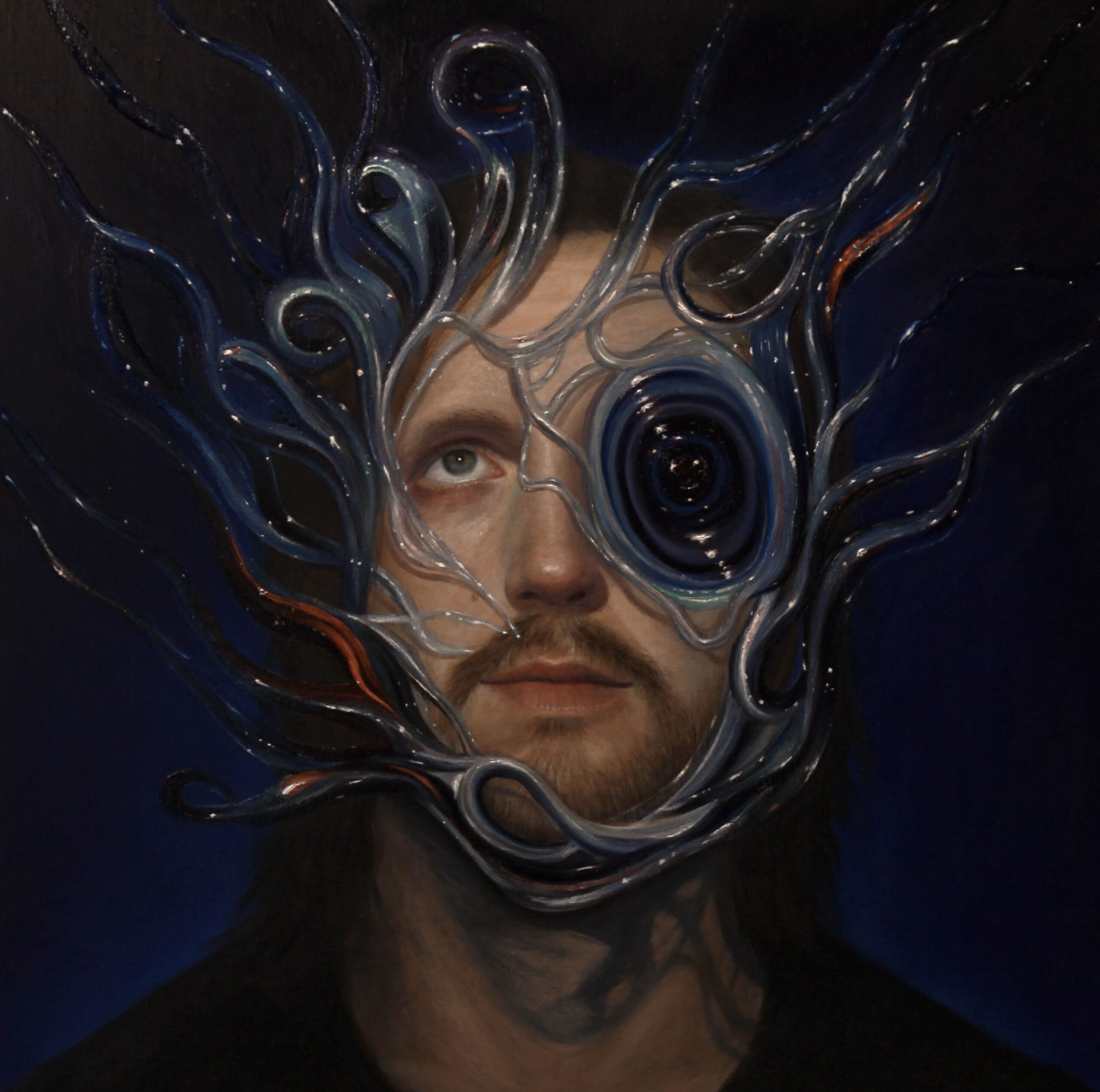
Garcia’s painting The Alchemy of Sight is a compelling example of how his practice merges technical realism with symbolic and visionary language. Measuring 12 x 12 inches and executed in oil on wood, the work presents a portrait that is intimate in scale yet expansive in meaning. It is a painting that draws the viewer close, then opens onto deeper questions of vision, consciousness, and transformation.
The portrait is grounded in classical realism, but it moves beyond naturalistic description. Across the face, delicate blown-glass forms seem to drift and weave like living currents. These translucent structures introduce a sense of fragility and motion, as though perception itself has taken material form. Glass is an especially potent choice here. It suggests clarity and distortion at once. It can reveal, refract, magnify, or fracture. In the context of the portrait, these forms become a metaphor for the unstable architecture of seeing.
Most striking is the replacement of natural sight with a cosmic eye. This transformation shifts the portrait from human likeness into visionary territory. The eye, traditionally associated with knowledge, awareness, and identity, becomes something larger and less fixed. It no longer belongs only to the individual figure. It becomes symbolic of expanded consciousness, altered perception, or an awakening beyond the limits of ordinary vision.
What makes this painting so effective is that its symbolism remains integrated with the body rather than floating above it as an illustration. The figure is not simply decorated with surreal elements. Instead, the entire face becomes a space of metamorphosis. Humanity and metaphysical vision coexist in luminous tension. The portrait seems to suggest that seeing is never neutral. It is fragile, transformative, and deeply tied to how we experience reality.
Fragility, Consciousness, and Imagination
In The Alchemy of Sight, Garcia turns portraiture into a meditation on consciousness itself. The painting’s title is important. Alchemy refers to transformation, to the conversion of one state into another, and to processes that are both material and spiritual. In this work, sight is not treated as a passive act. It is something that changes the self. To see is to become altered.
The blown-glass forms reinforce this idea beautifully. Their delicacy implies vulnerability, while their movement across the face suggests that perception is not fixed or complete. It is always being shaped, filtered, and reformed. The face becomes a place where inner and outer worlds meet, where imagination enters into contact with embodied reality.
The cosmic eye intensifies this sense of transformation. It implies a heightened awareness, perhaps even a visionary state, but Garcia handles this idea with restraint. The image does not become grandiose. It remains quiet, concentrated, and intimate. That tension between the cosmic and the personal is one of the painting’s greatest strengths. The figure is at once singular and universal, human and symbolic.
There is also a silence in the work that feels essential. Garcia does not overload the painting with explanation. He allows form, light, and symbolism to operate together without forcing a single interpretation. As a result, the painting invites contemplation rather than conclusion. Viewers are left to reflect on how perception shapes identity, how fragility relates to awareness, and how imagination can transform the ordinary face into a site of metaphysical inquiry.
Arturo Garcia’s Place in Contemporary Painting
Arturo Garcia’s art demonstrates that realism remains a fertile and relevant mode within contemporary painting. His work does not repeat the past, nor does it reject it. Instead, it reactivates traditional methods in order to address present concerns with sensitivity and depth. Through his refined technique and thoughtful approach to the figure, Garcia offers a form of painting that is both grounded and searching.
The Alchemy of Sight captures this balance with particular clarity. It is a portrait, but also a meditation. It is realistic in execution, yet visionary in implication. Most importantly, it reflects Garcia’s larger achievement as an artist: his ability to create images that are technically assured, emotionally restrained, and conceptually alive.
In a contemporary art landscape often shaped by speed and excess, Garcia’s paintings remind us of the power of stillness, observation, and sustained looking. His work affirms that the human figure continues to hold immense expressive potential, especially when approached with intelligence, care, and openness. Through this commitment, Arturo Garcia positions himself as a painter who understands realism not as an endpoint, but as a living, transformative practice.

