


M.J. Hartwig occupies a space rarely found in contemporary art. He is an attorney, artist, author, and farmer, roles that speak not only to professional versatility but to a life shaped by experience rather than abstraction. Dividing his time between the United States and Mexico, Hartwig’s worldview is forged at the intersection of land and sea, law and labor, intellect and instinct.
Before dedicating himself to painting, Hartwig worked as a fisherman, tugboat captain, and salvor, professions rooted in risk, physical endurance, and intimate knowledge of nature’s volatility. These years on the water instilled in him a firsthand understanding of impermanence and flux, lessons that would later emerge as foundational themes in his art. Unlike many artists whose relationship with nature is observational or symbolic, Hartwig’s connection is experiential. He has negotiated with storms, tides, and mechanical failure, learning early that control is always provisional.
This lived reality informs not only what Hartwig paints, but why he paints.
Nature as Flux, Humanity as Artifice
At the core of Hartwig’s practice lies a philosophical position. Nature is not static, and neither is humanity. He sees the natural world as inherently fluid, an ever-shifting system governed by entropy, adaptation, and renewal. Human beings, despite their technologies and institutions, are not exempt from this reality. Our social structures, political systems, and economic hierarchies are fragile constructs, subject to decay and collapse.
Hartwig is deeply critical of modern society’s refusal to acknowledge this truth. In an era increasingly defined by techno-totalitarianism, societal engineering, and the suppression of dissent, humanity has attempted to replace organic complexity with rigid control. Algorithms dictate behavior, narratives are curated, and deviation from sanctioned thought is often punished rather than debated.
Hartwig’s work positions itself in direct opposition to this trend. His paintings do not seek comfort, neutrality, or aesthetic detachment. Instead, they confront viewers with the tension between what is natural and what is imposed, between authentic human experience and manufactured consensus.
Painting Against Tyranny
For Hartwig, art is not decoration. It is resistance.
He holds the conviction that art plays a vital role in opposing tyranny, particularly in times when language itself has been compromised. When political discourse becomes performative, and truth is filtered through power, visual art retains the capacity to speak directly and often uncomfortably to the human conscience.
This belief shapes the structure of his body of work, which falls broadly into two categories. One explores the natural world. The other addresses political reality directly. The distinction, however, is not rigid. Even his nature-based works carry philosophical weight, emphasizing impermanence, vulnerability, and forces beyond human control. His political paintings often draw from classical composition and realism, grounding contemporary critique in the visual language of tradition.
Hartwig is a self-taught painter, and this independence is central to his artistic identity. Unbound by academic orthodoxy or market trends, he paints with the freedom of someone unconcerned with polite approval. He describes himself as a classical liberal and an anachronism, a chain smoker who avoids polite company and prefers conversations about politics, philosophy, physics, and religion. This rejection of superficial discourse mirrors his rejection of superficial art.
“Let Them Eat Kale”: A Modern Allegory
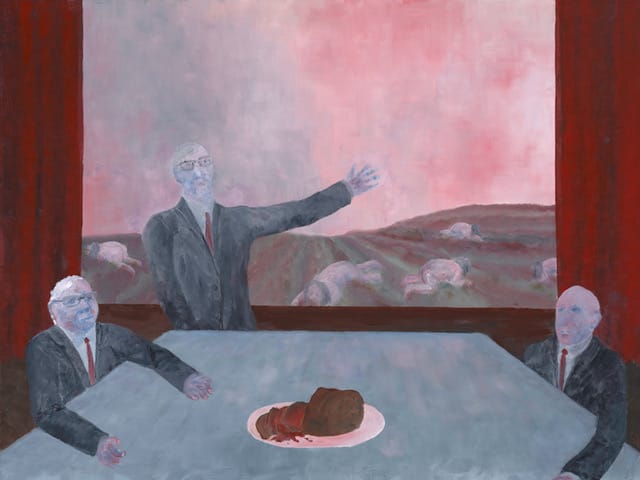
Hartwig’s painting Let Them Eat Kale (Oil on Canvas, 36 x 48 inches) stands as a sharp and unapologetic example of his political work. The composition depicts Bill Gates, Warren Buffett, and Jeff Bezos seated together, dining on Wagyu beef, one of the most expensive and luxurious foods available. The scene is rendered with deliberate irony, juxtaposing indulgence against moral posturing.
The title references Gates’ public assertions that the global population should transition toward plant-based diets, often framed as a moral necessity for sustainability and climate responsibility. Hartwig’s critique is not aimed at vegetarianism itself, but at the hypocrisy of elites who prescribe austerity for others while making no personal commitment to sacrifice. In Let Them Eat Kale, the wealthy do not merely consume. They feast, insulated from the consequences of the policies they advocate.
The painting operates as a contemporary allegory, echoing the historical sentiment attributed to Marie Antoinette while grounding it firmly in modern power dynamics. The elite are portrayed not as caricatures, but as composed beneficiaries of a system that treats the rest of humanity as resources rather than individuals. The masses, though absent from the canvas, are implicitly present, reduced to commodities to be managed and sustained rather than respected.
Art, Hypocrisy, and the Human Cost
What makes Let Them Eat Kale particularly striking is its moral clarity. Hartwig does not rely on obscured symbolism to soften his position. Instead, he confronts the viewer with a scene that demands judgment. The painting asks difficult questions. Who decides what others must give up? Who profits from moral authority? At what point does concern for the planet become justification for control?
This directness is a defining characteristic of Hartwig’s work. He is uninterested in ambiguity for its own sake. His paintings are meant to provoke thought, debate, and dissent. In a cultural climate where dissent is increasingly framed as danger, Hartwig insists on its necessity.
An Unfashionable Voice That Refuses Silence
M.J. Hartwig’s art does not seek validation from trends, institutions, or ideological camps. It exists in deliberate friction with contemporary norms, embracing discomfort as a form of honesty. His background as a mariner, laborer, attorney, and farmer grounds his philosophy in lived experience rather than theory.
In painting both nature and politics, Hartwig reminds us that nothing is fixed. Landscapes shift. Systems of power decay. Narratives imposed upon society can be challenged. His work urges viewers to recognize hypocrisy, resist engineered conformity, and reclaim the essential human capacity for critical thought.
In an age that rewards compliance and punishes complexity, Hartwig’s paintings stand as acts of defiance. They are visual arguments for freedom, responsibility, and truth.

