


Jean-Pierre Tessari is a self-taught artist whose creative journey began in 1975 while working at an advertising agency in Paris. It was within that professional environment that he produced his first drawings, works that would lay the foundation for a lifelong intuitive exploration of form, color, and repetition. Those early sketches were not isolated experiments; they became the starting point for entire series of paintings and the development of a distinctive visual language centered on the stencil.
From the beginning, Tessari approached art as a field of discovery rather than doctrine. Without formal academic constraints, he allowed instinct to guide him. His initial drawings were reworked into stencils cut from Bristol paper or mounted board. By 1980, he began introducing color, generating numerous painted variations from the same stencil. Over time, this process evolved into a defining technique: the stencil was no longer merely a preparatory tool but an essential structural and conceptual component of the finished work. It became both the origin and the imprint of the image, an enduring signature of his artistic identity.
The Stencil as Structure and Freedom
Tessari’s use of the stencil reflects both discipline and experimentation. The fixed outline provides a recurring anchor, ensuring that the subject remains present even as the surrounding space shifts toward abstraction. Each painting begins with this imprinted form, but what unfolds around it is an open field of reinvention.
He undertook an extensive exploration of materials in his pursuit of abstraction. Over the years, he experimented with model paint, stained-glass paint, gouache, and spray paint, pushing each medium to its expressive limits. Until 2000, spray paint played a central role in his work, allowing him to create sharp contrasts and atmospheric effects. Eventually, he transitioned to acrylics, embracing their depth and versatility while adopting new tools that refined his technique.
His curiosity extended beyond traditional canvas. Tessari explored alternative supports, continually challenging how and where painting could exist. Forms, lines, curves, and colors are in constant renewal in his work. Shadows intersect with patterns, contrasts generate movement, and backgrounds vibrate against the subject. Although his research often approaches abstraction, the stencil ensures that the motif remains a visible point of departure, a silent yet persistent presence.
Encounters That Shaped a Vision
Throughout his life, encounters have nourished Tessari’s imagination. The figure of the woman appears as a recurring theme, reflecting both aesthetic fascination and emotional resonance. His first self-portrait, “Narcisse,” created in 1984, marked a significant moment of introspection, blending personal reflection with symbolic depth.
He draws inspiration from the visionary world of science fiction comics, particularly the work of Philippe Druillet. Druillet’s dramatic compositions and powerful graphic structures resonate in Tessari’s bold outlines and layered imagery. Another profound influence came through his encounter with the painter and photographer Sarah Moon, whose poetic and dreamlike atmosphere inspired Tessari’s painting “Rêvdemask.” He also expresses admiration for Street Art, whose immediacy and graphic strength align naturally with his stencil-based approach.
Personal experiences have equally shaped his artistic path. A meditation session at a fellow painter’s home deepened his inner exploration. A hitchhiking journey to Denmark broadened his sense of movement and openness. In 1989, a theater-artist friend produced more than 178 photographic prints of his paintings and drawings, expanding the dialogue between original work and reproduction. These moments, both intimate and expansive, have left subtle yet enduring marks on his creative evolution.
Exhibitions and Recognition
By 1986, Tessari had already created more than 350 works and began exhibiting publicly. That same year, he designed the cover for the French pocket edition of Le Maître de l’Espace et du Temps by science fiction writer Rudy Rucker, published by Éditions Denoël. This collaboration affirmed his connection to imaginative and speculative universes.
After a temporary pause, he resumed painting in 1999 with renewed intensity, producing 92 works in less than a year. In 2000, he was selected among 130 painters to participate in the Salon de l’Art Contemporain in Paris and was also selected for the 17th Salon d’Art Contemporain in Senlis. In 2001, he exhibited around forty paintings at the Centre International de Séjour in Paris. That year marked a decisive technical shift as he transitioned from spray paint to acrylics, redefining his tools and methods.
He received several awards at exhibitions in the Picardy region and continued producing prolifically in Meaux. In 2011, he moved to Sauveterre-de-Guyenne. In 2015, members of the artistic collective Atelier 10 in Floirac invited him to exhibit multiple times, and he also showed his work in Rions. In 2016, he advanced his stencil practice further by having his designs laser-cut in stainless steel at an industrial facility, an innovation that combined precision technology with his long-standing technique.
Between 2015 and 2021, he participated in thirteen exhibitions across France. In 2022, he received First Prize for Technique and obtained an official artistic rating at the Salon Paris Art Show XII. Since then, he has continued exhibiting in the Bordeaux region, affirming his place within contemporary French art.
A Singular Work of Patience and Reinvention
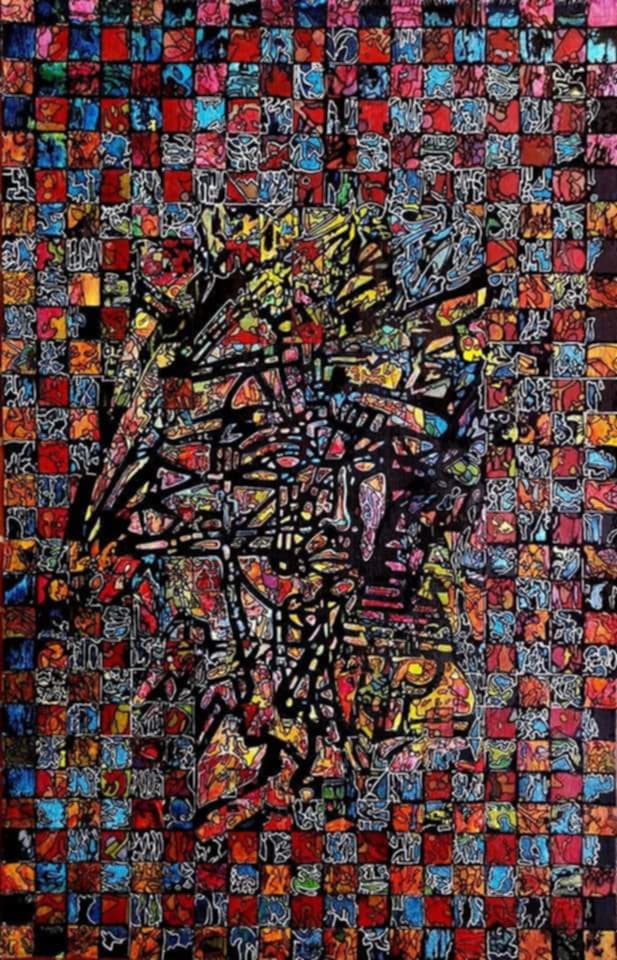
Among his works, one painting created in 2021 stands out for its unique story. Part of a theme developed in multiple formats and color variations, this particular piece became singular through accident. When removing the stencil, it tore, an unexpected rupture that might have ended the process.
Instead, Tessari embraced the accident as an opportunity. He returned to a technique he had not used that year: small square patterns surrounding the motif. What followed was nearly one hundred hours of meticulous labor, outlining each color by hand. The painting measures 37 x 55 cm, stretched on canvas and presented in a floating American box frame. Executed in acrylic, with outlines completed using a Pébéo 0.8 mm acrylic marker, it embodies both discipline and resilience.
The work demonstrates how unpredictability can lead to renewal. The torn stencil did not signal failure; it opened a new path within an ongoing exploration.
Only the Painting Matters
For Jean-Pierre Tessari, the artist is secondary to the artwork itself. What matters is the painting, the final rendering that carries emotion and meaning. The connection between artwork and viewer is always a “coup de cœur,” a heartfelt resonance that cannot be manufactured.
Each painting becomes a mirror. The viewer may recognize fragments of their own perception within it. If someone sees nothing, it is because the mirror reflects only what one brings to it.
Guided by intuition, shaped by encounters, and sustained by an unrelenting search for multiplicity in forms, colors, shadows, and patterns, Jean-Pierre Tessari continues to reinvent himself. Through the enduring presence of the stencil and the evolving freedom of abstraction, his work invites the gaze to wander and perhaps discover something unexpected within itself.

