


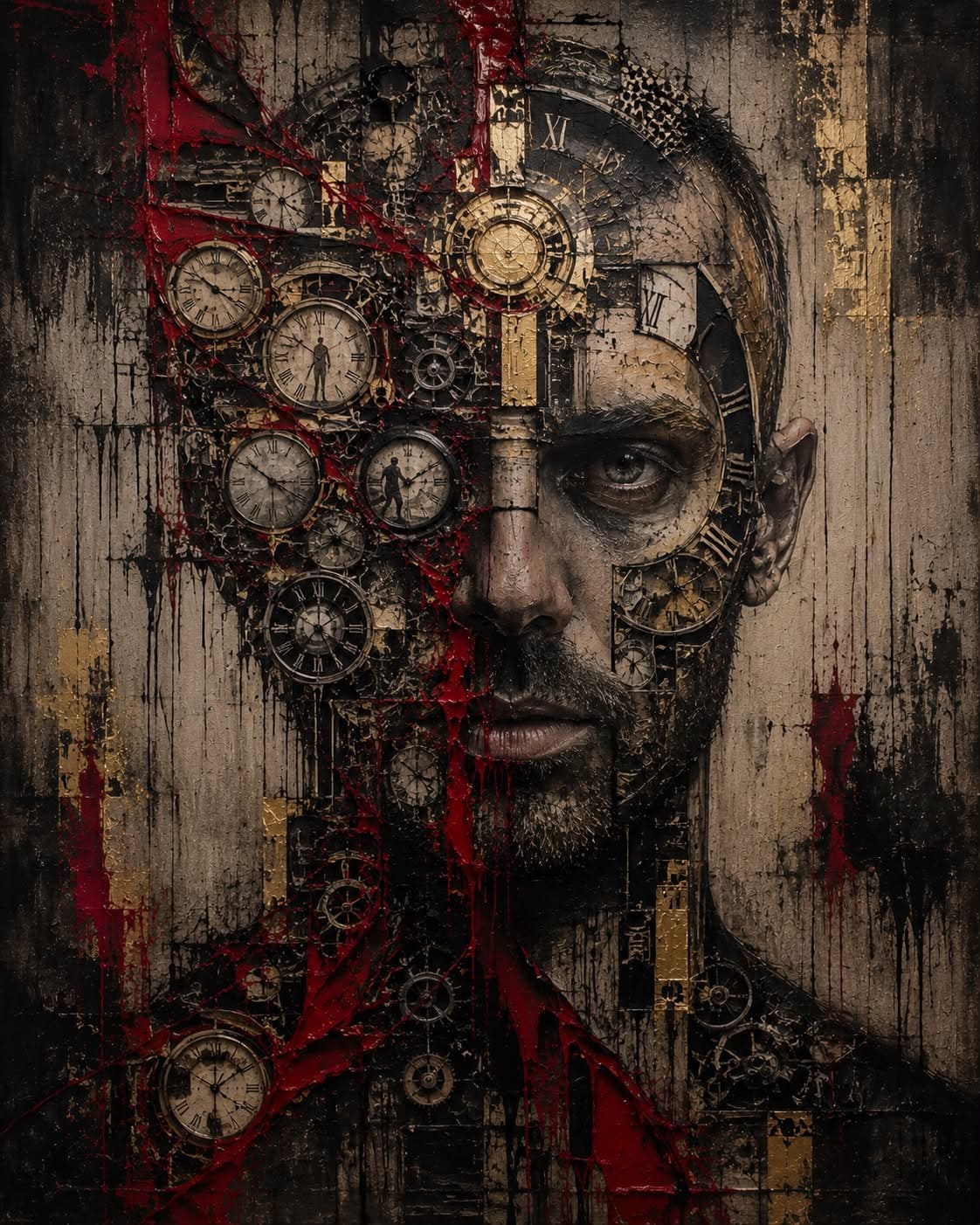
Ian Newman is a London-based artist whose work is deeply rooted in the realities of human existence. Rather than simply creating visually engaging compositions, Newman constructs meaningful narratives that invite viewers to reflect on their own lives, decisions, and personal transformations. Every artwork begins with a simple yet profound idea: life is defined by the choices we make, the connections we build, and the experiences that shape who we become.
His paintings are driven by symbolism, emotional honesty, and psychological depth. Layers of texture, carefully selected materials, and a restrained yet powerful colour palette work together to communicate ideas that often go beyond words. Instead of offering straightforward answers, Newman encourages viewers to pause, interpret, and discover their own meanings within the work.
At the heart of his artistic practice lies an exploration of resilience. His paintings acknowledge struggle without surrendering to it, presenting transformation not as an abstract concept but as a necessary part of being human.
A Visual Language Built on Three Pillars
Every artist develops a vocabulary unique to their creative practice. For Ian Newman, that vocabulary is defined by three essential visual pillars that appear throughout his work. Each element carries symbolic significance while contributing to the emotional architecture of the painting.
Industrial charcoal represents structure, history, and the weight that every individual carries. It reflects the foundations built through experience, both the visible and invisible burdens accumulated over time. The rough, tactile quality of charcoal reinforces the idea that life leaves permanent marks, shaping identity through both hardship and growth.
Crimson red introduces an entirely different emotional register. It represents life itself: energy, emotion, rupture, passion, and the force that pushes us through moments of uncertainty. It serves as the pulse within each composition, reminding viewers that beneath every scar or fracture exists an enduring vitality that refuses to disappear.
Gold completes this symbolic trilogy by representing connection. Rather than functioning simply as decoration, gold becomes the thread that binds experiences together. It symbolises relationships, shared humanity, spirituality, and the invisible bonds that remain intact even when people feel broken or isolated. Gold suggests that connection persists despite life’s fractures, offering hope without denying reality.
Together, these three elements create a visual language that is immediately recognisable while remaining open to personal interpretation.
The Psychology of Breaking and Rebuilding
Much of Ian Newman’s work focuses on transformation, not the idealised version often portrayed in popular culture, but the complicated, uncomfortable process of breaking apart before rebuilding.
His paintings acknowledge that personal growth frequently emerges from adversity. Emotional wounds, difficult choices, and life’s inevitable pressures become essential components of identity rather than obstacles to overcome and forget.
This psychological approach gives his work a remarkable emotional authenticity. Instead of separating vulnerability from strength, Newman presents them as inseparable forces. Every fracture contains the possibility of renewal, while every rebuilding carries traces of what came before.
Texture plays an essential role in communicating these ideas. Surfaces appear weathered, layered, and lived-in, echoing the complexities of memory and experience. Nothing feels overly polished because human lives themselves are rarely smooth or uncomplicated.
The result is artwork that resonates not only visually but emotionally, encouraging prolonged reflection long after the viewer has stepped away.
“The Time We Have Left”: A Portrait of Choice and Mortality
Among Ian Newman’s most compelling works is The Time We Have Left, a deeply personal self-portrait that examines humanity’s relationship with time, mortality, and personal responsibility.
Rather than presenting a literal likeness, Newman transforms his own face into a symbolic landscape where mechanical structures replace fractured features. Gears, mechanisms, and industrial forms become metaphors for the passage of time and the relentless movement of life.
The fractured face represents years already lived, moments that cannot be reclaimed, opportunities missed, lessons learned, and experiences that leave permanent marks upon identity. These visual disruptions communicate the emotional cost of time without resorting to sentimentality.
Yet the painting refuses to become an expression of despair.
The remaining gears continue to turn.
This simple but powerful image transforms the entire meaning of the work. While some parts have been damaged or lost, movement continues. Life continues. Choice remains possible.
Rather than focusing on regret, The Time We Have Left asks a universal question: What do we choose to do with the time that remains?
It is this balance between acceptance and hope that gives the painting its emotional strength. Newman acknowledges the irreversible passage of time while insisting that the future is still shaped by individual decisions.
Symbolism That Speaks Beyond the Canvas
One of the defining characteristics of Ian Newman’s work is his ability to create symbolism that feels both deeply personal and universally accessible.
Although many paintings emerge from his own experiences and reflections, they avoid becoming autobiographical in a limiting sense. Instead, they create space for viewers to project their own memories, emotions, and interpretations onto the work.
Mechanical components become metaphors for endurance.
Fractures become symbols of growth.
Gold becomes evidence that connection survives separation.
Charcoal becomes the accumulated weight of lived experience.
Red becomes the pulse that refuses to stop.
These symbols operate on multiple levels simultaneously, allowing different viewers to discover different meanings depending on their own life experiences. This openness gives his paintings lasting emotional relevance rather than a single fixed interpretation.
Texture, Material, and Emotional Presence
Ian Newman approaches materials as active participants in storytelling rather than passive tools.
His textured surfaces mirror the complexity of the human condition. Rough passages suggest hardship and endurance, while smoother transitions offer moments of reflection and calm. The physical qualities of the painting reinforce its psychological themes, making viewers almost feel the emotional weight embedded within each layer.
This tactile quality encourages close observation. Every mark contributes to the narrative, rewarding viewers who spend time engaging with the work rather than absorbing it at a glance.
The relationship between material and meaning is never accidental. Every surface supports the larger conversation about resilience, transformation, and human connection.
Art That Invites Reflection
In an age saturated with instant images and fleeting attention, Ian Newman’s paintings encourage something increasingly rare: contemplation.
His work does not demand immediate conclusions. Instead, it asks viewers to slow down and consider their own relationship with memory, identity, time, and choice. The paintings function almost as visual meditations, prompting introspection rather than passive observation.
This reflective quality explains why his work resonates with audiences from diverse backgrounds. While individual interpretations may differ, the underlying questions remain universal. Every person carries history. Every person experiences fracture. Every person must decide what to do with the time that remains.
By exploring these shared experiences through symbolic imagery, Newman transforms personal reflection into collective dialogue.
Continuing a Conversation About What It Means to Be Human
Ian Newman’s artistic practice is ultimately an exploration of the human condition. Through carefully constructed symbolism, expressive textures, and a disciplined visual language built upon charcoal, crimson red, and gold, he creates paintings that examine resilience, identity, and the choices that define our lives.
The Time We Have Left stands as a powerful example of this philosophy, reminding viewers that while the past inevitably shapes us, it does not entirely determine our future. The gears continue to turn, and with them comes the enduring possibility of choosing how we move forward.
By combining emotional honesty with symbolic sophistication, Ian Newman continues to create work that is both intellectually engaging and deeply moving. His paintings encourage us to acknowledge our fractures without being defined by them, recognise our connections even in moments of isolation, and embrace the reality that although time is finite, meaning is created through the choices we continue to make.

