


Claudio Moroco is a Colombian visual artist whose creative practice stands at the intersection of sculpture, technology, and environmental reflection. While professionally trained as a dentist, Moroco has developed a distinctive artistic language that transforms discarded electronic components into immersive audiovisual sculptures. His work demonstrates that materials often considered obsolete still possess untapped stories, energy, and emotional potential.
Rather than viewing electronic waste as the end of an object’s journey, Moroco approaches it as the beginning of a new narrative. Old power supplies, circuit boards, wiring, acrylic, light, and sound become the building blocks of sculptural compositions that challenge conventional ideas about permanence and value. Each recovered component is carefully integrated into works that are not only visually compelling but also interactive, inviting viewers to experience technology in an entirely different way.
His sculptures encourage audiences to slow down and reconsider the relationship between humans and the machines they create. By giving discarded technology a second life, Moroco creates poetic spaces where science, memory, and imagination coexist.
Reimagining Technological Obsolescence
Modern society constantly replaces electronic devices with newer versions, leaving behind an ever-growing landscape of technological waste. Claudio Moroco responds to this reality not through criticism alone but through transformation.
Instead of allowing obsolete electronics to disappear into recycling centers or landfills, he reclaims them as artistic materials capable of carrying new meaning. Circuit boards become intricate visual textures. Power supplies evolve into structural foundations. Acrylic layers capture and diffuse light, while electronic systems once designed for practical purposes are reconfigured to produce entirely different experiences.
This process reflects an important philosophical idea within his practice: obsolescence is not an ending but a transition. Objects that have lost their original function can still possess beauty, memory, and creative possibility.
By reconstructing these forgotten materials into interactive sculptures, Moroco reveals that innovation does not always require new resources. Sometimes it simply requires a new perspective.
Sculpture That Lives Through Interaction
One of the defining characteristics of Moroco’s work is its responsiveness. His sculptures are not static objects intended only for observation. Instead, they actively engage with their surroundings.
Audio, light, and movement become part of each installation, allowing the artwork to evolve in real time. Sensors, electronic circuits, and illumination transform sculptures into dynamic organisms that react to environmental conditions and human presence.
This interaction creates an intimate dialogue between artwork and audience. Rather than standing apart from the sculpture, viewers become participants whose presence contributes to the experience itself.
The result is an artistic encounter that feels alive. The sculptures pulse, illuminate, and shift in response to external stimuli, emphasizing the invisible energies that constantly surround us yet often go unnoticed.
Memory Embedded in Machines
Technology is frequently associated with speed, progress, and constant innovation. Moroco, however, is equally interested in what technology leaves behind.
Every discarded electronic component carries traces of previous lives. A circuit board may once have powered a computer filled with memories. A transformer may have operated within a device that connected families across great distances. Even after these objects lose their practical purpose, they retain a silent history.
Moroco embraces this invisible memory as an essential part of his artistic vocabulary.
Rather than erasing the identity of reclaimed materials, he allows their industrial origins to remain visible. Their textures, shapes, and electronic architecture become aesthetic elements while simultaneously reminding viewers of the countless stories hidden inside everyday technology.
Through this approach, machines cease to be anonymous objects and instead become vessels of collective human experience.
Energy as an Artistic Language
Energy occupies a central role throughout Claudio Moroco’s work. Electricity is no longer simply a technical function but a symbolic force representing life, transformation, and connection.
Light pulses through transparent structures. Electronic signals generate movement. Sound activates visual responses. These processes reveal energy not as something hidden inside machines but as an expressive artistic medium.
This emphasis on energy gives the sculptures an organic quality despite their industrial origins. Mechanical components begin to resemble living organisms, neural networks, or microscopic ecosystems that continuously communicate with their environment.
The contrast between rigid technological materials and fluid sensory experiences creates a visual language that feels both futuristic and deeply human.
Aria: Giving Breath to Forgotten Technology
Among Moroco’s most compelling works is Aria, an audiovisual sculpture that beautifully embodies the artist’s vision of transformation and renewal.
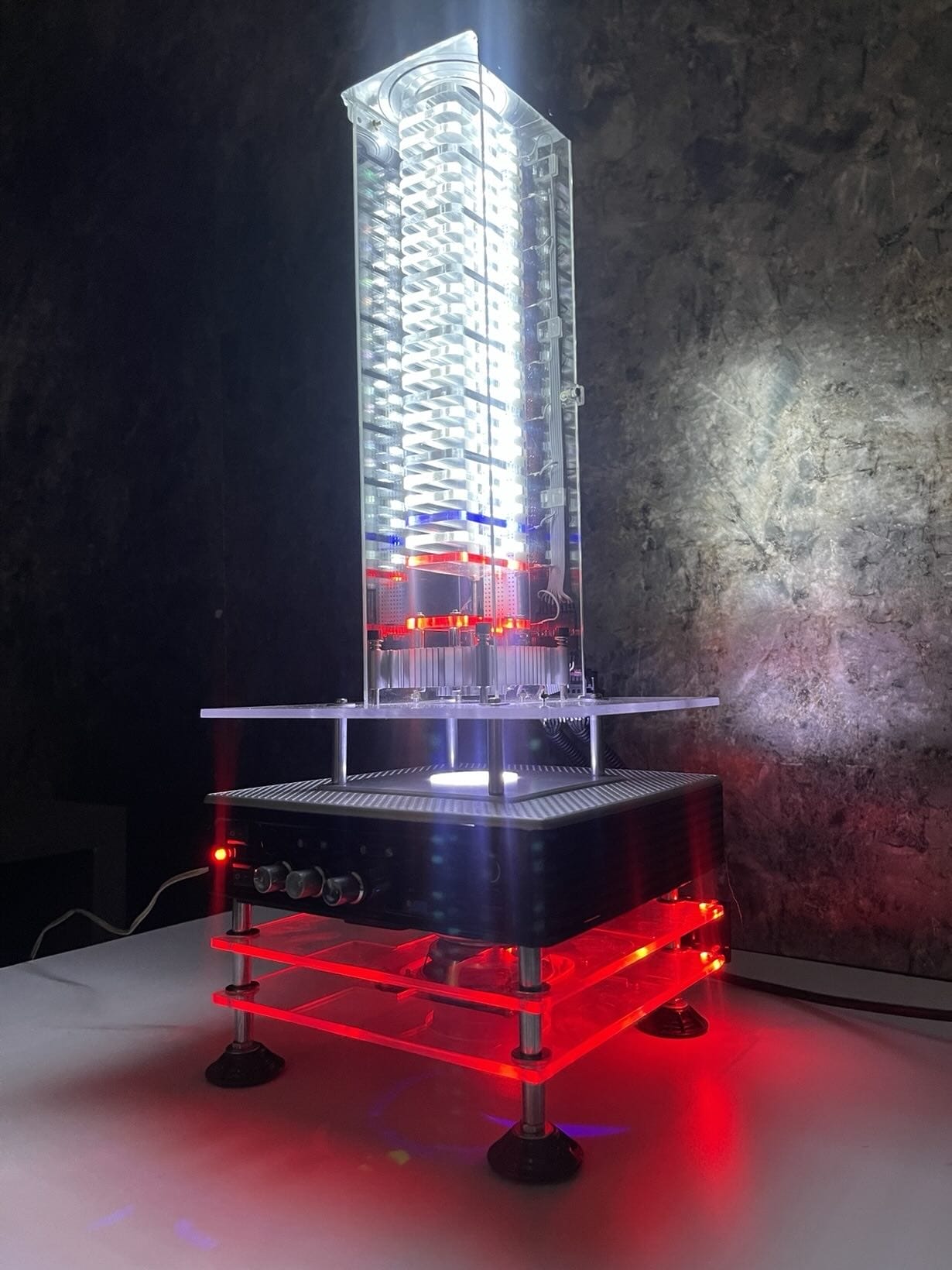
Constructed from recycled electronic components and transparent acrylic layers, Aria presents a vertical composition that evokes invisible currents of air, flowing energy, and waves of sound. The sculpture appears delicate and lightweight despite being built from industrial materials, creating a fascinating contrast between physical structure and visual sensation.
At the center of the installation is a luminous VU meter that responds directly to audio input. Rather than functioning merely as a technical measuring device, the meter becomes the heartbeat of the sculpture. As sound changes, the illuminated display generates a living visual rhythm that constantly evolves before the viewer.
The work explores themes of breath and communication, two invisible yet essential forces that sustain both life and human connection. By transforming obsolete electronic materials into responsive light and movement, Moroco grants abandoned machines a new poetic presence.
Aria reminds us that silence can become music, discarded objects can become sculpture, and forgotten technologies can once again speak through artistic imagination.
Sustainability Through Creative Transformation
Environmental awareness naturally emerges from Moroco’s artistic practice, although it is expressed through creation rather than confrontation.
His sculptures demonstrate that sustainable thinking can coexist with artistic experimentation. Recycling becomes more than a practical solution it becomes an aesthetic philosophy.
Instead of hiding recycled materials, Moroco celebrates them. Their imperfections become evidence of previous existence rather than flaws requiring concealment. This transparency encourages viewers to reconsider how they define value and beauty.
In an era increasingly shaped by disposable technology, his work offers an alternative vision where creativity extends the lifespan of materials while generating entirely new cultural meaning.
An Invitation to See Technology Differently
Claudio Moroco’s artistic practice ultimately challenges the boundaries between engineering, sculpture, environmental consciousness, and poetic expression.
His audiovisual sculptures reveal that technology is more than a collection of functional objects. It is also a repository of memory, energy, emotion, and possibility. Through thoughtful reconstruction, discarded electronic components become interactive works that breathe with light, respond to sound, and engage directly with their audiences.
By transforming electronic remnants into living artistic experiences, Moroco encourages viewers to look beyond the surface of everyday objects and discover unexpected beauty in what society has chosen to leave behind.
His work reminds us that transformation is one of art’s greatest powers, not simply changing materials into sculptures, but changing perspectives. In Claudio Moroco’s hands, obsolete machines are no longer symbols of consumption and waste. They become vibrant organisms that illuminate the enduring relationship between humanity, technology, and imagination.

