


Bryan Jennings came to painting later in life, but he has never viewed that as a disadvantage. Instead, he believes that life itself was his greatest teacher. Before he could express emotion through paint, he first needed to experience it. Moments of love, heartbreak, joy, disappointment, forgiveness, and personal growth all became part of the foundation that now defines his artistic practice.
For Jennings, painting is more than a visual exercise; it is a way of translating human emotion into landscapes that invite reflection. His work is rooted in kindness, empathy, and forgiveness, qualities he believes are discovered through living rather than simply imagined. Every painting becomes an opportunity to communicate emotions that are often difficult to express with words, allowing viewers to form their own personal connection with each piece.
Originally from Liverpool, England, Jennings now lives and works in Los Angeles, California, with his wife Christina, four dogs, and, as he humorously describes it, an awful lot of paint. His studio serves as a place where memory, observation, and emotion come together to create thoughtful contemporary landscapes.
Developing an Independent Artistic Practice
Bryan Jennings is primarily a self-taught artist whose creative voice has developed through years of dedication and experimentation. While he attended foundational art classes at Coastline College in Newport Beach, California, his education has largely been shaped by independent exploration and countless hours spent refining his technique.
Working outside the constraints of traditional academic expectations has allowed Jennings to build a style that feels deeply personal. Rather than following established formulas, he trusts instinct and emotion, allowing each painting to develop naturally throughout the creative process.
This independence gives his work an authenticity that resonates with viewers. His paintings are not driven by trends or commercial expectations but by an ongoing desire to better understand the relationship between landscape and human emotion. Every finished canvas represents another step in an evolving artistic journey built on curiosity, observation, and honesty.
Landscape as a Reflection of Human Emotion
The landscape has long inspired artists throughout history, but Bryan Jennings approaches it with a distinctly emotional perspective. Instead of focusing solely on geographical accuracy or picturesque scenery, he views nature as a mirror of the human experience.
The changing sky, distant horizon, shifting light, and quiet atmosphere all become metaphors for feelings that exist beneath everyday life. Jennings believes that landscapes possess an emotional language of their own, one capable of expressing hope, uncertainty, peace, longing, and resilience without relying on narrative.
His paintings encourage viewers to slow down and observe not only the physical environment but also their own emotional responses. A horizon becomes more than the meeting point between earth and sky; it becomes a place where memory meets possibility, where stillness exists alongside movement, and where visible forms hint at invisible emotions.
Painting the Quiet Turbulence Beneath the Surface
One of the defining ideas behind Bryan Jennings’ work is his desire to paint what he calls “the quiet turbulence beneath the surface of things.”
Life is rarely shaped only by dramatic events. More often, it is influenced by emotions that quietly accompany us over time grief that slowly softens, hope that gradually returns, forgiveness that takes patience, and memories that continue to influence the present.
Jennings transforms these subtle emotional experiences into visual form through careful compositions, layered textures, and atmospheric depth. His paintings often appear calm from a distance, yet closer observation reveals movement and tension beneath their peaceful surfaces.
This balance between tranquility and emotional complexity gives his work lasting impact. Rather than telling viewers exactly what they should feel, Jennings creates space for personal interpretation, allowing each person to discover their own meaning within the landscape.
“Black, White and Gray”
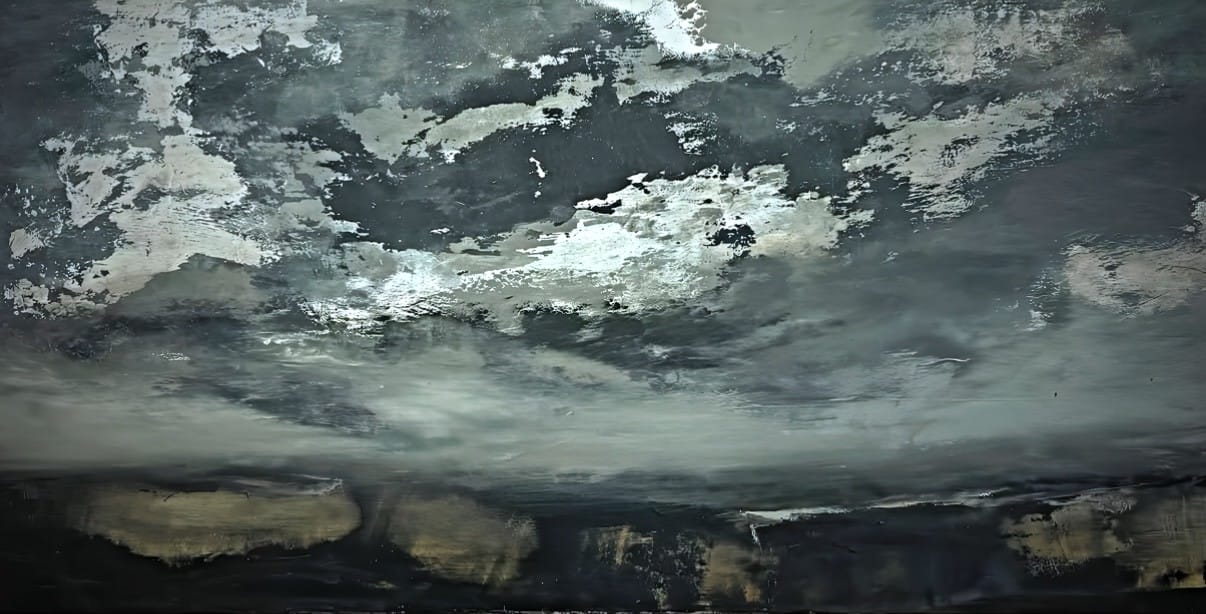
Among Bryan Jennings’ notable works is “Black, White and Gray,” a 24 × 48-inch oil painting on panel that beautifully demonstrates his artistic philosophy.
Rather than relying on vibrant color, Jennings limits his palette to black, white, and shades of gray. This intentional restraint shifts attention away from color itself and toward atmosphere, texture, light, and emotional presence.
Within this monochromatic composition, every tonal transition carries significance. Soft gradients create moments of quiet contemplation, while stronger contrasts introduce structure and visual rhythm. The result is a landscape that feels both expansive and intimate at the same time.
The wide horizontal format naturally emphasizes the horizon, a recurring motif throughout Jennings’ work. Here, the horizon becomes more than a physical boundary it symbolizes the place where certainty meets uncertainty, where emotional weight dissolves into open space.
“Black, White and Gray” demonstrates that emotional depth does not require visual excess. Through simplicity, Jennings creates an experience that invites prolonged observation and thoughtful reflection.
Kindness, Empathy, and Forgiveness as Creative Foundations
Bryan Jennings openly acknowledges that personal hardship has played an important role in shaping both his outlook and his art. Rather than allowing painful experiences to define him negatively, he has transformed them into sources of compassion and understanding.
He believes that heartbreak teaches the value of kindness, disappointment deepens empathy, and time makes forgiveness possible. These qualities extend beyond his personal philosophy and become visible throughout his paintings.
His landscapes do not seek to overwhelm the viewer with dramatic imagery. Instead, they offer moments of quiet contemplation that encourage emotional honesty. There is generosity in his work a willingness to create spaces where viewers can pause, reflect, and reconnect with themselves.
This emotional accessibility allows people from many different backgrounds to find something meaningful within his paintings, regardless of their familiarity with contemporary art.
From Liverpool to Los Angeles
Born in Liverpool, England, Bryan Jennings eventually found a new home in Los Angeles, California. This journey across continents has contributed to the richness of his artistic perspective.
Liverpool’s cultural heritage and Los Angeles’ expansive skies, varied terrain, and changing coastal atmosphere each offer unique sources of inspiration. Living in Southern California provides Jennings with endless opportunities to observe shifting light and natural forms, elements that continue to influence his evolving body of work.
His surroundings provide visual inspiration, but it is his emotional response to those landscapes that truly defines his paintings. Whether inspired by an open horizon or subtle atmospheric changes, Jennings always returns to the deeper emotional meaning beneath what is seen.
An Invitation to Pause and Reflect
Bryan Jennings creates paintings that ask viewers to slow down in an increasingly fast-paced world. His work reminds us that some of life’s most meaningful experiences happen quietly in moments of reflection, healing, forgiveness, and hope.
Rather than presenting definitive answers, his landscapes invite contemplation. They encourage viewers to bring their own memories, emotions, and interpretations to each painting, making every encounter deeply personal.
As his artistic journey continues, Jennings remains committed to creating work that reflects authenticity rather than expectation. His paintings demonstrate that art can emerge from lived experience, transforming ordinary landscapes into places of emotional discovery.
Through works such as “Black, White and Gray,” Bryan Jennings continues to explore the enduring relationship between nature and the human spirit. His paintings reveal that beneath every horizon lies an emotional landscape waiting to be discovered, reminding us that the quietest moments often carry the deepest meaning.

