


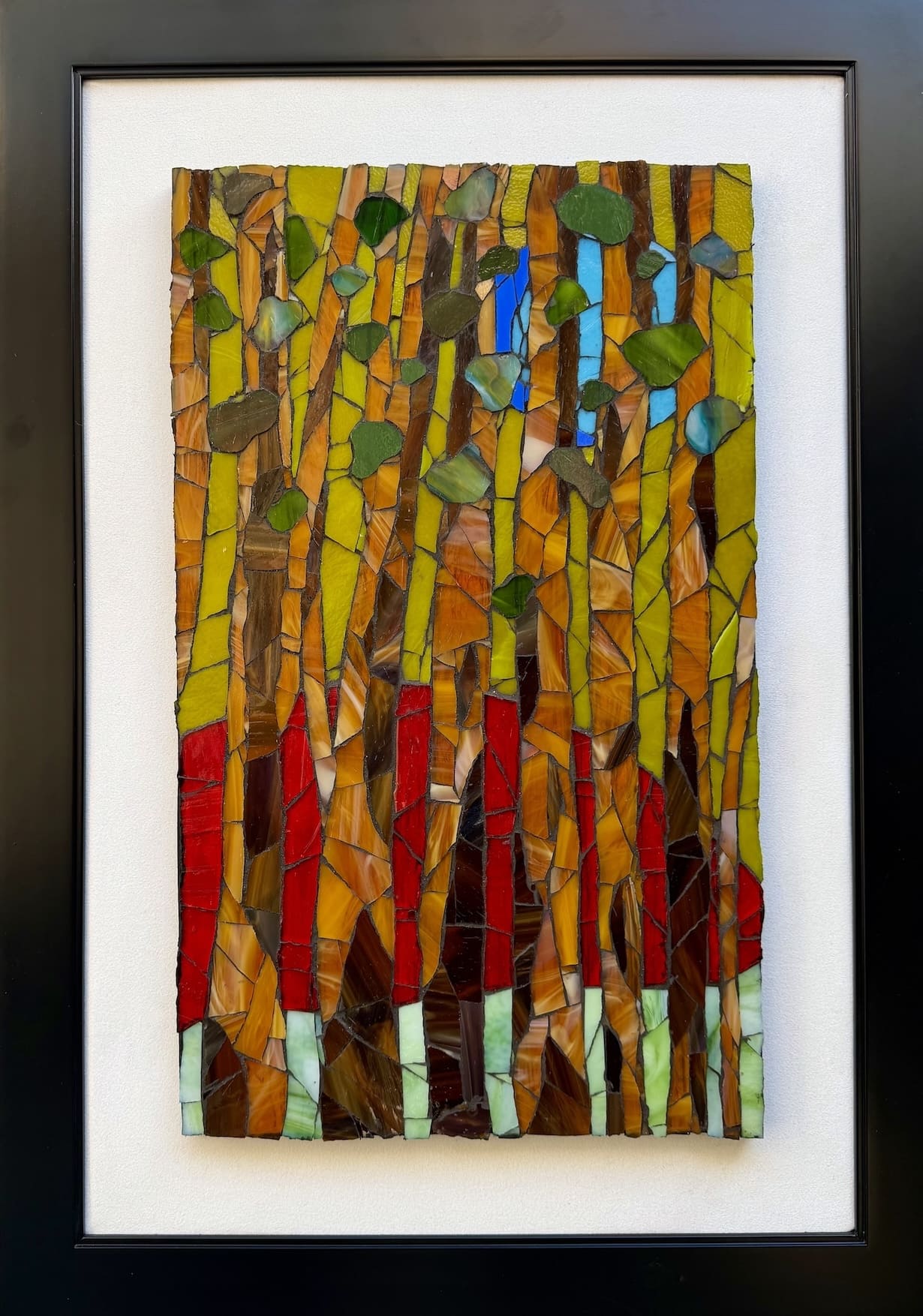
Carol Davis is an artist best recognized for her distinctive reimagining of the natural world through glass. Working from her own photographs of nature, Davis transforms scenes of forests, trees, flowers, and other elements of the environment into richly textured mosaics made from carefully hand-cut pieces of colored glass. Her work captures the visual beauty of the world around us while inviting viewers to pause and appreciate the perfection, complexity, and wonder found in nature.
Rather than simply reproducing what she sees, Davis creates a new interpretation of each scene. Her artistic process begins with photography, allowing her to preserve a particular moment or landscape that has moved her. She then translates that image into glass, carefully considering color, texture, light, and composition. The result is artwork that exists somewhere between painting and mosaic, combining the visual qualities of both while establishing an artistic language that is uniquely her own.
From Photography to Glass
Every mosaic Carol Davis creates begins with one of her own photographs. Photography allows her to capture the specific details and atmosphere that first inspire her, creating a visual foundation for the work that follows. Once she has selected a scene that speaks to her, she begins the process of interpreting it through glass.
This approach gives her work a strong connection to the places and moments that inspire it. Her mosaics are not imagined landscapes created from memory alone. Instead, they emerge from direct encounters with the natural world. Through her photographs, Davis first observes nature as it exists, and through her glass mosaics, she then reconstructs that experience in an entirely new medium.
The transformation from photograph to mosaic is an involved and thoughtful process. Carefully hand-cut pieces of colored glass become the building blocks of each composition. Every piece contributes to the overall image, while the spaces between them and the way light interacts with the glass add another dimension to the finished artwork.
For Davis, this process is a way of painting with a material that offers qualities traditional paint cannot provide.
Painting With Glass
Although Carol Davis has explored many different artistic mediums throughout her creative journey, including painting, drawing, and sculpture, she ultimately found herself drawn to mosaics. Her decision was rooted in the unique qualities that glass brings to an artwork.
Mosaics can introduce texture, depth, and light into a space in ways that other mediums simply cannot. Glass responds naturally to changing light, creating subtle shifts in color and reflection that can make a piece feel different depending on the environment in which it is displayed.
Davis embraces these qualities as an essential part of her artistic expression. She does not view her work as traditional decorative mosaic. Instead, she considers it fine art and presents her pieces in the same way a painting might be displayed, framing each work to emphasize its presence as an individual artwork.
Her description of herself as someone who is “painting with glass” captures the essence of her practice. Like a painter, she thinks carefully about color, composition, contrast, and atmosphere. However, instead of applying pigment to a canvas, she builds her images through the arrangement of individual pieces of glass.
This process requires both artistic sensitivity and technical precision. Each fragment becomes part of a larger visual language, allowing Davis to create scenes that are recognizable while also possessing an expressive, almost luminous quality.
Finding Inspiration in Nature
Nature is at the heart of Carol Davis’s creative practice. Her inspiration comes from the extraordinary beauty found in the world around us, from the smallest details to some of the most monumental landscapes on Earth.
She is inspired by the absolute perfection of nature and by the fact that these forms of beauty existed long before humanity arrived. A bee pollinating a marigold can hold as much wonder for her as a forest filled with enormous Redwood trees. Both represent the complexity and beauty of the natural world, and both have the power to inspire artistic reflection.
This sense of awe is central to Davis’s work. Her goal is not simply to depict nature accurately but to communicate something of the emotional response she experiences when encountering it. Through the transformation of photographs into glass mosaics, she seeks to preserve that feeling of wonder and share it with others.
Her work encourages viewers to look more closely at the natural world. The intricate details of leaves, the patterns of bark, the movement of light, and the relationships between trees can become sources of fascination when translated into glass. By slowing down these observations and transforming them into fine art, Davis gives familiar scenes a renewed sense of importance.
The Eucalyptus Forest of Sonoma County
One example of Davis’s approach can be seen in a mosaic inspired by a photograph she took in an eucalyptus forest in Sonoma County. The original photograph captured a scene that deeply moved her, particularly the way the trees stood closely together and created a layered, immersive environment.
She was drawn to the beauty of the trees, the light reflecting across their leaves, and the contrasting colors revealed through the bark. The combination of these elements created a scene she knew she had to transform into a mosaic.
The finished artwork represents more than a forest landscape. It is an interpretation of the experience that inspired Davis in the first place. The closely standing trees create a sense of depth and connection, while the changing colors and reflections of light offer opportunities for glass to reveal its natural qualities.
Through the mosaic process, Davis takes a fleeting moment observed in nature and gives it a lasting physical form. The original photograph becomes the starting point, but the glass introduces something new. Reflections, textures, and subtle variations in color allow the scene to evolve from a photographic record into a piece of fine art.
Creating Art With Environmental Responsibility
Carol Davis’s connection to nature extends beyond the subjects she depicts. Environmental responsibility is also an important part of her artistic practice.
As a member of the California Green Business Association, Davis is committed to minimizing the environmental impact of her creative work. She makes considerable efforts to create the smallest carbon footprint possible, reflecting a broader awareness of the relationship between artistic production and the natural world.
This commitment adds another meaningful dimension to her practice. The same environment that provides the inspiration for her artwork is one she seeks to respect and protect through responsible choices.
Her approach demonstrates that an artist can celebrate nature while also considering the impact of the creative process. In Davis’s case, environmental consciousness is not separate from her artistic identity. It is closely connected to the values that shape both her subject matter and her way of working.
A Celebration of Nature in Glass
Carol Davis’s art offers a unique perspective on the natural world. Through her photographs and carefully constructed glass mosaics, she transforms moments of visual beauty into artworks that celebrate light, color, texture, and depth.
Her journey across different mediums ultimately led her to discover the possibilities of glass, a material that allows her to combine the discipline of mosaic with the expressive qualities of painting. By hand-cutting and arranging colored glass, she creates works that are not merely representations of nature but personal interpretations of the awe she feels when experiencing it.
From a bee visiting a flower to the towering presence of Redwood trees, Davis finds inspiration across the full scale of the natural world. Her Eucalyptus forest mosaic demonstrates how a single photograph and a powerful emotional response can become the foundation for a complex work of fine art.
In every piece, she invites viewers to experience nature through a different lens. The familiar becomes luminous, the photographic becomes tactile, and the landscape becomes something that can be explored through color and light. By “painting with glass,” Carol Davis has developed a distinctive artistic practice that reflects both her deep admiration for nature and her commitment to creating meaningful, environmentally conscious art.
You can also reach out directly to the artist at: art@caroldavismosaics.com

