


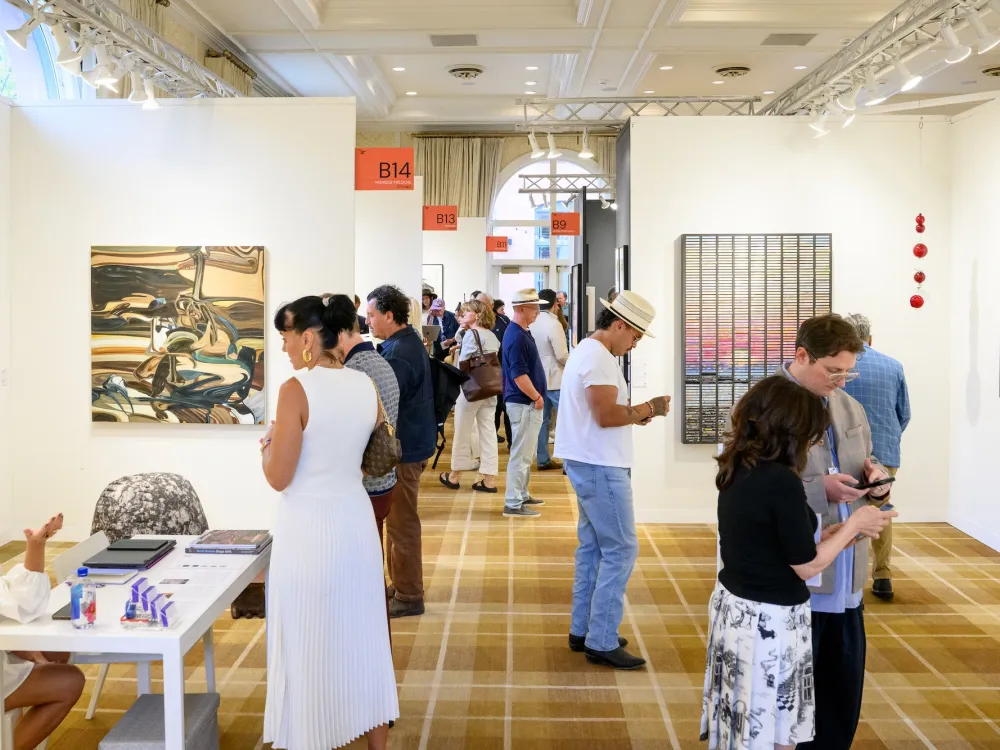
Aspen has long attracted visitors for its mountain scenery, luxury hospitality, and affluent community. During the summer art season, however, the Colorado destination offers another attraction: a growing gathering of international art galleries and collectors. The Aspen Art Fair has become part of that cultural calendar, bringing together established dealers, emerging artistic voices, and collectors in an intimate setting.
The fair’s third edition marked a significant step in its development. Hosted at the historic Hotel Jerome, the event welcomed 38 international dealers, a considerable increase from the 21 exhibitors who participated in its inaugural edition. The expansion reflects growing interest in Aspen as a destination for art-market activity while maintaining the smaller scale that distinguishes the fair from larger international events.
A Growing Fair With an Intimate Identity
The Aspen Art Fair was co-founded by dealer Bob Chase and Becca Hoffman. Chase, a third-generation art dealer who established Hexton Gallery in New York in 1995 before opening an Aspen location in 2018, envisioned the event as a way to extend the momentum created by art dealers who established temporary spaces in the city following the pandemic.
For Chase, growth is welcome, but preserving the character of the fair remains important. Its appeal lies partly in its comfortable atmosphere, where visitors can spend meaningful time with galleries and their representatives rather than navigating an overwhelmingly large exhibition.
This year’s edition was the first under the direction of Kelly Cornell, who also leads the Dallas Art Fair. Her experience brought a new perspective to the event, including connections with galleries that had previously participated in Dallas.
Cornell sees Aspen’s setting as central to the fair’s identity. The combination of a historic hotel, a walkable downtown, and the surrounding mountains creates an environment that differs from conventional exhibition halls. The event is designed to be more than a place to view and purchase art. Its program also encourages visitors to engage with the wider community through artist conversations, outdoor activities, hikes, and river experiences.
The boutique format offers practical advantages for exhibitors as well. With fewer galleries and relatively compact presentation spaces, dealers have more opportunities to speak directly with collectors. Some galleries also rearrange their displays during the event, allowing returning visitors to encounter different works and presentations.
The Historic Hotel Jerome as an Exhibition Setting
The Hotel Jerome provides a distinctive backdrop for the fair. The 19th-century brick building, dating to the 1880s, is listed on the National Register of Historic Places. Its character and location give the exhibition a sense of place that would be difficult to reproduce in a conventional convention center.
Participating galleries occupy two principal types of spaces. Some exhibit in hotel rooms, which can also serve as accommodation for dealers during the event. Others present their work in a large ballroom.
The financial commitment varies according to the space. Hotel rooms cost approximately $20,000 for participation, while ballroom spaces can reach $30,000. Accommodation in Aspen can add considerably to the overall expense, with the hotel’s deluxe rooms reaching around $1,300 and junior suites beginning at approximately $3,700.
The ballroom has its own visual character, with different carpet choices, exhibition lighting, and decorative details that reflect the hotel’s historic interiors. In the guest rooms, galleries use the available domestic spaces to create more personal presentations, allowing visitors to experience artworks in an environment that feels closer to a private collection.
An International Gallery Roster
The participating galleries represented a broad range of locations and artistic practices. International exhibitors included Galerie Gmurzynska, Galerie Perrotin, and Southern Guild. New York-based participants included Albertz Benda, R & Company, Boesky Gallery, and Sean Kelly, while Chicago was represented by Monique Meloche. Los Angeles galleries included Luis de Jesus, Gattopardo, and Charlie James Gallery.
The fair also benefited from its timing within Aspen’s wider cultural calendar. It coincided with the Aspen Art Museum’s ArtCrush gala and AIR, the museum’s art and culture festival. The fair’s VIP program extended beyond the exhibition floor, with visits to private collections and the sculpture park associated with Jorge M. and Darlene Pérez.
These activities helped connect the galleries with Aspen’s established collector community. The town’s concentration of significant private wealth and its history of art collecting make it an attractive setting for dealers seeking relationships with both existing clients and potential new buyers.
Strong Sales and a Diverse Range of Artworks
Dealers reported encouraging activity during the fair’s opening days, with several galleries describing active conversations and completed sales. Monique Meloche Gallery, for example, reported selling works by Luke Agada and Cheryl Pope for prices reaching $50,000. The gallery’s presentation demonstrated the appetite for contemporary artists among collectors attending the event.
At the higher end of the market, Galerie Gmurzynska presented works by several of its artists, including two large studies by Cuban artist Wifredo Lam. One of the studies related to Lam’s celebrated 1942–43 painting The Jungle. The works were priced as high as $4 million. The gallery also showed a collage and a substantial assemblage by Louise Nevelson.
Gallery director Mathias Rastorfer highlighted the fair’s collegial atmosphere, noting the value of an environment where dealers and collectors can interact without the intense competitive pressure sometimes associated with larger art fairs.
Marianne Boesky Gallery presented works by Jennifer Bartlett, Gina Beavers, Sanford Biggers, the Haas Brothers, and Tianyue Zhong. Several artists have connections to Aspen and the surrounding region. Bartlett participated in a residency in the city in 1985, while Biggers previously presented his monumental sculpture Unsui (Mirror) in Paepcke Park. Beavers was also represented in the ArtCrush benefit auction, and the Haas Brothers have worked with the nearby Anderson Ranch Arts Center.
By the end of the first day, Boesky Gallery reported sales exceeding $350,000. Among the reported transactions was a work by Sanford Biggers that sold for $135,000.
Colorado Connections and Local Inspiration
Regional history and landscape were visible throughout the fair. Hexton Gallery, which works with the estate of Christo and Jeanne-Claude, presented a drawing connected to the artists’ monumental project Valley Curtain (1970–72). The project was ultimately realized in Rifle, Colorado, although Aspen had also been considered as a possible location.
The gallery also showed a painting by Larry Poons, an artist who had been a resident at the Aspen Institute. By the close of Wednesday, Hexton Gallery reported sales approaching $200,000, including a Poons work priced at as much as $175,000.
Detroit-based Library Street Collective offered another interpretation of local identity through earthenware works by Jake Clark. His pieces feature painted scenes of Aspen establishments, including Ajax Tavern and Hickory House. The works were priced between approximately $14,500 and $16,000, translating familiar local settings into collectible ceramic objects.
Ceramics were also an important part of the presentation at Harvey Preston Gallery. The gallery showed works by artists including Betty Woodman, Jun Kaneko, and Tony Marsh. Among the highlights were a two-part work by Woodman priced at $110,000, a Kaneko piece at $35,000, and a work by Marsh at $16,000.
Art and Fashion in Conversation
One of the more unusual presentations came from Anat Ebgi Gallery, which shared its exhibition suite with the French luxury fashion house Balmain. Rather than treating the two creative fields as separate, the presentation placed contemporary artworks alongside fashion displayed on mannequins and clothing racks.
Works by Mucki Botkay, Marc Dennis, Simon Haas, and Caleb Hahne Quintana appeared alongside designs associated with Balmain’s incoming creative director, Antonin Tron. The fashion presentation included bags priced at around $2,000 and clothing reaching approximately $10,000.
The collaboration offered visitors an opportunity to consider how visual art and fashion can occupy the same environment and create different kinds of conversations. It also demonstrated how the smaller scale of the Aspen fair gives galleries room to experiment with presentation formats.
Aspen’s Place in the Art Market
The Aspen Art Fair’s development reflects the relationship between the art market and the communities that support it. Its location offers access to collectors who spend time in the region, while the surrounding cultural institutions and private collections create opportunities for engagement beyond the fair itself.
The reported sales during the opening days suggest that the event is attracting serious buying interest. At the same time, its identity is not based exclusively on transaction volume. The historic venue, regional connections, outdoor programming, and manageable scale all contribute to its appeal.
With 38 dealers participating in its third edition, the fair has expanded considerably since its launch. Its next challenge will be to sustain that momentum without losing the personal atmosphere that helped establish its reputation.
For galleries and collectors alike, Aspen offers a different kind of art-fair experience: one shaped not only by the artworks on display, but also by the architecture, landscape, and cultural life surrounding them.

