


Joe Stublick is a New York-based multidisciplinary artist whose practice explores the complexities of human expression, transformation, and the invisible forces that shape individual experience. Working across abstract painting, mixed media, live performance, and immersive experiences, Stublick approaches art as an expansive field of inquiry, one that extends beyond the physical boundaries of the canvas and into the rhythms of everyday life. His work examines the relationship between order and chaos, individuality and connection, and the visible forms through which people attempt to understand their inner worlds.
At the heart of Stublick’s artistic philosophy is the conviction that life itself is an artistic medium. Rather than treating art as an isolated object or a purely visual experience, he considers it an ongoing process of discovery, shaped by intention, movement, emotion, and personal evolution. This perspective positions the artist not simply as a maker of images, but as an observer of the human condition, attentive to the subtle relationships that connect individual experiences to a larger collective reality.
Through abstraction, Stublick creates spaces in which viewers can encounter these ideas without being directed toward a single interpretation. His compositions invite contemplation, allowing color, gesture, and movement to communicate what language may struggle to express. The resulting works function as visual investigations into the forces that influence identity and the ways seemingly separate experiences can become part of a greater whole.
The Invisible Line: Between Structure and Freedom
A central element of Stublick’s practice is his signature Invisible Line series, through which he investigates the emotional and psychological dimensions of human existence. The concept of an invisible line suggests a boundary that can be felt without necessarily being seen. Such boundaries may emerge between individuals, within the self, or between opposing states of being. They can define relationships, influence decisions, and shape perceptions while remaining difficult to identify or articulate.
Stublick’s exploration of these intangible structures reflects his broader interest in the relationship between order and chaos. Human experience rarely follows a completely predictable path. Moments of clarity coexist with uncertainty, and deliberate choices unfold alongside unexpected circumstances. His abstract compositions provide a visual language for these tensions, bringing contrasting elements into conversation rather than attempting to resolve them.
In this context, lines become more than formal components. They can suggest movement, connection, interruption, and direction, carrying associations that extend beyond their physical appearance. Their interactions evoke the complexity of individual lives, in which distinct intentions and experiences continually influence one another. The Invisible Line series thus offers a framework for considering how people navigate the boundaries that define their identities while remaining open to change.
Abstraction is particularly suited to this inquiry because it leaves room for personal association. Without relying on literal representation, Stublick allows visual relationships to generate meaning through their interaction with the viewer. Each encounter can become an opportunity to reflect on the unseen structures that influence how people understand themselves and relate to the world around them.
“Taste The Rainbow” (2025): A Meeting of Color, Movement, and Meaning
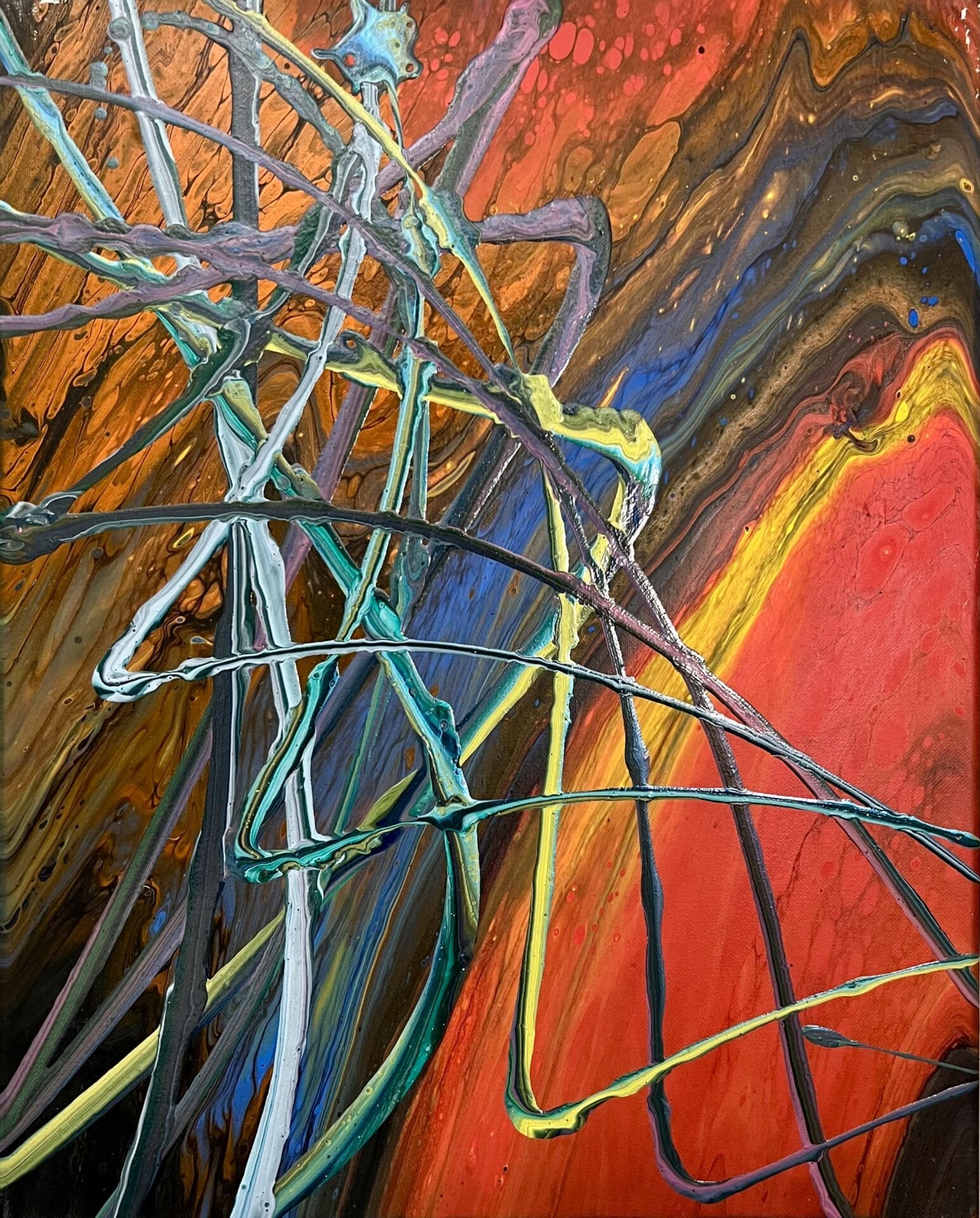
Created in 2025, Taste The Rainbow demonstrates Stublick’s interest in the relationship between individual expression and collective experience. Measuring 16 by 20 inches and executed in acrylic on canvas, the work brings vibrant, flowing lines into contrast with a dark expanse. The composition establishes a visual tension between the energy of color and the surrounding darkness, creating an environment in which movement becomes the primary vehicle for expression.
The lines intersect and interact across the surface, suggesting multiple trajectories unfolding within a shared space. Their vivid colors introduce a sense of vitality, while their movement creates an impression of spontaneity and interconnectedness. Against the darker background, each line becomes distinct, yet none exists entirely apart from the others. Their intersections establish relationships that transform separate gestures into a more complex visual structure.
This interplay reflects the central idea underlying the work: the invisible connections between intention, movement, and human experience. Each line represents an individual expression, carrying its own direction and character. Together, these expressions contribute to something larger than any single element could create independently. The composition becomes a metaphor for the ways individual lives intersect, influence one another, and participate in a shared reality.
The dark ground also plays an important role in the work’s visual language. Rather than functioning merely as a background, it provides the space against which the colored lines become perceptible. The contrast suggests that expression acquires meaning through its relationship with what surrounds it. Movement becomes visible against stillness, just as individual experiences often become more meaningful through their encounters with other people, circumstances, and perspectives.
The title, Taste The Rainbow, introduces an additional dimension to the painting. It suggests an experience that extends beyond passive observation, inviting a more immediate and sensory engagement with color. The phrase evokes variety, sensation, and the possibility of encountering different experiences within a single visual field. In this sense, the painting encourages viewers to consider how diverse expressions can coexist without losing their individual character.
Rather than prescribing a fixed narrative, Stublick allows the composition to remain open to interpretation. Viewers may discover associations with relationships, personal choices, emotional transitions, or the unpredictable patterns of everyday life. The work’s significance emerges through the interaction between its formal qualities and the experiences viewers bring to it.
Individual Expression and the Collective Whole
The relationship between individuality and connection is central to Stublick’s broader artistic vision. In Taste The Rainbow, the colored lines retain their distinct identities even as they intersect. Their convergence does not erase their differences; instead, those differences contribute to the composition’s overall complexity. This relationship offers a compelling parallel to human communities, where individual perspectives and experiences form part of a larger social and emotional landscape.
Stublick’s approach suggests that interconnectedness need not require uniformity. Each person follows a distinct path, shaped by personal history, intention, and circumstance. Yet these paths rarely unfold in complete isolation. Encounters, decisions, and shared experiences continually influence the direction of individual lives. The painting translates this condition into a visual arrangement in which separate movements collectively establish a sense of unity.
This perspective also reinforces the artist’s interest in transformation. Connections can alter the meaning of an individual gesture, just as experiences can change the way a person understands their own identity. What initially appears independent may acquire new significance when considered in relation to something else. Through abstraction, Stublick makes this process visible without reducing it to a literal illustration.
The work therefore operates on both an intimate and a broader conceptual level. It invites viewers to consider their own expressions of identity while reflecting on their participation in the lives of others. Its lines can be understood as individual journeys, but their intersections also suggest the shared experiences through which meaning develops.
Beyond the Canvas: The Art of Freedom
Stublick’s artistic interests extend beyond visual composition into philosophical inquiry. He is the creator of The Art of Freedom, an evolving framework concerned with intention, conviction, and personal evolution. This initiative reflects his belief that creativity is not confined to professional artists or specialized cultural spaces. Instead, artistic thinking can offer a way of approaching life itself, encouraging individuals to recognize their capacity to shape experiences and participate actively in their own development.
Within this framework, freedom becomes closely connected to awareness and intention. The choices people make, the convictions they maintain, and their willingness to evolve all contribute to the ongoing formation of identity. This understanding complements the ideas explored in Stublick’s paintings, where movement and interaction suggest that existence is neither entirely predetermined nor completely without structure.
His multidisciplinary practice provides different ways to investigate these concerns. Painting offers a concentrated visual encounter, while performance and immersive experiences can bring artistic ideas into more immediate relationship with participants and their surroundings. Across these forms, the emphasis remains on engagement, discovery, and the possibilities that emerge when art is understood as an active part of human experience.
Stublick’s belief that every individual is both artist and masterpiece encapsulates this philosophy. It positions personal development as an ongoing creative process, one in which people continually shape and reinterpret themselves through their actions, relationships, and experiences.
An Expanding Artistic Practice
Stublick’s work has been exhibited internationally at venues and events including Carrousel du Louvre in Paris, Artexpo New York, Art Basel Miami, and the Hamptons Fine Art Fair. These exhibition experiences situate his practice within an international art context while providing opportunities for audiences to encounter his explorations of abstraction, expression, and human connection.
His continued movement across artistic disciplines reflects a practice that resists narrow definitions. Rather than treating painting, performance, and philosophy as separate pursuits, Stublick brings them together through a shared interest in how people experience and interpret the world. His work encourages viewers to look beyond immediate appearances and consider the less visible forces that shape their perceptions, decisions, and relationships.
In Taste The Rainbow, this inquiry takes the form of vibrant lines moving through darkness, each maintaining its character while contributing to a larger visual experience. The painting offers a concise expression of Stublick’s wider concerns: that individuality and interconnectedness are not opposing conditions, but complementary aspects of existence.
Ultimately, Joe Stublick approaches art as an invitation to participate in the process of making meaning. His work asks viewers to reconsider the boundaries between artistic creation and everyday life, between personal identity and shared experience, and between the structures that define us and the possibilities that allow us to change. Through this perspective, the canvas becomes more than a surface for visual expression. It becomes a meeting point between individual perception and the larger, continually unfolding masterpiece of human life.

