


Kiara Sealey approaches art as an open-ended exploration of creativity, expression, and visual storytelling. Working across both traditional and digital mediums, she is interested in the many ways an image can communicate personality and emotion. Rather than restricting herself to a single artistic discipline or recognizable style, Sealey allows curiosity to guide her practice, experimenting with different techniques, approaches, and ideas as she continues to develop her visual language.
At the heart of her work is a fascination with people. Faces, gestures, expressions, and moments of human presence provide a rich source of inspiration, allowing her to explore how seemingly simple visual details can suggest something more complex. For Sealey, drawing is not simply an exercise in reproducing what she sees. It is a way of interpreting character and translating emotion into a visual form.
Her practice reflects an artist who values experimentation. Traditional drawing provides an opportunity to work directly with line, texture, tone, and shading, while digital art offers another space for exploration and creative possibility. Moving between these approaches allows Sealey to continually challenge herself and consider how different techniques can alter the atmosphere and impact of an image.
Finding Expression Through the Figure
Human subjects occupy an important place in Sealey’s artistic interests. People naturally carry stories through their faces, posture, clothing, and gestures, and these details can become powerful elements within a portrait. Rather than relying solely on conventional notions of portraiture, Sealey is drawn to the expressive qualities that make an individual visually distinctive.
Her interest in emotion is particularly evident in the way she considers facial expression and physical gesture. A raised hand, a particular direction of the gaze, or the tension within a pose can change the entire character of an image. These details give her subjects an individuality that extends beyond physical resemblance.
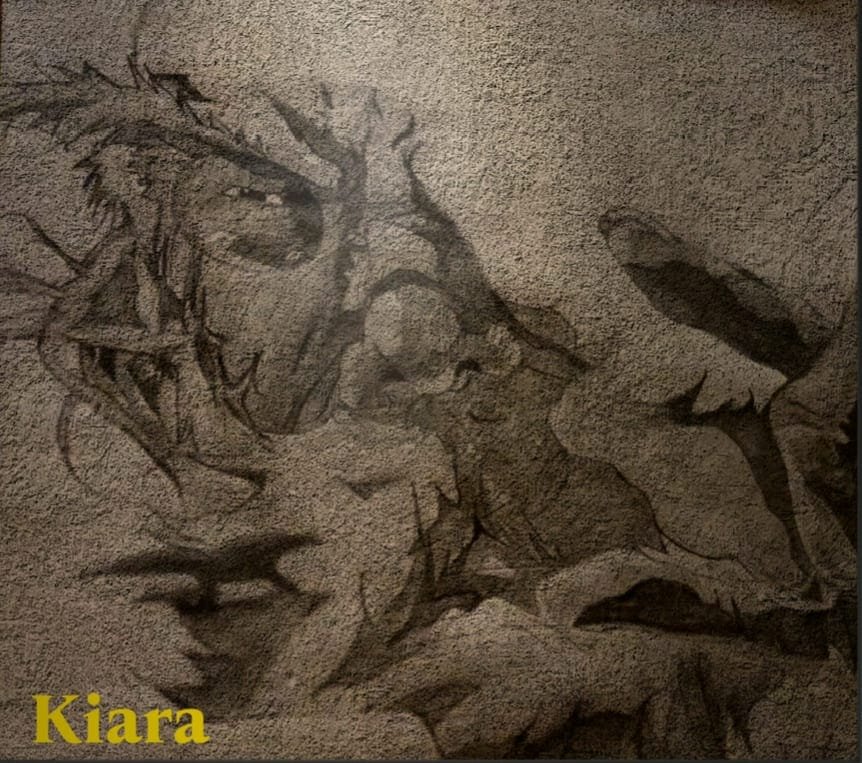
This sensitivity toward gesture is central to her featured pencil drawing of an elderly man. The figure is depicted pointing forward, creating an immediate sense of direction and engagement. The gesture becomes the visual anchor of the composition, encouraging the viewer to follow the movement of the hand and consider the personality behind it.
The Character of a Pencil Portrait
The pencil drawing demonstrates Sealey’s ability to use traditional materials to create a portrait with considerable presence. The elderly man’s face, beard, clothing, and hand are rendered with careful attention to detail, allowing the physical qualities of the subject to emerge through layers of graphite.
Pencil is particularly suited to the kind of observation evident in the work. Through changes in pressure, density, and tonal value, Sealey builds a sense of age and individuality into the figure. The texture of the beard, the structure of the face, and the folds of clothing become more than descriptive details. Together, they establish the subject as someone with a distinct visual identity.
The darker passages of shading are equally important. Rather than treating shadow simply as a means of defining form, Sealey uses tonal contrast to give the portrait greater depth. Areas of darkness create weight within the composition, while lighter passages allow particular features to emerge. This interplay between light and dark gives the drawing a sense of dimensionality and strengthens its overall visual impact.
Gesture as a Visual Language
The pointing finger immediately commands attention. Its position introduces a strong directional element into the drawing, giving the composition a sense of movement despite the stillness inherent in a portrait.
This gesture also creates an intriguing relationship between the subject and the viewer. The man appears to address something beyond the boundaries of the image, making the viewer instinctively wonder what he is pointing toward or what prompted the gesture. In this way, a simple physical action becomes a narrative device.
Sealey’s decision to emphasize the hand demonstrates her understanding of how body language can influence a portrait. The drawing does not depend entirely on the facial expression to communicate character. The pose itself contributes significantly to the personality of the figure, giving the work a direct and assertive quality.
Detail, Contrast, and Presence
One of the drawing’s defining characteristics is the balance between meticulous detail and expressive impact. Sealey pays attention to the smaller elements that establish the physical reality of the subject, but these details ultimately serve the larger purpose of communicating character.
The aged facial features and beard contribute to a strong sense of individuality. Lines and tonal variations suggest experience and age without reducing the subject to a collection of physical characteristics. His clothing adds another layer of visual information, while the carefully rendered hand reinforces the central gesture.
The resulting portrait feels immediate. It does not present the figure as distant or anonymous. Instead, the combination of expression, posture, and detailed observation gives him a compelling presence. The viewer encounters not merely an elderly figure, but a personality captured at a particular moment.
An Experimental Approach to Creativity
Although traditional drawing remains an important part of Sealey’s practice, her artistic interests extend beyond pencil and paper. Her willingness to work digitally reflects a broader desire to explore what art can become when different tools and methods are brought into the process.
This openness to experimentation is an important part of her development. Instead of defining herself through a single medium, Sealey approaches each artistic method as an opportunity to learn. Traditional techniques can strengthen her understanding of observation, proportion, texture, and tonal structure, while digital processes can introduce new possibilities for composition, experimentation, and visual treatment.
The connection between these approaches lies in her interest in expression. Whether working traditionally or digitally, Sealey seeks to create imagery that catches the eye while retaining a sense of personality and feeling.
Continuing to Develop an Artistic Voice
Sealey’s practice is ultimately defined by a willingness to keep learning. Her exploration of different styles and techniques reflects an artist who sees creativity as an ongoing process rather than a fixed destination.
The featured pencil portrait offers a clear example of her interest in expressive human imagery. Through detailed observation, tonal contrast, and a striking gesture, she transforms a straightforward portrait into an image with character and narrative potential. The pointing figure becomes memorable because of the relationship between his expression, posture, and carefully rendered physical details.
As Sealey continues to expand her skills, her openness to experimentation may allow her artistic language to evolve in unexpected directions. Her work demonstrates that creative development can come from remaining curious, testing unfamiliar approaches, and allowing different mediums to inform one another.
For Kiara Sealey, art provides both a means of expression and a continuous challenge. Her commitment to exploring traditional and digital practices, combined with her fascination with people and emotion, gives her work a foundation rooted in observation and individuality. Whether through the controlled marks of a pencil drawing or the possibilities of digital creation, she continues to investigate how visual art can capture personality, communicate feeling, and leave a lasting impression.

