


Nadia Spagnolo is an Italian artist from Lecce whose journey into painting took an unexpected path. Although she loved drawing as a child, art gradually disappeared from her life as she grew older. Encouraged to pursue a more conventional academic direction, she studied Economics and eventually earned a degree in Environmental Economics. Her education would later prove unexpectedly relevant to her artistic practice, particularly in the way she explores humanity’s relationship with nature and the future of the planet.
After completing an internship in France, Spagnolo returned to painting and began creating her first canvases. However, her artistic identity was still developing. Painting initially represented a return to something she had loved in childhood, but it would take a much more personal period of change before she discovered the technique and visual language that would become central to her work.
Following an identity crisis and a dark period in her life, Spagnolo began painting with the pointillism technique. This marked an important turning point. Instead of simply returning to the art of her childhood, she developed a distinctive approach through which imagination, emotion and observations of the natural world could come together.
Discovering a Personal Artistic Language
Pointillism became an important part of Spagnolo’s artistic expression. The technique, built through the application of individual points of color, creates images through the interaction of small marks rather than relying solely on conventional brushwork. For Spagnolo, this method offers a way to construct atmospheric landscapes while giving her paintings a distinctive visual rhythm.
Her approach is also connected to the tradition of Impressionism and Neo-Impressionism. She has drawn inspiration from artists including Vincent van Gogh, Paul Signac and Georges Seurat. Each of these artists explored color and perception in different ways, and their influence can be seen in Spagnolo’s interest in using color and individual marks to create larger visual experiences.
Yet her paintings are not simply exercises in technique. They emerge from a highly imaginative process. Spagnolo describes herself as someone who daydreams and then paints what she dreams. Natural and seascape landscapes become the settings for these visions, allowing her to transform imagined scenes into paintings that communicate ideas about freedom, love and environmental responsibility.
Dreaming Through Natural and Seascape Landscapes
Nature occupies a central position in Spagnolo’s artistic world. Her landscapes and seascapes are more than representations of physical places. They provide a space where emotions and ideas can be explored.
The themes of freedom and true love appear alongside her love of nature, creating an artistic language that connects personal experience with wider concerns. The open spaces of landscapes and the expansive qualities of the sea can suggest movement, possibility and liberation. At the same time, these environments remind viewers of what is vulnerable when the natural world is placed under increasing pressure.
Environmental protection is therefore an important message within her work. Her background in Environmental Economics adds an interesting dimension to this concern. Although her paintings are imaginative and poetic, they also reflect an awareness of the relationship between human activity and the natural environment.
Rather than presenting nature only as something beautiful to observe, Spagnolo uses painting to encourage reflection on humanity’s responsibility toward it.
“The Planet’s Scream”
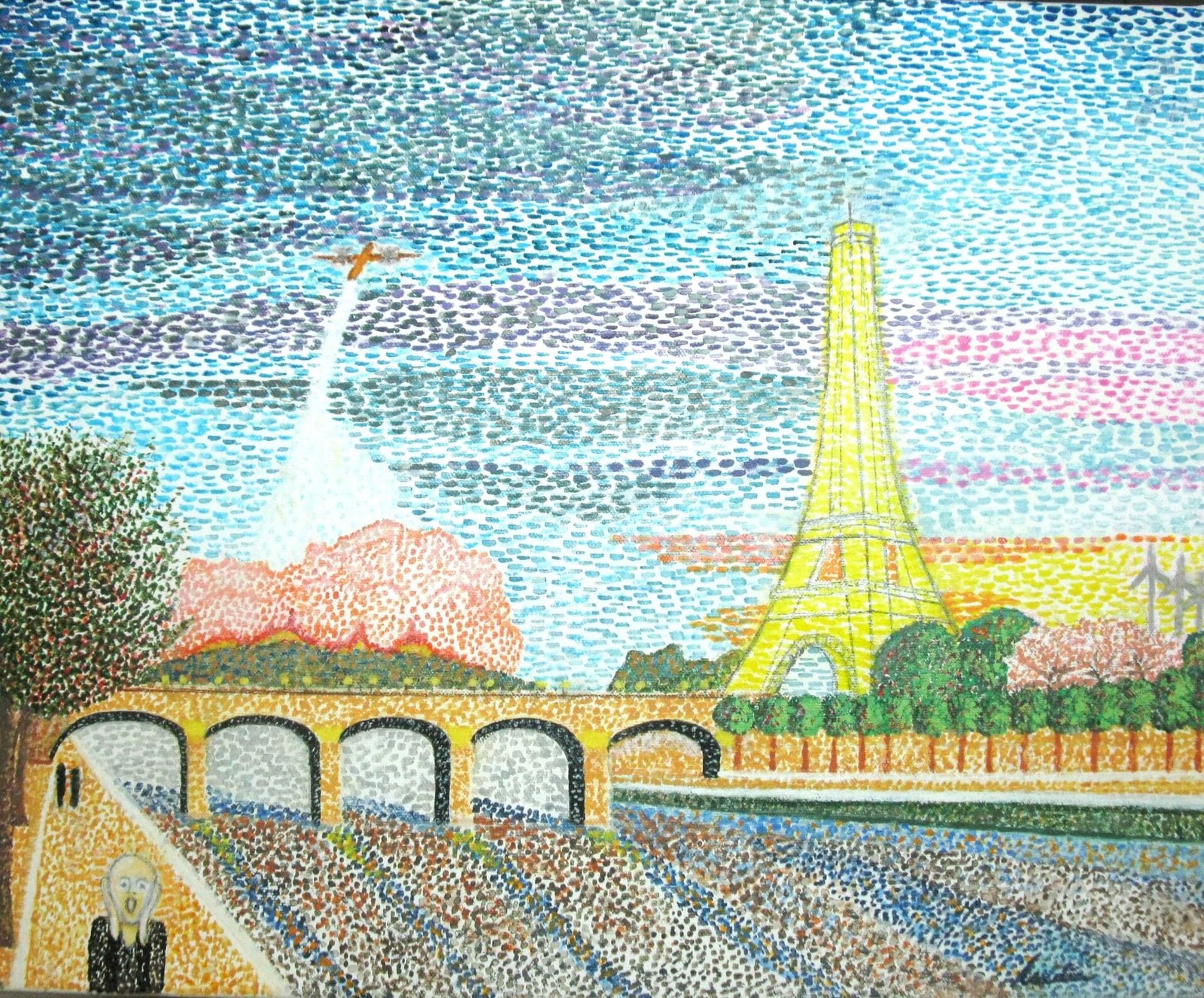
One of Spagnolo’s environmentally focused works is The Planet’s Scream, an acrylic painting on canvas measuring 40 × 50 cm. The work directly references Edvard Munch’s iconic painting The Scream, transforming the familiar emotional language of Munch’s work into a contemporary reflection on the environmental crisis.
At the center of Spagnolo’s painting is a human figure representing humanity and the planet in the present day. The figure appears distressed and vulnerable, surrounded by the darkness of a night associated with global warming and its consequences.
The painting brings together several environmental threats that have become increasingly visible around the world. Dried-up rivers, desertification, wildfires and melting glaciers form part of the imagery, creating a landscape of ecological instability. These elements turn the painting into more than a depiction of fear. They represent the consequences of environmental damage and the uncertainty surrounding the future.
The reference to Munch is particularly meaningful because The Scream has long been associated with intense emotional distress. Spagnolo reinterprets that emotional language through an environmental lens. The scream is no longer only the expression of an individual facing an overwhelming world. It can also be understood as a symbolic expression of a planet under pressure and a humanity confronted by the consequences of its actions.
A Vision Beyond Environmental Crisis
Despite its darker imagery, The Planet’s Scream does not end with despair. Spagnolo deliberately introduces an alternative vision within the composition.
Alongside the signs of environmental destruction, she depicts renewable technologies and a spring sunrise. These elements introduce the possibility of a different future, one in which humanity responds to environmental challenges through more sustainable choices.
The sunrise becomes a particularly important symbol. Following the darkness of the night, it suggests renewal and rebirth. In this context, it represents the possibility that humanity can change its relationship with the natural world.
This contrast between destruction and renewal gives the painting a sense of movement. The work acknowledges the seriousness of climate-related challenges while leaving room for hope. The future is presented not as something predetermined, but as something that can potentially be shaped by human choices.
Art as a Message of Freedom and Responsibility
Across her artistic practice, Spagnolo brings together personal dreams, natural landscapes and wider social and environmental concerns. Her return to painting after years away from art became more than a rediscovery of an old childhood interest. It became a way of expressing experiences, emotions and ideas that could not easily be communicated through other means.
Her pointillist approach gives these ideas a distinctive visual form, while her interest in landscapes and seascapes provides a recurring connection to the natural world. Through her paintings, she explores freedom, true love and the beauty of nature while drawing attention to the importance of protecting the planet.
Her work has also reached audiences in several international artistic centers. She has exhibited her paintings in Florence, Beijing, Paris and New York, bringing her visual language to different cultural environments.
For Nadia Spagnolo, painting appears to exist between imagination and reality. Her daydreams become landscapes, her personal experiences inform her artistic direction, and environmental concerns become subjects for visual storytelling. Through color, pointillist marks and symbolic imagery, she creates paintings that invite viewers to look at nature not only as a source of beauty, but also as something precious and vulnerable.
In The Planet’s Scream, this approach becomes particularly direct. By connecting Munch’s powerful symbol of human distress with the consequences of climate change, Spagnolo creates a work that reflects anxiety while still looking toward renewal. The dark landscape and the signs of environmental destruction are balanced by the possibility represented by renewable energy and the rising sun.
Her artistic journey, from childhood drawing to economics, from returning to painting to discovering pointillism, demonstrates how seemingly different experiences can eventually become part of a single creative identity. Today, Spagnolo uses painting to transform her dreams and concerns into visual stories, offering viewers both a reflection on the present and a vision of what might still be possible for the future.

