


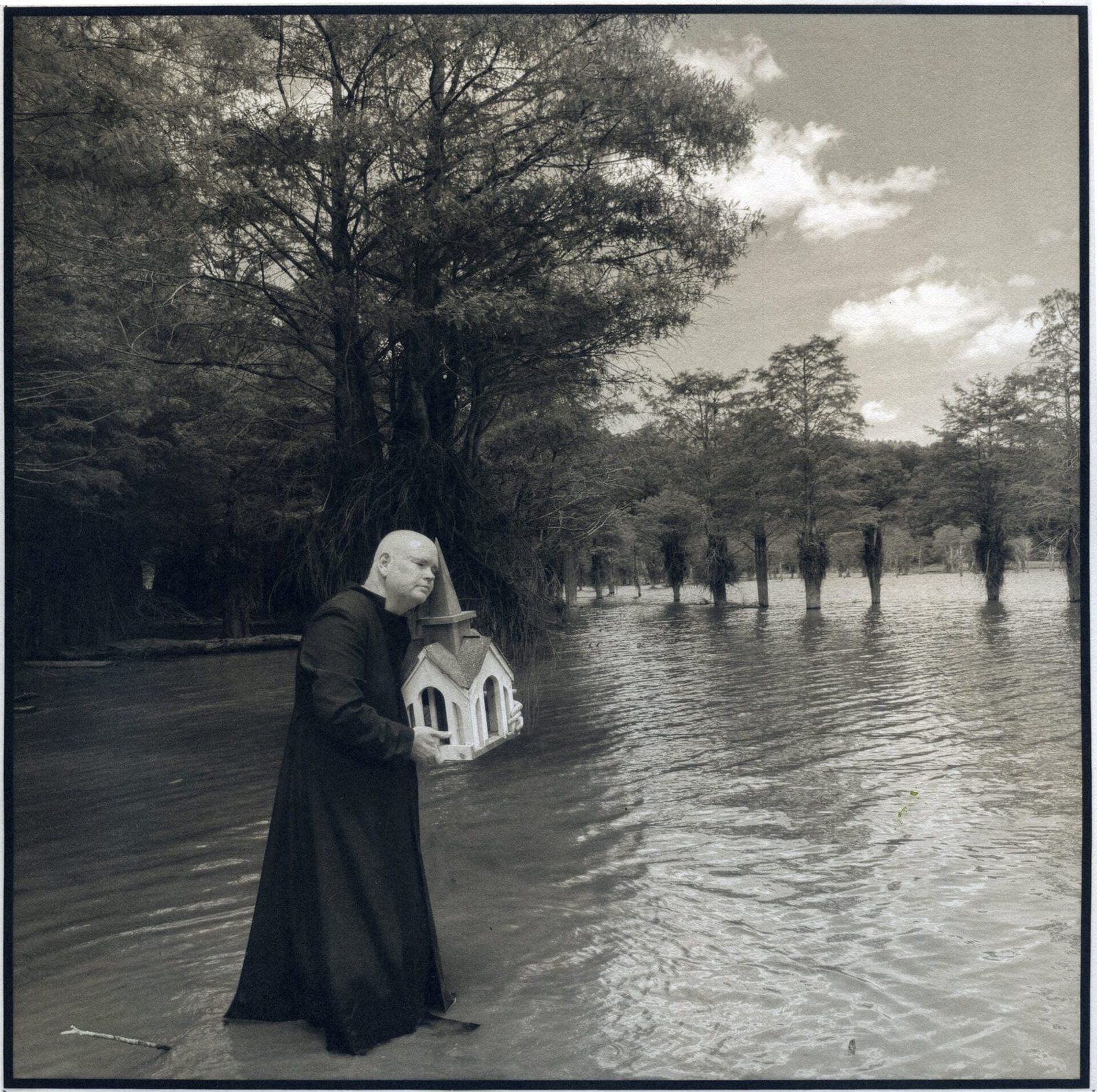
Greg Banks is an Appalachian born photo-based artist whose work explores memory, folklore, identity, and the complicated relationship between people and the places that shape them. Rather than presenting Appalachia through familiar documentary imagery, Banks approaches the region as something more mysterious and psychologically layered. His photographs draw from personal experience, historical photographic processes, self-portraiture, and regional mythology to create an imagined landscape where memory and reality can exist together.
For Banks, Appalachia is not simply a geographical location. It is an emotional and cultural presence that continues to influence his understanding of himself. The mountains, family histories, religious traditions, isolation, and stories passed through generations all contribute to a personal mythology that becomes central to his photographic practice.
His series, “Don’t Do in the Dark What You Don’t Want Brought Out in the Light,” is an intimate exploration of this connection. Through carefully constructed photographs, Banks returns to the Appalachian hills of his earliest memories and examines what it means to belong to a place while also carrying the complicated histories and assumptions associated with it.
An Artistic Journey Rooted in Appalachia
Banks’ relationship with photography and fine art has developed over decades. He earned dual B.A. degrees in Photography and Fine Art from Virginia Intermont College in 1998 before continuing his education with an MFA in Photography from East Carolina University, which he completed in May 2017.
His professional career has combined artistic practice with education and engagement within the photographic community. He currently serves as an instructor at Appalachian State University, where his experience as both an artist and educator informs his approach to photography.
Since 2022, Banks has also served as a contributing editor for Lenscratch, further connecting him to the wider contemporary photography community. His work has received recognition through exhibitions, publications, and curated opportunities. In 2017, he was among seven artists selected for The Light Factory’s Annuále 9. His photographs have appeared in Fine Art News and Obscura Craft Magazine, while his portfolio was also recognized as one of the five most-viewed portfolios on the online magazine Don’t Take Pictures.
His work has been exhibited throughout the American South, including appearances at Slow Exposures and a solo exhibition at Emory & Henry College.
Beyond Familiar Images of Appalachia
One of the most important aspects of Banks’ practice is his decision to move away from conventional representations of Appalachia. The region is frequently photographed through recognizable images of mountains, rural communities, industry, poverty, and traditional life. While these subjects can form part of Appalachian identity, Banks’ experience is more complex.
His photographs ask viewers to consider another version of the region, one that exists within memory and imagination as much as physical geography.
This approach allows him to question what Appalachian photography can be. Instead of simply documenting what is visible, he explores what is remembered, inherited, imagined, and emotionally experienced.
The result is a body of work that can feel dreamlike and unfamiliar, even when its origins are deeply rooted in a specific place. The absence of conventional Appalachian imagery is intentional. By avoiding expected visual symbols, Banks creates space for a more personal understanding of the region.
Self-Portraiture as a Journey Through Memory
Self-portraiture plays a significant role in Banks’ visual language. His presence within the photographs allows the work to become more than an examination of landscape or regional culture. The artist places himself directly inside the mythology he is exploring.
The repeated appearance of the self gives the photographs the quality of recurring dreams. Figures seem to exist somewhere between the remembered past and the present moment, creating encounters that could never occur in ordinary reality.
This blending of time is central to the emotional power of the work. The photographs do not simply tell viewers what happened. Instead, they create an atmosphere where fragments of experience can surface and interact.
Through these constructed scenes, Banks examines the way personal identity is shaped by childhood memories, family histories, cultural traditions, and the places we once called home. The self becomes both subject and witness, moving through a landscape where the boundaries between memory and imagination are deliberately uncertain.
Historical Processes and the Physicality of the Image
Banks’ use of historical photographic processes adds another layer to his exploration of memory. His palladium prints are particularly important to the visual character of the series.
The earthy tones of palladium printing evoke the colors and textures associated with Appalachian soil, rust, weathered surfaces, and the natural environment. The physical appearance of the prints reinforces the idea that these photographs are connected to something deeply embedded in the land.
There is also a tactile quality to the process that complements Banks’ interest in history. These are not images designed to feel detached or purely contemporary. Their material qualities suggest age, preservation, and the persistence of things that refuse to disappear.
The photographic process therefore becomes part of the meaning. Darkness is transformed into an image, memory becomes visible, and something internal is given a physical form.
What Remains Beneath the Surface
The title “Don’t Do in the Dark What You Don’t Want Brought Out in the Light” carries a sense of warning, revelation, and transformation. Inspired by an Appalachian saying that echoes the biblical idea that what happens in darkness will eventually be revealed in light, the phrase becomes especially meaningful when connected to photography.
Photography itself can be understood as an act of bringing things into the light. A camera can expose what is hidden, while the photographic process transforms an unseen moment into something tangible.
For Banks, this metaphor reaches beyond the mechanics of making photographs. His work confronts personal and regional histories that may be difficult to acknowledge. Memories, cultural assumptions, inherited stories, and unresolved feelings can remain buried, but they continue to influence the present.
By bringing these elements into his photographs, Banks creates a visual space for confrontation and reflection.
Reclaiming an Appalachian Identity
At the heart of the series is an act of return. Banks is not simply returning to Eastern Kentucky as a physical place. He is returning to earlier versions of himself and reconsidering what Appalachia means within his identity.
This return is also an act of reclamation.
Rather than accepting definitions of Appalachia created from outside the region, Banks constructs his own visual language. His photographs allow him to explore the region on personal terms, embracing its contradictions, myths, memories, and emotional complexities.
The mountains become more than scenery. They become witnesses to a life and repositories of memory. They represent something that remains present even after an individual has physically moved away.
Through this perspective, Banks demonstrates how a place can become permanently woven into a person’s sense of self. Geography can become psychology, and landscape can become memory.
Photography as a Conversation Between Past and Present
Greg Banks’ work ultimately demonstrates the ability of photography to operate between documentation and imagination. His images do not attempt to provide a single definition of Appalachia. Instead, they offer a personal interpretation shaped by experience, mythology, and memory.
The photographs invite viewers to consider how much of identity is inherited and how much is constructed. They also ask what happens when we return to places and memories that have influenced us, particularly when those places carry stereotypes or histories that do not fully represent our experiences.
By combining self-portraiture, historical processes, and imagined encounters, Banks creates photographs that feel both intimate and universal. His Appalachian landscape exists somewhere between the physical mountains and the interior landscape of memory.
In the end, his work is about more than returning home. It is about understanding how home remains within us, even when we believe we have moved beyond it. Through photography, Banks brings hidden memories into the light and uses the language of images to reclaim a personal and psychological terrain that continues to shape who he is.

