


For Stuart David Grunow, architecture and art are not separate disciplines. They are two ways of understanding the world, asking questions, interpreting experience, and giving form to ideas. With more than 25 years of professional practice as both an architect and artist in California and Hawaii, Grunow has developed a creative practice that brings together technical knowledge, visual exploration, history, and a deep awareness of place.
Describing himself as an “Architect, Artist, Storyteller,” Grunow explores what he calls the residue of history within the built and natural world, both consciously and unconsciously. His work considers the traces that people, landscapes, journeys, and events leave behind. These remnants can exist in physical structures, geographic landscapes, historical records, or even in the memories and emotions associated with a particular place.
His architectural experience has provided him with a highly developed understanding of space, structure, materials, and design. At the same time, his artistic practice allows him to approach those same ideas with greater freedom and personal expression. This relationship between disciplines is central to the way he thinks about creativity.
“If design is defining the question, then art is willful self expression,” Grunow explains.
The distinction reveals an important aspect of his philosophy. Architecture often begins with a problem that needs to be defined and resolved, while art can begin with an impulse, an emotion, an observation, or an idea that demands expression. For Grunow, however, both processes remain connected through curiosity and interpretation.
Where Data Becomes Space
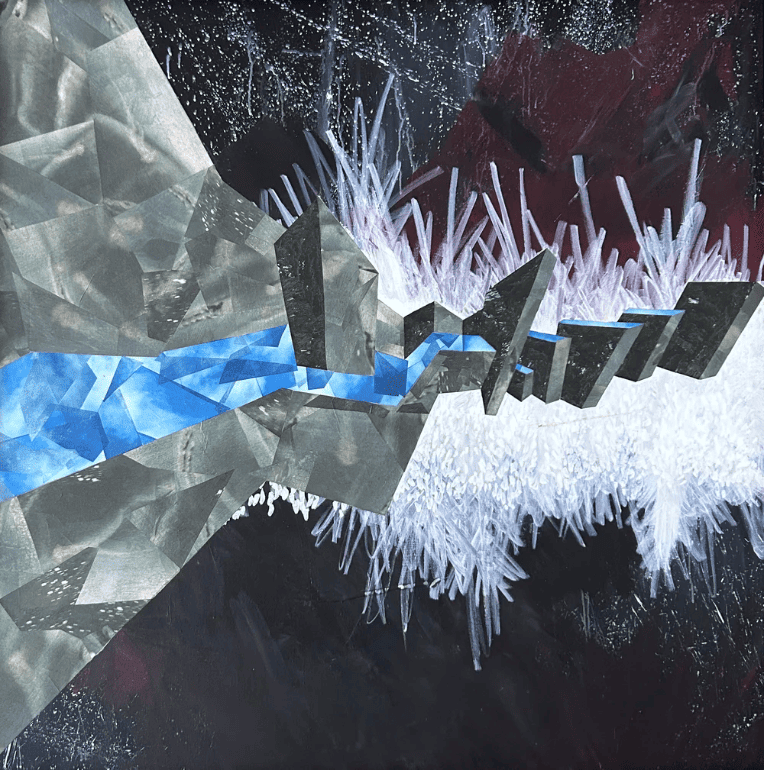
One of the clearest examples of Grunow’s interdisciplinary approach can be found in his work Moscow, 2019. Created using acrylic and rice paper prints on canvas, the painting developed from an earlier encounter with an influential piece of information design.
The starting point was Charles Minard’s famous infographic depicting Napoleon’s campaign into Russia. The graphic communicates the devastating scale of the campaign through a remarkably simple visual device. The thickness of the line represents the size of Napoleon’s army as it moves across the continent. As the troops advance toward Moscow, the line becomes progressively thinner. On the return journey, only a small fraction of the original force remains.
For Grunow, the infographic offered more than historical information. It became an example of how data can be transformed into design.
When he was invited to give a design talk at the University of Idaho in Moscow, Idaho, Grunow used Minard’s graphic as an introduction to the concept that design can begin with data. He explored how a two dimensional image could be scanned into a computer, traced using vector lines, and then transformed through three dimensional software.
The result was a conceptual progression from information to line, from line to volume, and ultimately from volume to inhabitable space. What begins as historical data could theoretically become an amphitheater, a park, a house, or another architectural environment.
This process reflects Grunow’s architectural way of thinking. Information is not merely something to be studied. It can become the foundation for physical and visual experiences.
A Journey Toward Moscow
The significance of Moscow, 2019 extends beyond the historical reference that inspired it. The work also became a personal reflection on Grunow’s own journey.
The Minard image became so compelling to him that he began incorporating it into his professional identity, using it as a logo, letterhead, and other printed materials associated with his business. What had initially been a historical infographic gradually became a recurring visual language.
Eventually, Grunow felt compelled to bring the idea into the realm of painting.
The image originally generated during his time in Moscow became the foundation for the artwork. Rather than simply reproducing the original graphic, however, Grunow transformed it by embedding his own experiences of place and time within its structure.
The resulting painting becomes both a historical reference and a personal map.
The path toward Moscow is no longer solely Napoleon’s journey. It also represents Grunow’s own path, the places he has encountered, the landscapes that have influenced him, and the experiences accumulated before the moment of creation.
Landscape as Memory
A particularly distinctive element of Moscow, 2019 is the way Grunow replaces conventional shade, shadow, and color with photographic imagery drawn from the natural environment around him.
The painting incorporates images he captured from the landscapes surrounding his own experience. Clouds and vapor trails appear in the sky. Jellyfish evoke the sea. Monterey Pines reference the coastal landscape and bluffs.
These images introduce an organic dimension to a work that began with a highly structured historical diagram.
The contrast is meaningful. Minard’s infographic is analytical, precise, and data driven. Grunow’s photographic elements are atmospheric, sensory, and personal. By bringing the two together, he creates a visual conversation between objective history and subjective experience.
The historical diagram provides the framework, while the landscape provides memory.
The work therefore operates on several levels simultaneously. It can be viewed as an exploration of Napoleon’s campaign, an investigation into the transformation of data into design, a meditation on architecture and space, and a personal record of Grunow’s own relationship with place.
Between the Built and Natural World
This tension between structure and nature appears throughout Grunow’s broader artistic perspective. His interest in the residue of history encompasses both the built and natural environments, recognizing that places accumulate layers of meaning over time.
Architecture leaves physical traces. Landscapes carry evidence of geological and environmental change. Human journeys create paths, boundaries, memories, and stories. Art can bring these layers into a single visual experience.
Grunow’s background in architecture gives him the ability to recognize systems, patterns, relationships, and spatial possibilities. His artistic practice allows him to move beyond purely functional outcomes and investigate the emotional and conceptual dimensions of those same systems.
This is particularly evident in the way he approaches materials and imagery. Acrylic and rice paper prints on canvas provide a physical foundation for combining different forms of visual information. Photography, graphic design, historical imagery, and painting can coexist within one work, reflecting the layered nature of memory itself.
Art as Storytelling
Storytelling is another important component of Grunow’s practice. His works are not simply arrangements of shapes, colors, or materials. They emerge from stories of journeys, places, historical events, and personal encounters.
Moscow, 2019 demonstrates how a single historical image can become the beginning of an entirely new narrative. Minard’s map tells the story of an army’s movement and loss. Grunow takes that story and transforms it through his own experiences, allowing the historical journey to intersect with a contemporary personal one.
The result is a work that asks viewers to consider how information becomes meaning. A line on a map can represent thousands of people. A path can become a spatial form. A landscape can become a memory. A historical image can become a personal symbol.
A Practice Rooted in Exploration
After more than two decades working across architecture and art in California and Hawaii, Stuart David Grunow continues to explore the connections between design, history, nature, and individual experience. His professional work has included a diverse range of special commissions, guided by a commitment to artful, sustainable, and value driven results.
His artistic practice grows naturally from that same foundation while allowing him to investigate questions that may not have straightforward functional answers.
Through works such as Moscow, 2019, Grunow demonstrates how architecture and art can inform one another. His approach transforms data into visual language, historical information into personal experience, and landscapes into fragments of memory.
Ultimately, his work invites viewers to look more closely at the traces that surround them. History does not exist only in textbooks or monuments. It can remain embedded in landscapes, structures, images, journeys, and the ways individuals remember a place.
For Grunow, art becomes a way of uncovering those traces and giving them a new form.

