


Martin Trebuch is a music-addicted visual artist and self-described “abstracteur extraordinaire” whose work explores the fascinating intersection of chance, subconscious thought, and deeply personal psychological experiences. Since beginning his artistic journey in 2007, he has developed a unique visual language that encourages viewers to look beyond the surface and discover meanings of their own. Rather than presenting straightforward narratives, Martin creates abstract compositions that invite curiosity, conversation, and emotional reflection.
For Martin, art is not simply about creating beautiful images. It is about capturing feelings that are difficult to explain with words. His paintings become visual spaces where coincidence and intention coexist, allowing both the artist and the viewer to experience something unexpected. Every canvas is an opportunity to transform internal emotions into powerful visual expressions that remain open to interpretation.
The Beginning of an Artistic Journey
Martin began painting with artistic intent in 2007. Interestingly, his original plan was to avoid titles altogether, choosing instead to simply number each painting. He believed that removing titles would leave viewers completely free to interpret the work without influence.
Over time, however, his relationship with naming his artworks evolved. As someone deeply connected to music, Martin started giving paintings the names of songs that captured their atmosphere or emotional tone. Today, his titles arise naturally during the creative process. Sometimes they are inspired by a particular feeling, while other times they include a personal shout-out that adds another layer of meaning without limiting interpretation.
This evolution reflects Martin’s broader philosophy: art should remain open-ended. Titles may provide a starting point, but they never dictate what viewers are supposed to see or feel.
Aleatorics and the Beauty of Coincidence
A defining element of Martin Trebuch’s creative process is his use of aleatorics, often described as the art of coincidence. Instead of controlling every brushstroke from beginning to end, he intentionally allows accidental marks, unexpected textures, and spontaneous developments to influence the final composition.
This balance between conscious decision-making and randomness gives his work a sense of movement and authenticity. Rather than fighting against unpredictability, Martin embraces it as an essential creative partner.
Coincidence becomes more than a technique; it becomes a philosophy. The unexpected shapes that emerge often lead the artwork in directions that could never have been planned in advance. This openness allows each painting to develop organically while preserving an emotional honesty that carefully calculated compositions sometimes lack.
Turning Personal Psychology into Universal Art
Martin’s paintings are deeply rooted in his own psychological experiences. Instead of hiding emotions that may be difficult to discuss, he transforms them into abstract visual symbols that others can engage with in their own way.
Among these recurring experiences are feelings associated with paranoia. Rather than presenting them literally, Martin incorporates symbolic imagery that communicates what those moments feel like emotionally. His goal is not to explain his experiences but to create opportunities for empathy and understanding through visual language.
Because the work remains abstract, viewers are free to connect the imagery with their own memories, fears, hopes, or emotions. The paintings become personal not only for the artist but also for everyone who encounters them.
Sometimes I Just Want to go to Space
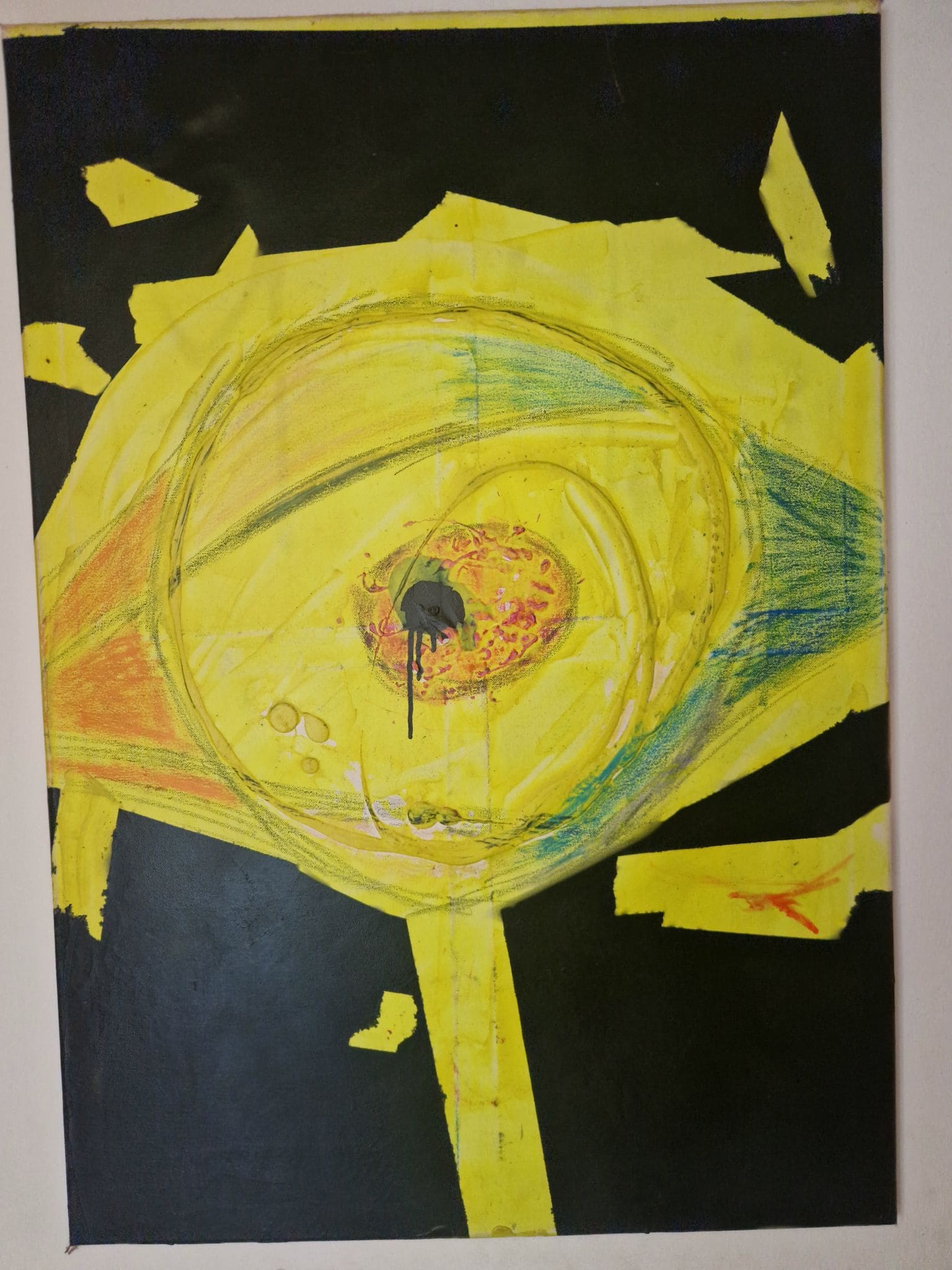
One of Martin Trebuch’s most compelling works is “Sometimes I Just Want to go to Space (ShoutOut to Jeph Jacques),” completed in 2020.
Created with mixed media on canvas, the artwork measures 120 × 90 cm (47.24 × 35.43 inches) and is now held in a private collection. The painting combines aleatorics with subconscious inspiration while exploring themes drawn directly from Martin’s psychological experiences.
At the center of the composition is a prominent eye. This symbol represents the unsettling sensation of being watched, a feeling Martin experiences often enough that it has become a recurring theme in his work. The eye is not intended as a literal representation but as a visual expression of an internal emotional state.
The painting’s title introduces another powerful layer of meaning. “Sometimes I Just Want to go to Space” expresses a longing for distance, silence, and escape from overwhelming thoughts. Space becomes a metaphor for freedom, a place beyond constant observation and mental noise.
Yet the painting deliberately avoids offering definitive answers. Some viewers may interpret the eye as awareness, others as surveillance, intuition, consciousness, or even spiritual presence. Every interpretation becomes part of the artwork’s continuing story.
Harder Rorschach Tests
A friend once described Martin’s paintings as “harder Rorschach tests,” a comparison that perfectly captures his artistic philosophy.
Like the famous psychological inkblot tests, Martin’s abstract compositions encourage viewers to project their own emotions and experiences onto the canvas. The artwork does not tell people what they should see. Instead, it reveals something about the person who is looking.
As Martin explains, what viewers discover in his paintings is often something that already existed within themselves before they ever encountered the artwork.
This idea transforms every exhibition into a deeply personal experience. Two people may stand before the same painting and leave with entirely different interpretations, yet both are equally valid. There is no single correct reading because the artwork exists through the interaction between artist and audience.
Blurring the Boundaries of Visual Art
Martin believes his calling lies within visual media as a whole rather than within any single artistic category. He intentionally blurs the boundaries between different forms of visual expression, allowing materials, techniques, and ideas to merge naturally.
His mixed-media approach reflects this philosophy perfectly. Different textures, layers, and accidental discoveries come together to create compositions that feel both spontaneous and carefully considered. Each painting develops through a conversation between intention and coincidence, resulting in works that continue to reveal new details over time.
This willingness to experiment keeps Martin’s practice constantly evolving while maintaining a distinctive visual identity.
Creating Art That Sparks Conversation
More than anything else, Martin hopes his artwork inspires dialogue. He wants viewers to experience emotions they may never have encountered before. He wants them to feel challenged, intrigued, confused, or inspired enough to discuss what they have seen with others.
Rather than delivering fixed messages, his paintings create opportunities for conversation. Every interpretation adds another layer to the artwork, extending its meaning beyond the canvas itself.
This openness is one of the greatest strengths of Martin’s work. By refusing simple explanations, he allows each viewer to become an active participant in the creative experience.
An Invitation to Discover Yourself
Martin Trebuch’s abstract paintings remind us that art can be both deeply personal and universally relatable. Through aleatorics, subconscious inspiration, symbolic imagery, and emotional honesty, he creates works that encourage viewers to explore not only the canvas but also their own inner worlds.
His art challenges the expectation that every painting must provide clear answers. Instead, it celebrates uncertainty, imagination, and personal interpretation. Whether someone sees hope, fear, curiosity, or mystery, that response becomes part of the artwork’s meaning.
For Martin Trebuch, every painting is an invitation to pause, to reflect, to question, and to discover emotions that may have always been present, waiting only for the right image to bring them into view.

