


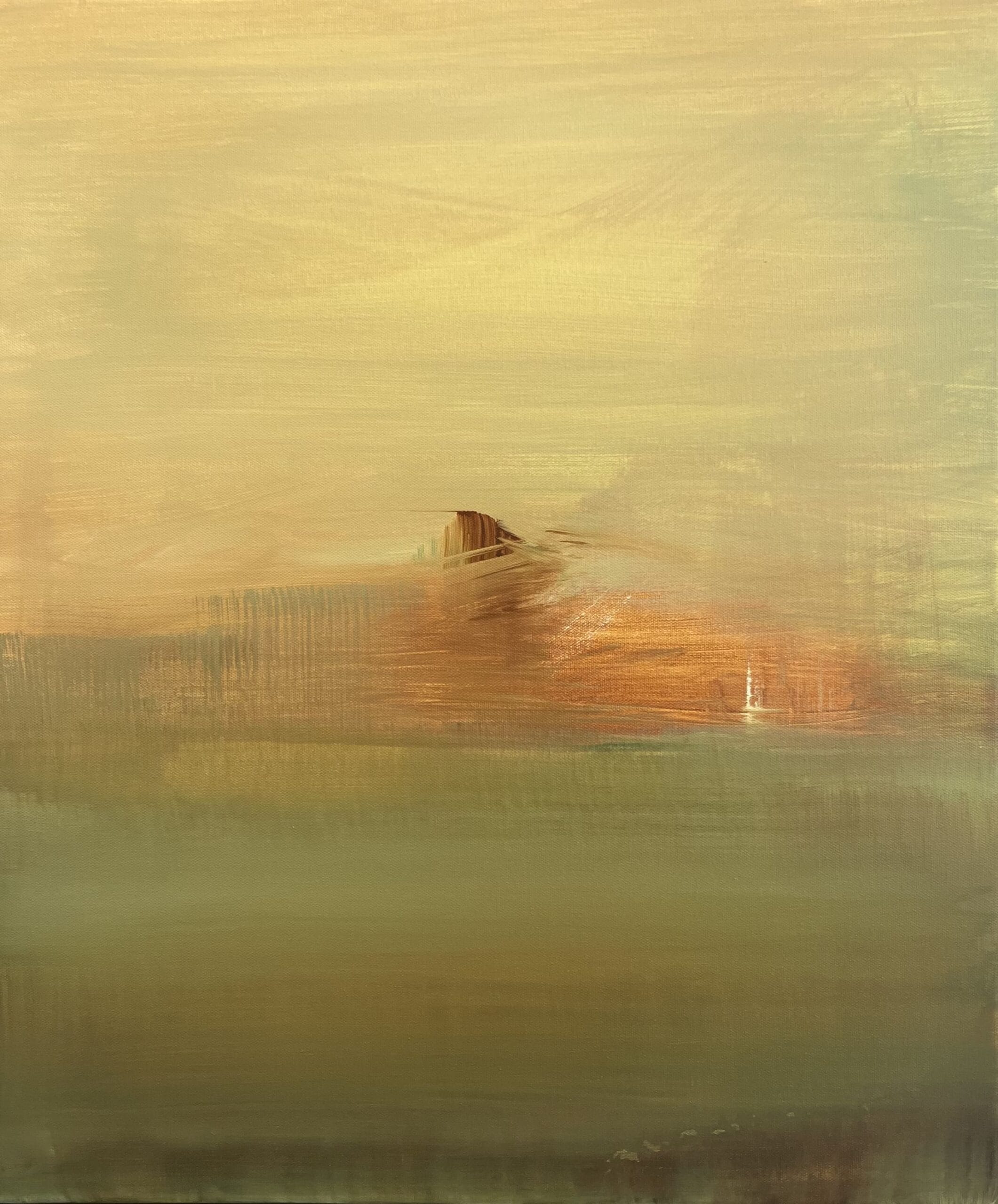
Jane Foley Ferraro has established a distinctive artistic voice through paintings that explore the emotional resonance of landscapes rather than their literal appearance. Based between Western New York and Naples, Florida, Jane Foley Ferraro creates semi-abstract land and seascapes that invite viewers into quiet, contemplative spaces where color, texture, and atmosphere become the primary storytellers. Instead of documenting a specific place, she captures the feeling of being present within nature, allowing each painting to evoke memories, emotions, and personal reflection.
Throughout her creative journey, Jane experimented with a variety of artistic mediums before discovering that painting offered the greatest freedom for expression. The fluidity of paint allows her to communicate ideas that cannot easily be described with words, transforming familiar elements such as the horizon, water, and sky into poetic visual experiences. Her intuitive process encourages spontaneity, resulting in works that feel alive with movement while maintaining a remarkable sense of calm.
Creating from Memory Rather Than Observation
One of the defining qualities of Jane Foley Ferraro’s work is her commitment to painting from memory and imagination instead of relying on photographs or direct observation. This approach enables her to move beyond the physical landscape and into an emotional one, where personal experiences blend with universal themes.
Rather than recreating a recognizable coastline or countryside, she allows remembered impressions to guide each composition. Fleeting moments, changing weather, and emotional responses become the foundation of her creative process. The resulting paintings possess a timeless quality, encouraging viewers to discover their own connections within the work.
The artist describes her style as intuitive expressionism, a philosophy that embraces instinct over precision. Every layer of paint is applied in response to what has come before, allowing each composition to evolve naturally. This willingness to trust the creative process gives her paintings an organic rhythm that feels both spontaneous and thoughtfully composed.
The Language of Color and Texture
Color is central to the emotional impact of Jane’s paintings. Rather than using it simply to describe the natural world, she employs subtle shifts in tone to suggest mood, memory, and atmosphere. Soft blues dissolve into muted earth tones, luminous whites emerge through layered surfaces, and delicate transitions create a sense of continuous movement.
Texture is equally important within her practice. Rich surfaces invite viewers to look closely, revealing layers that echo the complexity of human experience. These textured passages add depth and dimension, allowing light to interact with the painting in ways that continually change depending on the viewer’s perspective.
The painter balances abstraction and representation with remarkable sensitivity. While hints of shoreline, sky, and distant water remain visible, they never dominate the composition. Instead, these familiar forms become entry points into a more emotional and imaginative experience.
The Ever-Changing Horizon
Among the recurring themes found throughout Jane’s body of work, the horizon stands as perhaps the most significant. Appearing again and again in different forms, it symbolizes transition, possibility, and the constant evolution of life.
For the artist, the horizon is far more than a line separating earth from sky. It represents the space between certainty and mystery, where endings gradually become beginnings. Just as light continually transforms the natural world throughout the day, life itself is defined by continuous change.
This fascination with shifting horizons reflects her broader artistic philosophy. Boundaries are softened rather than fixed, encouraging viewers to embrace ambiguity instead of seeking definitive answers. Every painting becomes an invitation to pause, observe, and appreciate the quiet beauty found within moments of transition.
A Life Dedicated to Creative Growth
Before becoming a full-time painter, Jane enjoyed a successful career as a psychotherapist. Although the professions may appear quite different, both are rooted in a deep understanding of human emotion and personal experience.
Following her retirement, she devoted herself entirely to painting and now works in her studio every day. This daily commitment has allowed the contemporary painter to continually refine her visual language while exploring increasingly nuanced ideas about memory, perception, and emotional connection.
Her dedication has earned widespread recognition. Jane Foley Ferraro’s works are included in the permanent collections of The Savannah College of Art & Design and St. Bonaventure University, in addition to numerous private collections. She is represented by Meibohm Fine Arts in East Aurora, New York, and Fine Line Designs Gallery in Ephraim, Wisconsin, where collectors continue to appreciate the depth and sensitivity of her work.
Fugitive: A Meditation on Time and Human Existence
One of Jane’s most thought-provoking works, Fugitive, explores the fragile relationship between mortality and permanence. Rather than presenting a literal narrative, the painting communicates through atmosphere and symbolism, encouraging quiet reflection on the passage of time.
Colors gently fade into one another, much like daylight slowly giving way to evening. These seamless transitions suggest that life is never static; every moment naturally transforms into the next. Through this gradual movement, she reflects on the impermanence that defines the human experience.
Embedded within the composition is a brilliant white light that serves as both a visual and symbolic presence. It represents an enduring essence beneath our physical existence, reminding viewers that while the body is temporary, something deeper continues to resonate beyond the limits of time.
The title Fugitive reinforces this idea. Humanity exists within an ongoing journey, constantly moving through moments that can never be held still. The painter captures this delicate tension with extraordinary subtlety, presenting viewers with a work that is both deeply personal and universally meaningful.
Rather than offering conclusions, she leaves space for contemplation. Every viewer may interpret the painting differently, bringing individual memories and beliefs into conversation with the work.
Inviting Reflection Through Atmosphere
The emotional power of the Western New York–based artist’s paintings lies in their openness. Instead of directing viewers toward a single interpretation, she creates visual environments where personal reflection naturally unfolds.
Atmosphere becomes a language of its own. Gentle color harmonies, luminous passages, and layered textures encourage prolonged observation, revealing new relationships with each viewing. This quiet complexity distinguishes her work from more descriptive landscape painting, offering experiences that continue to evolve long after the initial encounter.
Whether standing before one of Jane’s expansive seascapes or contemplating the symbolic depth of Fugitive, viewers are invited to slow down and reconnect with emotions that often remain just beneath the surface of everyday life.
An Artistic Vision That Resonates Beyond the Canvas
Through an intuitive approach to painting, Jane has developed a body of work that celebrates memory, transformation, and the enduring relationship between humanity and the natural world. Her luminous landscapes and atmospheric compositions remind us that beauty often exists within moments of uncertainty, where light shifts, horizons change, and memories quietly take shape.
As the artist continues her daily studio practice, each new painting expands an already compelling visual language built upon intuition, emotional honesty, and thoughtful exploration. She demonstrates that the most meaningful landscapes are not always those we can locate on a map, but those we carry within ourselves.
By transforming personal memories into universal experiences, Jane Foley Ferraro offers viewers more than beautiful paintings. She creates opportunities for reflection, encouraging us to embrace the fleeting nature of life while recognizing the enduring light that remains at its heart.

