


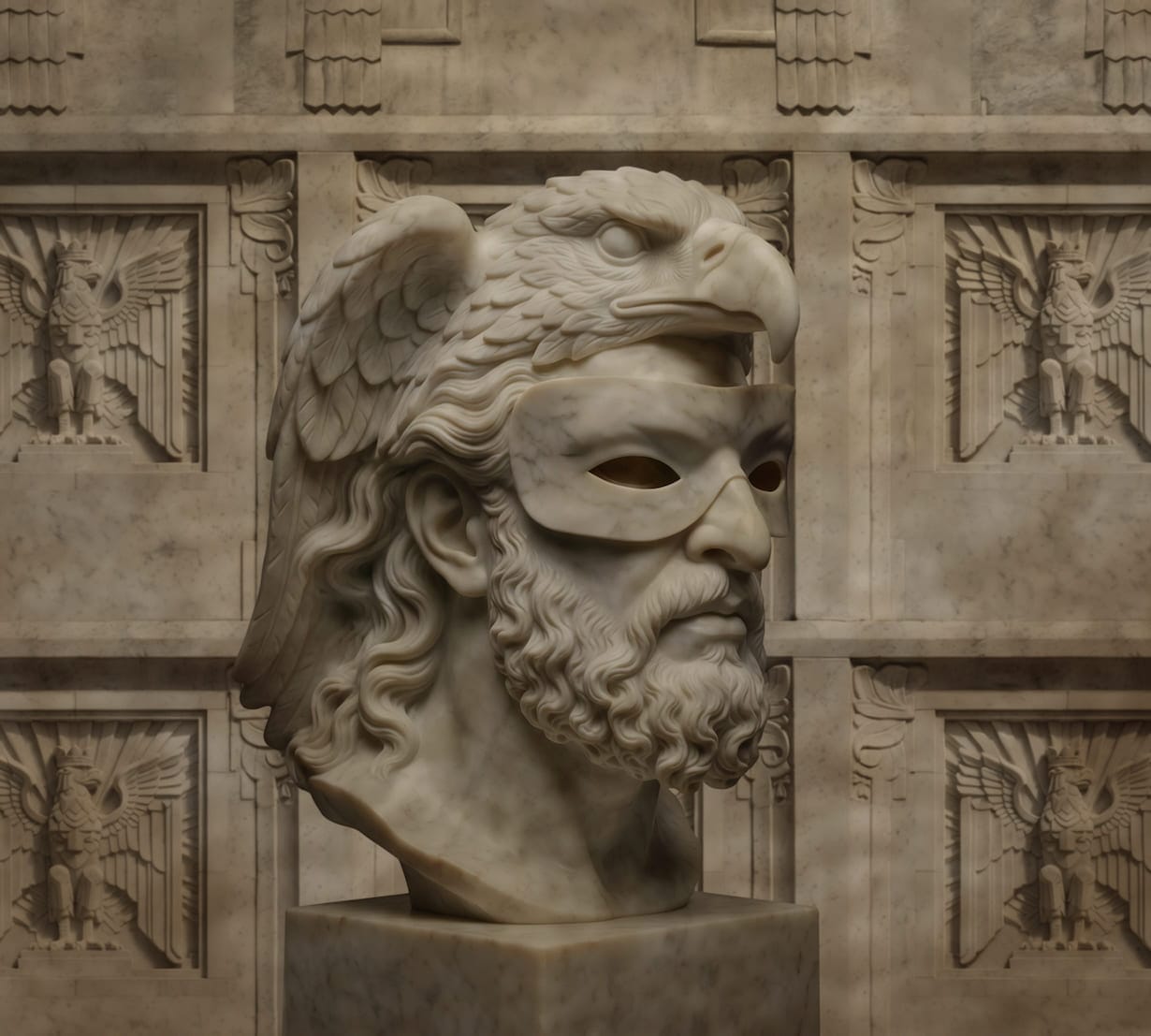
Adamo Macri’s work exists in a space that resists easy definition. It is neither purely portraiture nor strictly sculpture, neither fully digital nor entirely physical. Instead, his art inhabits a charged threshold between mask and face, object and body, protection and exposure. Within this shifting terrain, identity is never stable. It morphs, accumulates, fractures, and reforms, creating a visual language that feels at once ancient and strikingly contemporary.
Macri does not present the self as a fixed image to be consumed. Rather, he treats identity as an evolving site shaped by myth, memory, and material. In his hands, a portrait can become a ritual artifact, a sculpture can feel like a spectral presence, and a self-portrait may emerge disguised as something fragile, uncanny, or even archaeological. This refusal to settle into a single form is central to his practice, inviting viewers to question not just what they see, but how identity itself is constructed.
The Concept of the Mutable Self
At the core of Macri’s work lies a fascination with transformation. His figures are rarely presented as complete or resolved. Instead, they appear suspended in states of becoming. Faces blur into surfaces, bodies merge with structures, and forms seem to oscillate between organic and constructed.
This approach reflects a deeper philosophical inquiry. What does it mean to inhabit a body that is constantly changing? How do external forces cultural, environmental, psychological reshape the way we understand ourselves? Macri’s work does not attempt to answer these questions directly. Instead, it creates a space where such questions can exist, unresolved and evolving.
There is a palpable tension in his imagery, a push and pull between concealment and revelation. Masks do not simply hide. They transform. Surfaces do not merely contain. They absorb and reflect. In this sense, identity becomes less of a fixed point and more of a fluid process, continually negotiated between inner experience and outer expression.
Concrete Facade: Identity in Architectural Form
In the Concrete Facade series, Macri extends his exploration of identity into the realm of architecture and digital portraiture. Based in Montreal, the artist positions himself within these works as a conceptualized figure, almost sculptural in presence, set against meticulously constructed architectural environments.
These are not passive backdrops. The architectural forms in Concrete Facade function as active participants in the composition, shaping and reshaping the figure itself. Walls, surfaces, and structures seem to merge with the body, creating hybrid forms that blur the boundary between human and environment.
Each piece in the series becomes a kind of psychological landscape. The built environment reflects internal states, while the figure appears both embedded within and transformed by its surroundings. This interplay suggests that identity is not formed in isolation but is deeply influenced by the spaces we inhabit, both physical and conceptual.
Concrete Facade IV: A Study in Tension and Transformation
Concrete Facade IV, the fourth installment in the series, continues this investigation with remarkable intensity. Measuring 40 x 36 inches, the work presents a figure that feels both monumental and vulnerable, caught in a moment of transformation that resists resolution.
Here, Macri’s use of architectural elements becomes particularly pronounced. The figure does not simply stand before a structure. It appears to be emerging from it, or perhaps dissolving into it. The boundaries between body and facade are deliberately ambiguous, creating a sense of unease that is both compelling and thought-provoking.
The surface textures evoke materials associated with permanence such as concrete and stone, yet they are rendered in a way that suggests fragility and erosion. This contradiction lies at the heart of the work. What appears solid is, in fact, unstable. What seems protective may also be restrictive.
In this piece, Macri invites viewers to consider the ways in which we construct our own facades. Are they shields protecting us from external forces, or are they structures that limit and define us, shaping how we are perceived by others?
Somatic Structuralism: The Body as Architecture
A defining aspect of Macri’s practice is what can be described as somatic structuralism. In this approach, the human body and architectural space are treated as interchangeable membranes, each capable of containing, shaping, and transforming the other.
Rather than depicting architecture as static or inert, Macri presents it as a living system, one that breathes, erodes, and evolves. His works often resemble fragments of imagined structures such as anatomical chapels, submerged ruins, or sacred spaces that feel both familiar and otherworldly.
These environments are not merely visual constructs. They carry emotional and psychological weight. The blending of organic forms with architectural elements creates a sense of dissonance, evoking the uncomfortable realities of bodily decay and transformation. At the same time, the presence of sacred or ritualistic imagery introduces a dimension of spiritual reflection.
Through this synthesis, Macri transforms space into something deeply experiential. Viewers are not just observing an image. They are entering a conceptual environment where the boundaries between self and surroundings are continually shifting.
Ritual, Decay, and the Sacred
Macri’s work is deeply informed by themes of ritual and the sacred, though not in a conventional sense. His imagery often suggests ceremonial objects or spaces, yet these are imbued with a sense of decay and impermanence.
This juxtaposition creates a powerful tension. The sacred is not presented as pristine or untouchable. Instead, it is shown as something that evolves, deteriorates, and transforms over time. This perspective aligns with Macri’s broader exploration of identity as a process rather than a fixed state.
The presence of decay in his work is particularly significant. It serves as a reminder that all forms whether bodily, architectural, or symbolic are subject to change. In this way, decay becomes not a sign of loss, but a catalyst for transformation.
Living Questions: The Power of Uncertainty
Perhaps the most compelling aspect of Macri’s work is its refusal to provide definitive answers. His images do not resolve into clear narratives or symbols. Instead, they function as living questions, open-ended explorations that invite interpretation without dictating it.
What is the self made of? Is it defined by the body, the environment, or the interplay between the two? What does it mean to protect identity, to perform it, or to allow it to evolve?
These questions resonate throughout Macri’s practice, creating a body of work that is both intellectually engaging and emotionally evocative. By embracing uncertainty, he allows viewers to bring their own experiences and interpretations into the work, making each encounter unique.
A Contemporary Vision of Transformation
Adamo Macri’s art stands as a powerful reflection of contemporary concerns around identity, embodiment, and the spaces we inhabit. In a world where boundaries are increasingly fluid between physical and digital, personal and collective his work offers a visual language that captures this complexity with striking clarity.
Through the Concrete Facade series and beyond, Macri continues to push the boundaries of portraiture and architectural representation. His work challenges us to reconsider not only how we see ourselves, but how we understand the relationship between body, space, and identity.
In this ever-shifting landscape, one thing remains constant: the recognition that identity is not something we possess, but something we continuously create.

