


Charles Inge’s relationship with art began not in a classroom or gallery, but in the quiet intimacy of childhood. Some of his earliest memories are of painting alongside his father, a devoted watercolourist who introduced him to colour in an unconventional, almost alchemical way. Inge learned to recognize pigments not just by sight, but by taste, discovering, for instance, the distinctive sweetness of Rose Madder. From the very beginning, paint was never only visual for him. It was sensory, emotional, and experiential. This early immersion shaped an artist for whom colour is not simply applied, but felt.
Foundations in Fine Art and Visual Storytelling
Inge went on to formally study art at the Ruskin School of Art at Oxford University, an environment known for its rigorous intellectual approach to visual practice. There, he refined both his technical skills and his conceptual thinking, learning to view art as a language capable of expressing complexity, contradiction, and nuance. These formative years laid a foundation that would later allow him to move fluidly between disciplines and creative industries.
After graduating, Inge embarked on a long and successful career as an Art Director, working for over three decades with some of the world’s most respected directors, photographers, artists, and designers. This period profoundly shaped his artistic sensibility. Immersed in the fast-paced, collaborative world of visual communication, he developed a sophisticated understanding of composition, narrative, and emotional impact. While much of this work was commercially driven, it sharpened his ability to distill ideas into powerful visual statements, a skill that continues to inform his fine art practice today.
A Turning Point at Fifty
On his 50th birthday, Inge made a decision that would redefine his life and career. He chose to step away from the security and structure of the commercial world to pursue art on his own terms. Leaving behind decades as an Art Director, he committed fully to becoming a full-time artist. This was not merely a career change, but a philosophical shift, a move toward a slower, more introspective way of working.
He relocated to the Isle of Wight, where he established his studio in a 19th-century coach house surrounded by rolling countryside. The physical and psychological space of this new environment became integral to his practice. Removed from the pressures of the city and the demands of clients, Inge found the freedom to explore painting as a meditative process. The landscape, quiet, and rhythm of rural life offered a counterbalance to the chaos of contemporary existence, a theme that would become central to his work.
Exploring Balance and Fragility
At the heart of Charles Inge’s work is an exploration of balance within a fragile world. His paintings often reflect the tension between chaos and harmony, instability and calm. Rather than presenting idealized or resolved visions, his work acknowledges the vulnerability inherent in both nature and human experience.
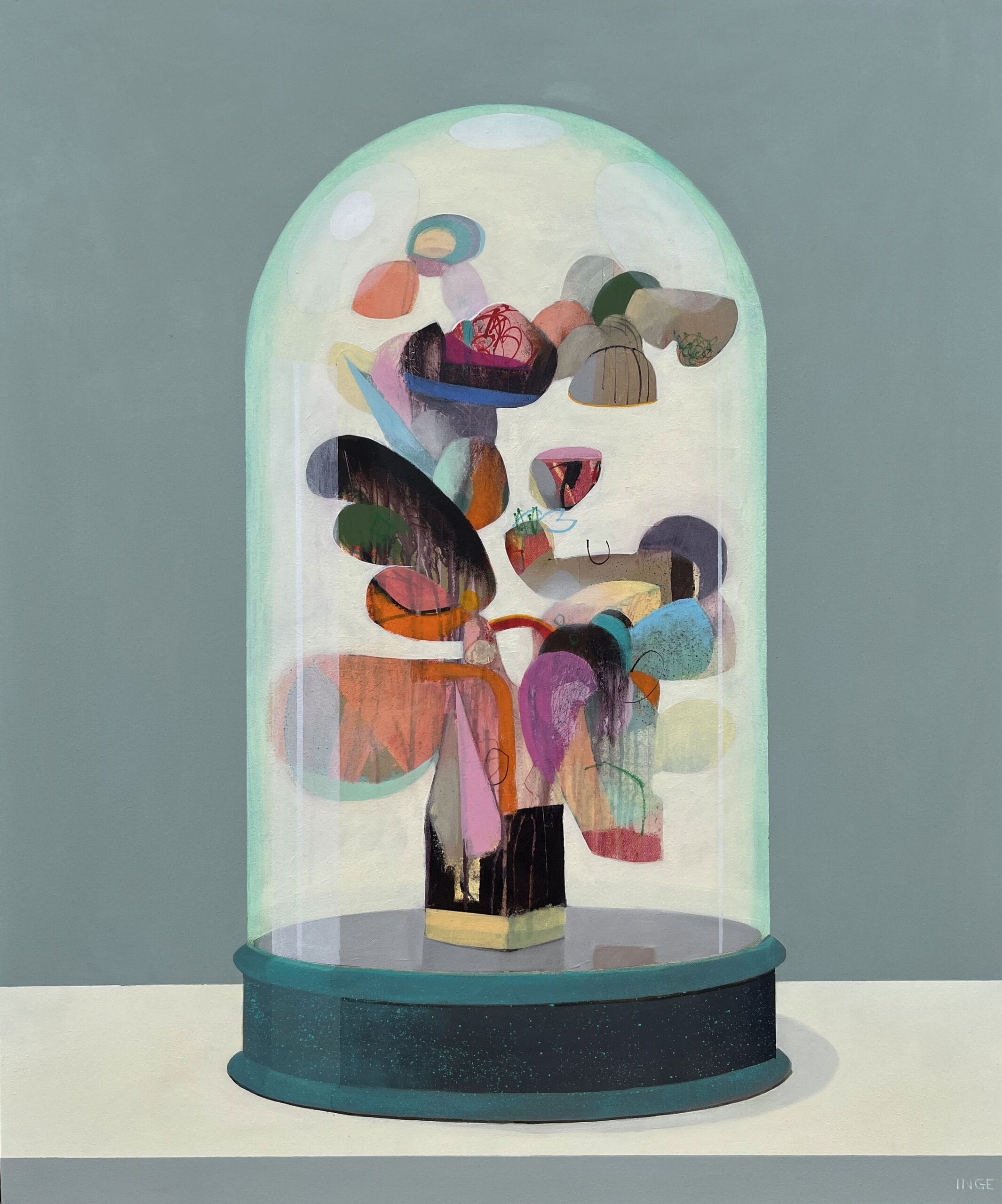
This philosophy is most clearly articulated in his Bell Jar series. Each painting begins in a state of disorder, with spontaneous gestures, competing colours, and layered forms. Through an intuitive and labor-intensive process, Inge gradually builds up and pares back the surface, responding to what the painting demands rather than imposing a fixed outcome. Layers are added, erased, softened, and reworked until the composition reaches what he describes as a moment of harmony.
This balance is never absolute. It is delicate, temporary, and hard-won. Once achieved, Inge metaphorically seals this beauty within the jar, preserving a fleeting moment of equilibrium. He describes the process as a strange journey, one that involves returning with souvenirs from places that do not exist. These imagined landscapes and emotional terrains are less about depicting reality and more about capturing states of being.
“Our Dreams Keep Growing on Sugar Candy Mountain”
A compelling example of Inge’s approach is the painting Our Dreams Keep Growing on Sugar Candy Mountain, an acrylic on canvas measuring 120 h x 100 w. The title itself suggests optimism, longing, and a touch of irony, hinting at idealized dreams set against an unstable foundation.
The work embodies the core principles of the Bell Jar series. Layers of acrylic paint interact in a complex visual dialogue, moving between intensity and restraint. Colours seem to emerge, recede, and reconfigure, creating a sense of depth that draws the viewer inward. There is an underlying sense of movement, as if the painting is in a constant state of becoming, yet held in check by an invisible structure.
Despite its abstract nature, the painting feels emotionally resonant. It invites viewers to project their own interpretations, memories, and aspirations onto its surface. The “Sugar Candy Mountain” of the title becomes a metaphor for the dreams we nurture, even when the world around us feels uncertain or fragile. Inge does not offer answers or resolutions, but rather creates a space for contemplation.
Recognition and Exhibitions
Charles Inge’s work has been exhibited widely and is held in both private and public collections. His exhibitions include prestigious institutions such as the National Portrait Gallery, the Saatchi Gallery, and the Museum of Modern Art. These venues reflect the breadth of his appeal and the seriousness with which his work is regarded within the contemporary art world.
Inge is also the incumbent of the Ashurst Artist Prize, an honor that recognizes both artistic excellence and sustained contribution to the field. This recognition underscores the significance of his transition from commercial art to fine art, affirming that his decision to follow a more personal and introspective path has resulted in work of lasting impact.
An Ongoing Journey
Today, working from his studio on the Isle of Wight, Charles Inge continues to explore the fragile balance that defines our world. His paintings are not fixed statements, but ongoing conversations between chaos and order, intuition and control. Rooted in a lifetime of visual experience, yet open to uncertainty and discovery, his work reflects an artist deeply engaged with the complexities of contemporary life.
Through layered abstraction, rich colour, and a process that mirrors the unpredictability of existence itself, Inge invites viewers to pause, reflect, and consider the beauty that can emerge even in the most fragile of circumstances.

